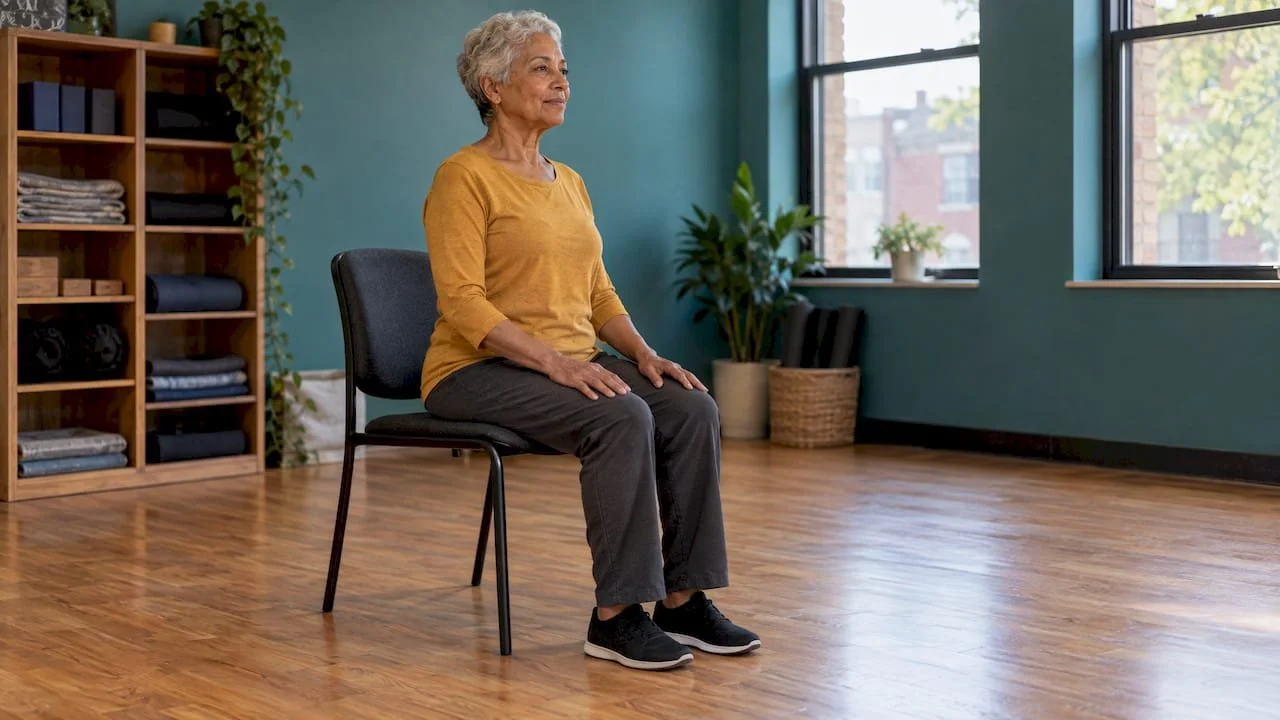
The safest way for an older beginner to start yoga is from a sturdy chair, with a wall or counter nearby, moving slowly and breathing the whole time. Start with seated poses, add supported standing poses once those feel easy, and treat balance as something you build over weeks, not something you test on day one. Below are ten poses, how to do each one, where people go wrong, and how to progress. If you would rather learn them with a teacher watching your form, we teach beginners at our Philadelphia studio.
Amritayogawellness
Start Yoga With Support
Explore beginner-friendly classes and wellness offerings at our Philadelphia studio as you find a practice that suits you.
TL;DR
Begin seated in a solid chair with feet flat. Add supported standing poses later, with a chair or wall within reach.
Move slowly, breathe steadily and never hold your breath. Stretch to mild tension, not pain.
Aim for a short practice at least two or three days a week. Build time gradually.
If you have been inactive, have a medical condition or take medications that affect balance, check with your doctor or a physical therapist first.
A teacher can adjust each pose to your body. Our Community Class Drop In is $11 and private sessions start at $85 per hour.
Table of Contents
Before You Start: Set Up the Space and the Body
Part One: Five Seated Poses
Part Two: Five Supported Standing Poses
A Simple 15-Minute Routine
What the Research Says About Safety and Benefits
Practice Rules That Keep You Safe
Why a Teacher Helps an Older Beginner
Perspective
Start at Amrita Yoga & Wellness in Philadelphia
FAQ
Sources
Before You Start: Set Up the Space and the Body
Most yoga injuries for beginners come from a bad setup or from rushing, not from the poses themselves. Five minutes of preparation matters more than any single pose.
Get the all-clear if you need it. The UK's National Health Service advises people who have been inactive to see a GP before starting a new exercise routine, and the same logic applies to a US primary care doctor. NHS guidance for older people also recommends a stable, solid chair without wheels or arms, feet flat and knees at right angles, loose comfortable clothing and water within reach.
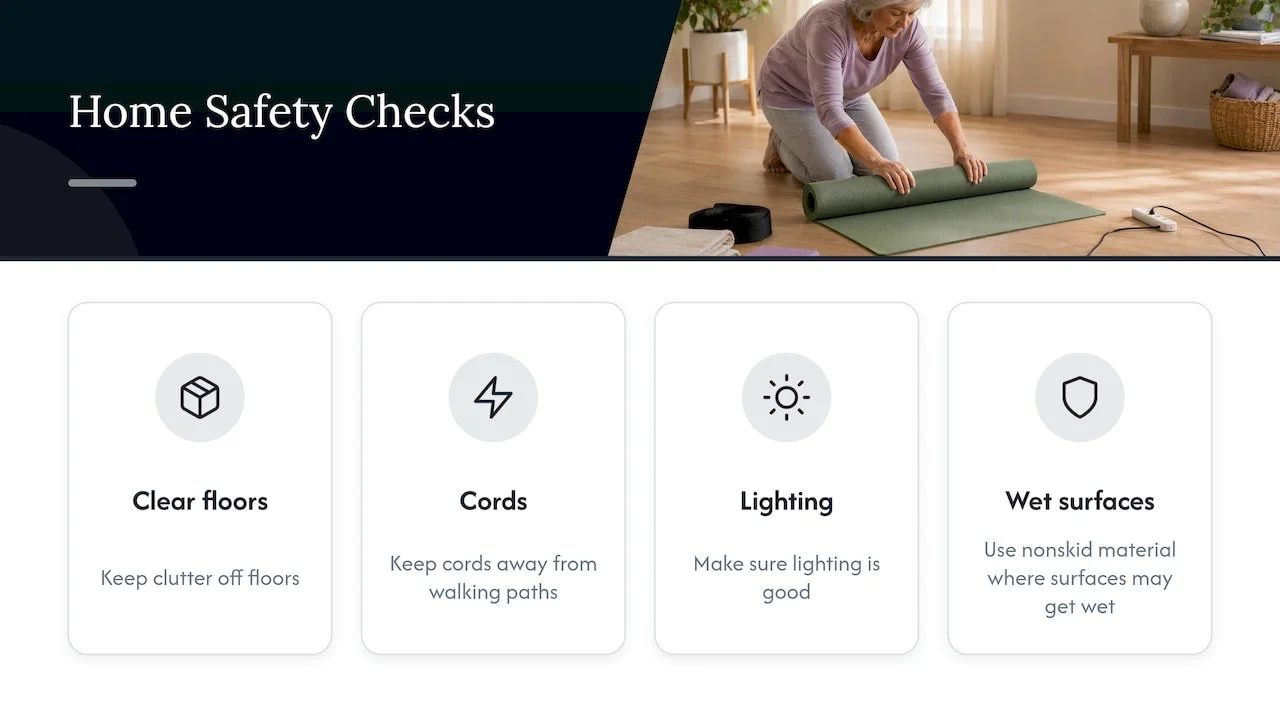
Clear the floor. The National Institute on Aging (NIA) notes that more than one in four people age 65 or older fall each year. Its home advice is simple: keep clutter off floors, keep cords near walls and away from walking paths, make sure lighting is good, and use nonskid material on surfaces that may get wet. Practice on a nonslip floor or a yoga mat placed against a wall so it cannot slide.
Know what raises your risk. The same NIA guide points out that even people who seem strong and healthy can fall, and that poor eyesight or hearing, loss of muscle mass, balance problems and medication side effects can all increase the risk. If you take medication that can make you dizzy, ask your doctor or pharmacist before you start standing work.
Start easy. The American College of Sports Medicine (ACSM) advises starting slowly with light-to-medium effort and building up gradually. For stretches it suggests two or more days per week, holding each stretch 30 to 60 seconds. As a beginner, count breaths instead of seconds: three to five slow breaths per pose is a fine start.
Part One: Five Seated Poses
These are chair yoga poses. Sit toward the front of the chair with your spine tall, feet flat under your knees, and hands resting on your thighs. Chair yoga is a recognized option for people with stiffness or limited mobility: ACSM's guidance for people with mobility limitations suggests trying chair yoga or adaptive yoga for flexibility.
1. Seated Mountain (Tadasana)
Sit tall, press your feet into the floor, lengthen the crown of your head toward the ceiling and let your shoulders drop away from your ears. Rest your hands on your thighs. Breathe in through your nose for about four counts and out for about four.
Why start here: it teaches posture and breath, which every other pose uses. Common mistake: leaning back against the chair and rounding the lower back. Sit forward enough that your spine holds itself up.
2. Seated Cat-Cow
Place your hands on your knees. As you inhale, lift your chest and gently draw your shoulder blades together. As you exhale, round your back and let your chin move toward your chest. Repeat five to eight times.
Why: it moves the whole spine gently, which helps with morning stiffness. Common mistake: forcing the range. Move only as far as feels comfortable.
3. Seated Side Bend
Rest your left hand on the chair seat or your thigh. Inhale and reach your right arm up, then exhale and bend gently to the left, keeping both hips planted. Hold for two or three breaths and switch sides.
Why: it opens the ribs and sides of the torso, which tighten with long periods of sitting. Common mistake: leaning forward or back instead of straight sideways. If raising the arm bothers your shoulder, keep your hand on your hip.
4. Seated Spinal Twist
Sit tall, place your right hand on the outside of your left knee and your left hand on the back or side of the chair. Inhale to lengthen, and exhale to turn gently to the left. Look over your shoulder only if your neck feels fine. Hold three to five breaths, then switch.
Why: it improves rotation, which you use for looking behind you and reaching into a car back seat. Common mistake: yanking on the knee to twist further. Let the twist come from your middle back, and keep it mild.
5. Seated Forward Fold
Scoot to the front of the chair, feet hip-width apart. Hinge forward from the hips with a long spine and let your hands slide down your thighs toward your shins. Stop where you feel a gentle stretch along the back of your legs. Rest there for three to five breaths, then use your hands on your thighs to roll up slowly.
Why: it stretches hamstrings and the lower back. Common mistake: dropping the head quickly or rising fast, which can cause dizziness. Come up slowly, especially if you take blood pressure medication, and ask your doctor if dizziness is a pattern for you.
Part Two: Five Supported Standing Poses
Move here once the seated poses feel comfortable. Stand behind your chair, with its back toward you and the seat pushed against a wall so it cannot slide. A kitchen counter also works. Research on yoga for fall prevention treats progression as the point: a 2020 trial protocol from Australia says standing yoga can challenge balance and improve leg strength and stability, but postures should be modified for ability. It names chairs, blocks, straps and bolsters as tools that make poses safer, and says the balance challenge should increase gradually as skill and confidence grow.
6. Standing Mountain at the Chair
Stand with feet hip-width apart and fingertips resting on the chair back. Feel your weight spread evenly through both feet. Breathe for five breaths. Once steady, lift your fingertips off the chair for a few breaths, then return them.
7. Chair-Supported Sit-to-Stand Squat
Face away from the chair, feet hip-width apart. Bend your knees and send your hips back as if to sit, tapping the seat lightly, then press through your feet to stand. Do three to five slowly. This is a modified chair pose and it builds the leg strength you use to get out of a chair or car.
Common mistake: letting your knees fall inward. Keep them in line with your second toes.
8. Supported Tree
Hold the chair back with one hand. Shift your weight onto your left foot and rest the sole of your right foot on your left ankle or calf, never against the knee joint. If that is too much, keep your right toes on the floor and just rest the heel against the ankle. Hold for three breaths, then switch sides.
How to progress: move from two hands to one hand on the chair, then to fingertips. Take as many weeks as you need.
9. Supported Warrior II
Stand sideways beside the chair with one hand on the back. Step your feet about three feet apart, turn your outer foot out, and bend that knee gently, keeping it over the ankle. Extend your free arm out to the side and look past your fingertips. Hold for three to five breaths and switch sides.
Common mistake: stepping too wide. A shorter stance is steadier and still builds strength.
10. Standing Supported Forward Fold
Stand facing the wall or counter with feet hip-width apart. Place your hands on the surface at hip height and walk your feet back until your torso is a long, flat line. Let your head hang between your arms and breathe. This lengthens the back of the legs and spine without going upside down. Bend your knees slightly if your hamstrings are tight.
A Simple 15-Minute Routine
Put the poses together in this order, with the breath count in parentheses:
| Minutes | Pose | Breaths or reps |
|---|---|---|
| 0 to 2 | Seated Mountain | 8 to 10 breaths |
| 2 to 4 | Seated Cat-Cow | 5 to 8 rounds |
| 4 to 6 | Seated Side Bend | 3 breaths per side |
| 6 to 8 | Seated Spinal Twist | 3 to 5 breaths per side |
| 8 to 10 | Standing Mountain at the chair | 5 breaths |
| 10 to 12 | Sit-to-Stand Squat | 3 to 5 reps |
| 12 to 14 | Supported Tree or Warrior II | 3 breaths per side |
| 14 to 15 | Seated Mountain | 5 slow breaths |
Three sessions a week is a sensible target. The NIA recommends about three sessions of balance exercises a week, with a sturdy chair, a person or a wall nearby for support. If you want more written routines, our blog has 10 chair yoga poses with a 15-minute routine and 7 simple yoga poses for seniors.
What the Research Says About Safety and Benefits
Studies of older adults doing modified yoga are small, but encouraging on safety. A 2012 pilot study of 16 older adults with a median age of 88 and a history of falls had them do modified chair yoga twice a week for eight weeks. There were no adverse events, and fear-of-falling and sit-to-stand scores improved. A 2025 case series of four adults aged 77 to 92 doing weekly chair yoga for eight weeks reported balance improvements in all participants on the Tinetti balance test. Both sets of authors say larger studies are needed, so read these as signs that chair yoga is feasible for older adults, not as guarantees.
The broader picture on movement is stronger. The ACSM's summary of the 2018 US Physical Activity Guidelines Advisory Committee report found strong evidence that physical activity reduces fall-related injuries in older people by 32 to 40 percent. Yoga that builds leg strength and balance fits into that kind of activity, alongside walking and strength work.
Practice Rules That Keep You Safe
Never hold your breath. ACSM's mobility guidance says to keep breathing during exercise. A good test: you should be able to talk in short sentences.
Warm up and cool down. Spend the first and last minutes at an easy pace, as ACSM advises.
Hold stretches 30 to 60 seconds eventually. ACSM gives this range for older adults, repeated three or four times. Work toward it over several weeks, and stop short of pain.
Stop for warning signs. Sharp pain, dizziness, chest discomfort or shortness of breath means stop, sit down and call your doctor. For chest pain or severe breathlessness, call 911.
Use props freely. Blocks, straps, a folded blanket and a wall are not a sign of weakness. They are how the poses are adapted. For more ideas on supporting yourself and raising the challenge step by step, see these balance exercises for older adults.
Why a Teacher Helps an Older Beginner
A video can show you the shape of a pose, but it cannot see that your knee is drifting inward, that your twist is coming from your neck, or that you are holding your breath. A teacher who sees you can correct this in the moment and change the pose to fit your hips, knees, shoulders and confidence. Also, the habit of going somewhere at the same time each week is often what turns a good intention into a routine.
At our studio, class structures and detailed guidance are designed for safety, personal growth and connection across all experience levels. We keep a page of chair yoga with Heather, and our class descriptions explain each style so you can choose the right level. Our live schedule lists current times.
Perspective
We teach people who walk in saying they have never done yoga, and the most important thing we tell them is that the pose is never the goal. A pose is a shape that helps you breathe, steady your balance and notice your body. If a version of a pose works for you, that is the pose.
That is why we put inclusivity and beginner approachability first. An older beginner should not feel behind in a room, and they should not be handed a version of a class designed for someone else. Props, slower pacing and clear instructions are part of how we design classes for every experience level.
We also think community does as much as any stretch. A regular class gives you a teacher who learns your body, neighbors who notice when you are missing, and a reason to keep your practice going through the winter. Our memberships and drop-in options are built so you can start small and grow.
Juiced
Start at Amrita Yoga & Wellness in Philadelphia
If you live in or near Philadelphia, you can try a class without committing to a plan. Our Community Class Drop In is $11 per session, a Group Class Drop In is $28, and Nurtured Beginnings is a $35 pass. Monthly options include Earth Monthly Membership at $119 per month and 1 Month Unlimited Group Classes at $169 per month. You can see all options on our in-studio group class page.
If you want one-on-one attention while you learn the poses above, our private yoga and mat Pilates sessions start at $85 per hour for a one-to-one session. Mention your goals and any limits to your teacher when you book, and bring your doctor's guidance if you have one.
FAQ
What is the easiest yoga for seniors to start with?
Chair yoga is the easiest entry point. You sit in a sturdy chair and do gentle movements such as seated cat-cow, side bends and twists. Once those feel comfortable, add standing poses with the chair or a wall for support.
How often should an older beginner do yoga?
Two to three short sessions a week is a good start. The NHS suggests flexibility exercises at least twice a week, and the NIA suggests about three sessions of balance exercises a week. Begin with 10 to 15 minutes and add time slowly.
Can yoga help prevent falls?
Yoga can build leg strength and balance, which matter for steadiness. Small studies of chair yoga in older adults reported good safety and improved balance scores, but the authors say larger trials are needed to confirm fall prevention. Pair your practice with a safe home setup and regular check-ups on eyesight and medications.
Do I need to be flexible to start?
No. Yoga builds flexibility over time, and props bring the floor closer to you. Move only to a comfortable stretch, breathe steadily, and let a teacher adjust each pose for your body.
Sources
Three Types of Exercise Can Improve Your Health and Physical Ability (NIA)
Yoga-based exercise to prevent falls in community-dwelling older adults (2020)
Physical and Mental Benefits of Chair Yoga for Older Adults (2025)