The best breathing exercise is the one that fits what you need right now. For calming down before sleep or during stress, 4-7-8 breathing is the most widely recommended. For a steady daily base, belly (diaphragmatic) breathing is the place to start. For feeling short of breath while moving, pursed-lip breathing is the classic choice. Each takes under ten minutes, needs no equipment, and is explained below with the exact counts.
Amritayogawellness
Explore Breathwork in Community
Amrita offers wellness classes and workshops in Philadelphia, bringing opportunities to explore practices that support mind and body.
TL;DR
Stress, anxiety or trouble falling asleep: try 4-7-8 breathing (in for 4, hold for 7, out for 8), unless you have chronic lung disease.
A daily foundation: belly breathing for 5 to 10 minutes, practiced when you are breathing comfortably.
Breathless during activity: pursed-lip breathing, with the exhale at least twice as long as the inhale.
A steady, even rhythm: box breathing, 4 counts for each side of the "box".
First time? Keep it to three to five cycles, and stop if you feel dizzy or light-headed.
Table of Contents
Why there is no single winner
4-7-8 breathing: the best pick for stress and sleep
Box breathing: an even rhythm you can do anywhere
Belly breathing: the foundation for everything else
Pursed-lip breathing: for breathlessness during activity
Resonant breathing: a slow rhythm for focus
Does breathing really help your blood pressure and pain?
How to pick, and how to start safely
Make it a habit: five minutes a day
A sample week
Practice with others at Amrita
Our perspective
FAQ
Sources
Why there is no single winner
Breathing exercises are techniques that make your lungs work more efficiently, in the way aerobic exercise improves how the heart works, according to the American Lung Association. The same page and the American Heart Association describe what slow, deep breathing can do: stabilize or lower blood pressure, create a sense of calm, ease stress, and reduce symptoms of anxiety and depression.
Different techniques lean on different mechanics. A long exhale tends to calm. A fuller belly breath uses the diaphragm, the large muscle under your lungs, more effectively. Pursed lips slow the breath when you feel winded. So the useful question is not "which is best?" but "best for what?"
| Your goal | Start with | The pattern |
|---|---|---|
| Calm down, wind down for sleep | 4–7–8 breathing | In 4, hold 7, out 8 |
| A steady, even reset | Box breathing | In 4, hold 4, out 4, hold 4 |
| A daily habit and a strong diaphragm | Belly breathing | Slow nose inhale, belly rises, slow exhale |
| Feeling short of breath when active | Pursed-lip breathing | In 2, out 4 or more |
| Slow, rhythmic practice for focus | Resonant breathing | Roughly 5 breaths per minute |
4-7-8 breathing: the best pick for stress and sleep
The American Heart Association says 4-7-8 breathing can be used by anyone without chronic lung disease when stress or anxiety is high, or when falling asleep is hard. The long exhale helps activate the vagus nerve, a major nerve that helps switch on your body's rest-and-digest response.
The British Heart Foundation notes that the method is based on pranayama, an ancient yogic breathing practice. Here is how to do it:
Sit comfortably with a straight back. Rest your tongue against the roof of your mouth.
Breathe in silently through your nose for a count of 4.
Hold the breath for a count of 7.
Breathe out through your mouth for a count of 8, making a soft "whoosh" sound.
Repeat up to three more times, for four rounds in total.
Where it goes wrong: counting too fast, or forcing the hold. If the 7-count feels like a strain, shorten every number but keep the same proportions, for example 2-3.5-4. Beginners may feel lightheaded at first, which the British Heart Foundation describes as normal. If it persists, stop and breathe normally.
Box breathing: an even rhythm you can do anywhere
Box breathing gets its name from its four equal sides. The American Heart Association describes it as a way to bring on the body's parasympathetic state, the calmer counterpart to the stress response.
Breathe in through your nose for 4 counts.
Hold for 4 counts.
Breathe out for 4 counts.
Wait for 4 counts before inhaling again.
Repeat the sequence.
Because every side is the same length, it is easy to remember, which makes it a good choice before a meeting, a hard conversation or a workout. The NHS inform version of controlled breathing uses a 3-second box: in for 3, hold for 3, out for 3, hold for 3, repeated for a few minutes until you feel more relaxed. NHS inform says this kind of slow, controlled breathing can help you feel calmer, reduce anxiety, help sleep and reduce anger. It is also particularly useful if anxiety makes you feel dizzy or light-headed.
If you are new to this, start with the 3-count version. Move to 4 when it feels effortless.
Belly breathing: the foundation for everything else
Diaphragmatic breathing, usually called belly breathing, is the technique most other exercises build on. Cleveland Clinic explains that it strengthens the diaphragm, slows your breathing rate, lowers oxygen demand and lets you breathe with less effort. Its listed benefits include relaxation, better muscle function during exercise, more oxygen in the blood, lower blood pressure and a lower heart rate.
The American Lung Association's steps:
Sit up straight in a comfortable chair, or lie down.
Put your hands on your belly.
Close your mouth and breathe in slowly through your nose, so your belly fills like a balloon.
Blow the air out slowly and gently through pursed lips, as if blowing bubbles.
Keep your attention on the breath and your hands on your belly. Repeat for 5 to 10 minutes.
Where it goes wrong: the chest rises and the belly does not. Rest one hand on your chest and one on your belly, and aim to move the lower hand more. Do not force a giant breath. Comfortable and slow beats big.
The American Lung Association also advises not to try a new breathing exercise for the first time when you are short of breath. Learn it when you are breathing comfortably, ideally for about 5 to 10 minutes a day, so that it is familiar when you need it.
Pursed-lip breathing: for breathlessness during activity
The American Heart Association points to pursed-lip breathing for anyone who has trouble holding their breath, such as people with chronic lung disease. MedlinePlus says it helps you use less energy to breathe, relax and slow your pace of breathing. It suggests using it during exercise, bending, lifting, climbing stairs, or when you feel anxious.
Relax your neck and shoulders and sit with your feet on the floor.
Breathe in slowly through your nose for 2 counts, feeling your belly expand.
Pucker your lips as if you were whistling or blowing out a candle.
Breathe out slowly through your lips for 4 or more counts.
Do not force the air out or hold your breath. Repeat until your breathing slows.
The HSE in Ireland frames the rule simply: breathe out for twice as long as you breathe in. It suggests practicing four to five times a day, during routine activities such as watching TV or using a computer, to retrain your breathing.
If you live with asthma or COPD, the evidence is encouraging. A 2019 meta-analysis of 19 studies of people with COPD found that pursed-lip breathing, diaphragmatic breathing and combined exercises improved respiratory rate, and pursed-lip breathing also improved tidal volume (the amount of air moved with each breath). A Cochrane review of 22 studies in adults with asthma found improved quality of life at three months and fewer hyperventilation symptoms from four to six months. Talk with your own doctor about which technique suits your condition.
Resonant breathing: a slow rhythm for focus
Resonant (or coherent) breathing is slow diaphragmatic breathing at about five breaths per minute. The Alzheimer's Discovery Institute describes it as breathing at the pace that maximizes heart rate variability, typically somewhere between three and seven breaths per minute. Its summary also notes that slow breathing techniques, alternate nostril breathing in particular, can improve measures of attention and reduce anxiety.
A simple way to try it: breathe in through your nose for 5 counts and out for 5 counts, with no holds, for a few minutes. That works out to six breaths per minute, close to the range described above. It suits people who find breath holds uncomfortable.
Does breathing really help your blood pressure and pain?
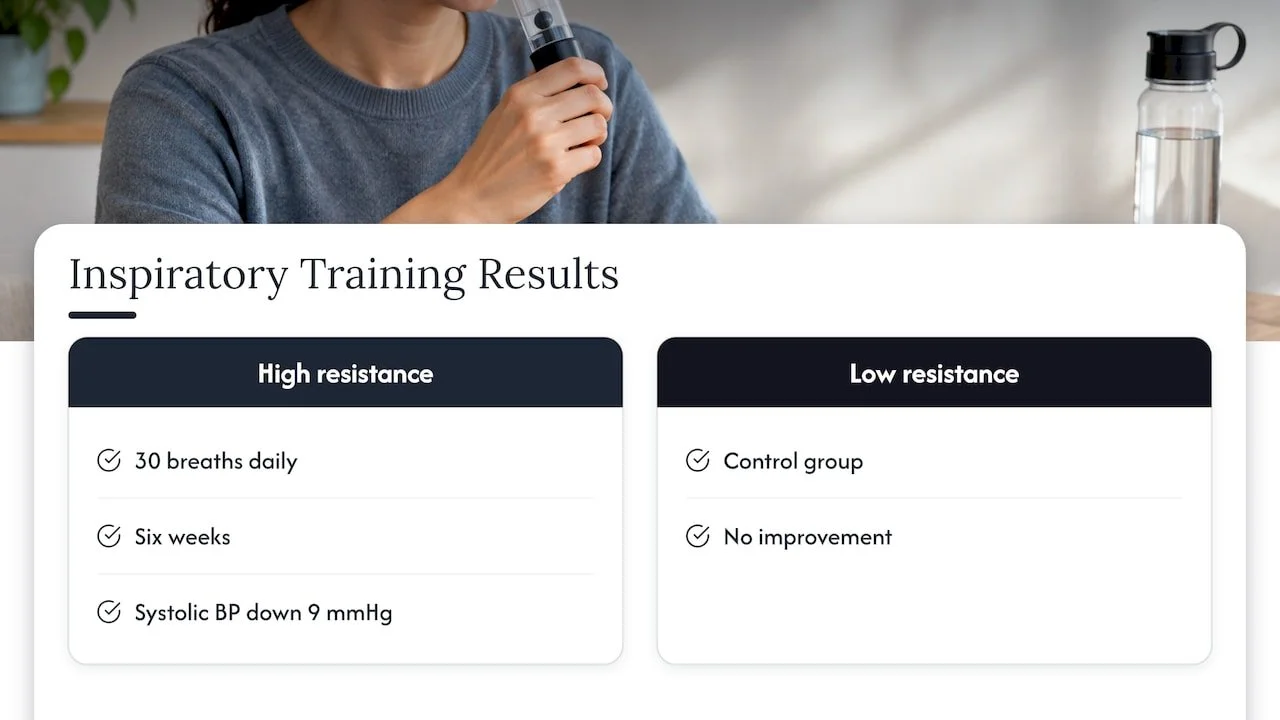
There is research behind some of the more specific claims. The American Heart Association reports on high-resistance inspiratory muscle strength training: 30 breaths a day for six weeks in healthy adults dropped systolic blood pressure by 9 mmHg, while a control group using low resistance saw no improvement. That is a device-based technique, different from the free exercises above. A 2024 study of 45 people with hypertension also reported that device-guided breathing exercises decreased blood pressure.
The American Heart Association also calls controlled breathing a well-established tool for pain control, because it calms the sympathetic nervous system (the stress response) and encourages the parasympathetic one. It adds that breathing alone is not a substitute for care of a serious chest injury or a blood clot in the lungs, and that it cannot cure severe depression or anxiety. If either is part of your picture, see your doctor.
How to pick, and how to start safely
Use this simple decision path:
Wound up or awake at 2 a.m.? 4-7-8 breathing.
Need to settle before something stressful? Box breathing.
Want a habit you can build on? Belly breathing, daily.
Out of breath on the stairs? Pursed-lip breathing.
Want slow, steady focus? Resonant breathing.
Some calming habits pair well with these. If anxiety keeps you up, you might also read about weighted blankets and anxiety alongside a short breathing routine.
Safety points that apply to everyone:
Keep first sessions short. The American Heart Association recommends no more than three to five cycles at once when trying a technique for the first time.
Stop if you feel dizzy or light-headed. Return to normal breathing.
Check first if you have a medical condition. The British Heart Foundation advises checking with your healthcare team before experimenting if you have a heart condition, another severe medical condition, or are pregnant. It also says to stop right away if you feel pain, breathlessness or dizziness.
4-7-8 is for people without chronic lung disease. If you have one, pursed-lip breathing is the better-matched technique, and your doctor can guide you.
Make it a habit: five minutes a day
The technique matters less than doing it regularly. Pick one exercise, attach it to something you already do (your morning coffee, a commute, brushing your teeth) and aim for five minutes. Our guide to a five-minute breathwork habit walks through a daily checklist. If you are not sure which style fits you, six purpose groups for beginners sorts breathwork by what you want from it.
If you already practice Pilates or aerial yoga, breath is part of the movement too. See our guides to breathwork in Pilates practice and aerial yoga breathing techniques.
A sample week
If you want a plan rather than a menu, this one takes about five to ten minutes a day:
Monday, Wednesday, Friday: belly breathing for 5 minutes, seated or lying down, with your hands on your belly.
Tuesday and Thursday: box breathing for 3 to 5 minutes, using the 3-count version first.
Any night sleep is slow to come: 4-7-8 breathing for up to four rounds.
Weekend: resonant breathing at 5 counts in and 5 out, for a few minutes, outdoors if you can.
Notice what changes: how quickly your shoulders drop, whether your jaw unclenches, how fast your thoughts slow down. Those small signals tell you which technique to keep.
Practice with others at Amrita
Breathing is easier to learn when someone watches your form and gives you a cue. At Amrita Yoga & Wellness in Philadelphia we teach yoga, Pilates mat and group reformer classes, barre and tai chi for beginners through advanced students, and we host breathwork workshops. Our group class drop-in is $28 per session, a community class drop-in is $11, and a livestream class drop-in is $19. Unlimited group classes for a month are $169. You can check times on our class schedule.
If you prefer personal attention, one-to-one sessions start from $85 per hour.
Our perspective
We teach breath first because everything else in a practice depends on it. A pose, a Pilates movement or a quiet minute on the mat all go better when the breath is steady.
Our approach is built around inclusivity, beginner approachability and community. You do not need to be flexible, fit or experienced to breathe well, and you do not need to find the "perfect" technique before you start. Our classes and detailed guidance are designed for safety, personal growth and connection at every level.
That is why we pair simple exercises like belly breathing and box breathing with movement, and why we offer breathwork workshops alongside our yoga, Pilates, barre and tai chi classes. Practicing in a room with others, with a teacher who can adjust your pace, makes the habit easier to keep.
Juiced
FAQ
What is the best breathing exercise for anxiety?
For most healthy adults, 4-7-8 breathing is a common first choice, because the long exhale helps bring on the body's calming response. NHS inform also describes slow controlled breathing as a way to reduce anxiety and help you think before you react. Keep your first sessions to three to five cycles.
How long should I practice a breathing exercise?
The American Lung Association suggests about 5 to 10 minutes a day, practiced when you are breathing comfortably. Beginners trying a new technique should start with three to five cycles, per the American Heart Association. Build up slowly.
Can breathing exercises make me dizzy?
Sometimes, especially at first with breath holds. The British Heart Foundation says mild lightheadedness can be normal for beginners. Stop if it continues or if you feel pain or breathlessness, and return to normal breathing.
Which breathing exercise is best for beginners?
Belly breathing is the easiest to learn and the foundation for the rest. Sit or lie down, put your hands on your belly, breathe in through your nose until it rises, and breathe out slowly through pursed lips for 5 to 10 minutes.
Sources
Breathing Exercises for Better Lung Health, American Lung Association
It's not just inspiration: careful breathing can help your health, American Heart Association
3 breathing exercises to relieve stress, British Heart Foundation
Diaphragmatic Breathing Exercises & Benefits, Cleveland Clinic
Effects of Different Inspiratory Muscle Training Protocols, 2024 study