The Amrita Journal
Explore thoughtful stories, practical wellness guidance and inspiring ideas to support your movement, mindfulness and everyday wellbeing at Amrita.
What is group Pilates? A guide to community wellness
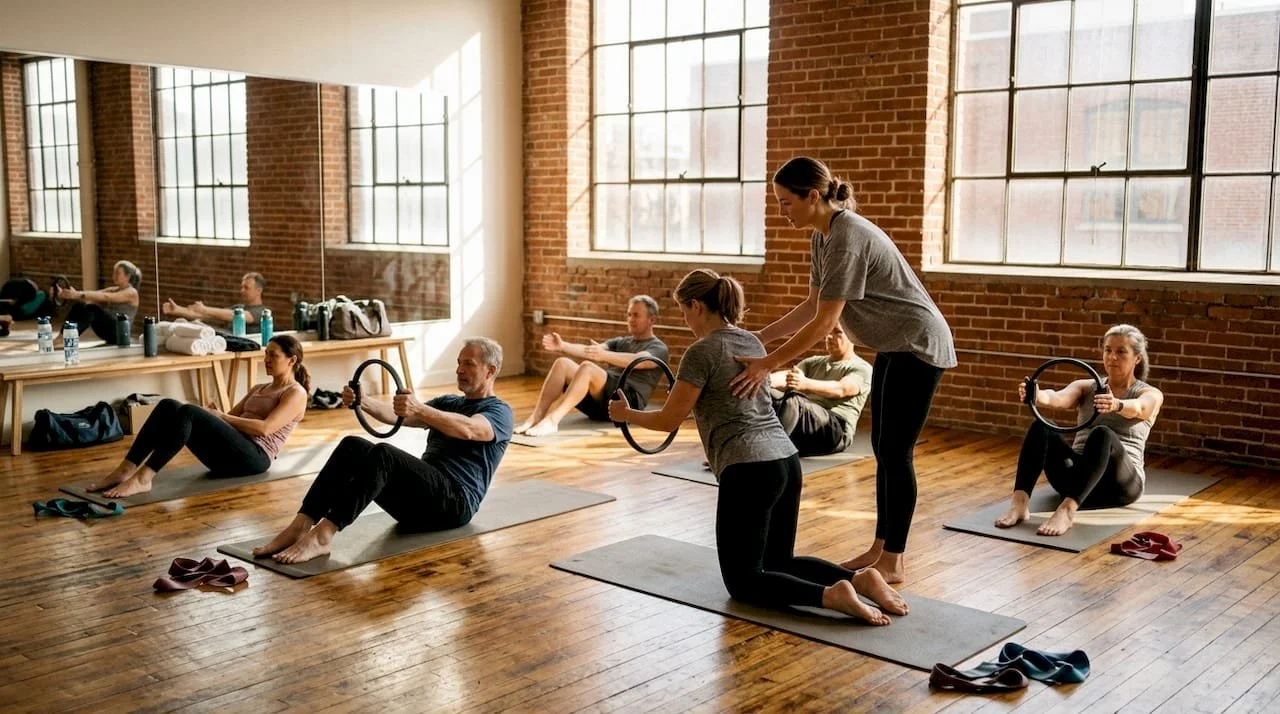
Group Pilates is quietly reshaping how Philadelphia adults think about fitness. Research shows that regular Pilates sessions can reduce anxiety and depression in adults, even from once-weekly participation. Yet many people still picture Pilates as a solo, advanced practice reserved for dancers or athletes. That picture is wrong. Group Pilates classes are built around inclusivity, shared energy, and real community connection. This guide breaks down exactly what group Pilates is, how it works, what the science says, and how you can find the right class right here in Philadelphia.
Table of Contents
Defining group Pilates: Structure, equipment, and atmosphere
The science-backed benefits: Strength, flexibility, and wellness
Group versus private Pilates: Pros, cons, and who thrives in each
Group Pilates in Philadelphia: Classes, studios, and real community impact
Try group Pilates in Philadelphia—your next step to wellness
Key Takeaways
| Point | Details |
|---|---|
| Small-group focus | Most group Pilates sessions have 4–10 participants, helping foster a supportive and energetic class experience. |
| Core health benefits | Regular attendance improves strength, flexibility, and mental well-being, with clinical support for reduced anxiety and better daily function. |
| Adaptable to all levels | Layered instruction and progressions ensure both beginners and advanced students are appropriately challenged in every session. |
| Community connection | Philadelphia studios leverage group settings to build camaraderie, motivation, and sustained wellness habits. |
| Clear class choices | Understanding the pros and cons of group versus private Pilates helps you find the experience best aligned with your needs. |
Defining group Pilates: Structure, equipment, and atmosphere
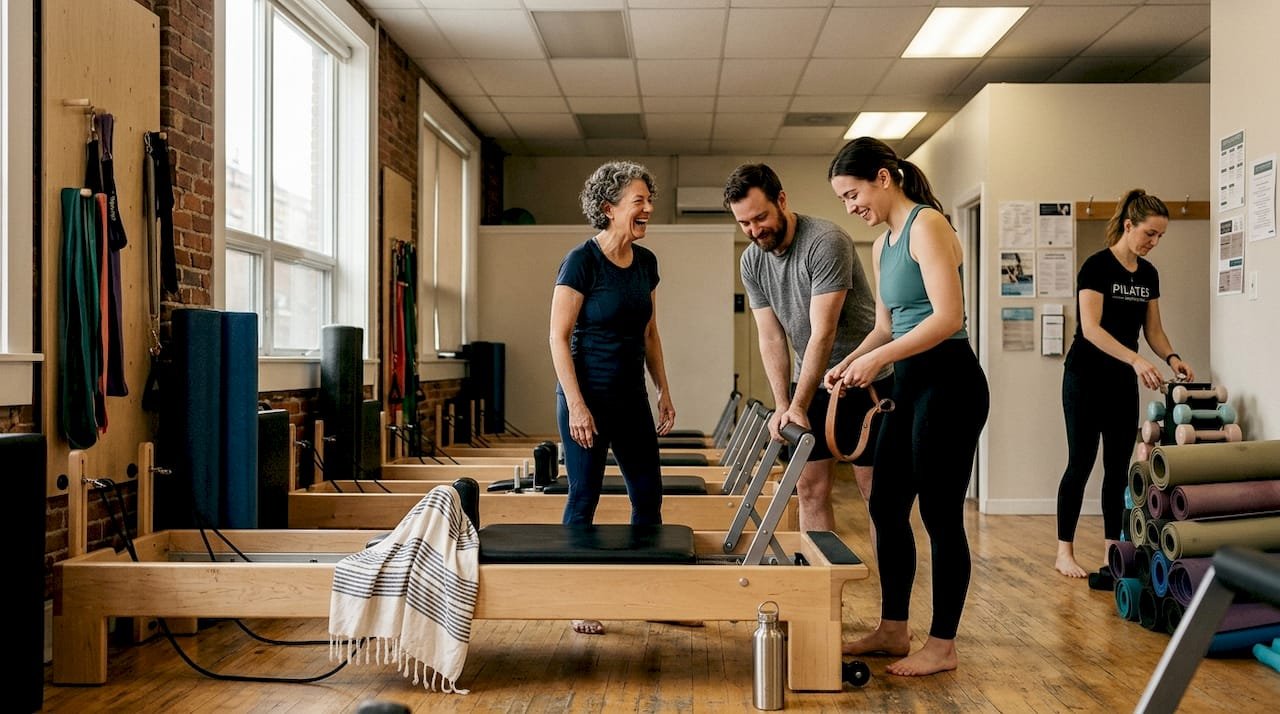
Group Pilates is a structured fitness format where a small number of participants move through a guided session together under one instructor. Unlike a crowded gym class, the small-group model keeps things personal. Group Pilates classes typically have 4 to 10 participants and use apparatus like Reformers, Towers, or mats for 30 to 60 minute sessions. That size is intentional. It gives your instructor enough eyes on the room to catch alignment issues while still creating a social, energizing atmosphere.
Here is a quick look at the most common equipment you will encounter:
Reformer: A sliding carriage with springs and straps that creates resistance and support simultaneously
Tower (or Cadillac): A vertical frame with bars and springs for a wide range of exercises
Wunda Chair: A compact apparatus that challenges balance and stability
Mat: The most accessible option, requiring no equipment beyond your own body weight
If you are exploring Pilates classes near you, knowing which equipment a studio uses helps you choose the right fit. Sessions typically open with a warm-up, move through a progressive sequence of exercises, and close with a cool-down stretch. The instructor cues movement, corrects form, and adjusts intensity for each participant.
| Class format | Typical size | Session length | Equipment used |
|---|---|---|---|
| Mat Pilates | 6 to 15 people | 45 to 60 min | Mat only |
| Reformer group | 4 to 8 people | 50 to 60 min | Reformer |
| Mixed apparatus | 4 to 10 people | 45 to 60 min | Reformer, Tower, Chair |
| Barre-Pilates fusion | 8 to 15 people | 45 to 55 min | Mat, barre |
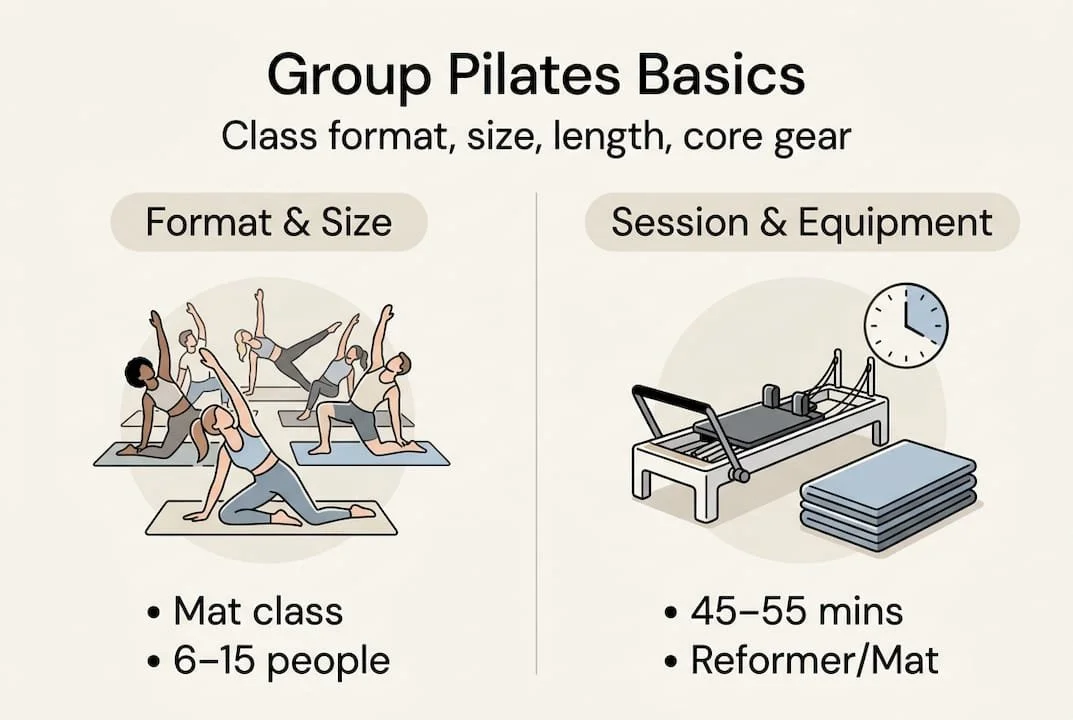
The atmosphere in a well-run group class feels supportive rather than competitive. People cheer each other on, laugh through the hard parts, and leave feeling connected. That social layer is not a bonus. It is a core part of why group Pilates works.
Core principles and methodologies in group Pilates
Knowing the logistics, it is essential to understand the underlying principles that make these classes effective and adaptable. Every group Pilates session is built on a foundation of six guiding principles: Breathing, Concentration, Centering, Control, Precision, and Flow. These are not abstract ideas. They shape every single movement you make on the mat or the Reformer.
Here is how each principle shows up in a group setting:
Breathing: Coordinated breath patterns help activate deep core muscles and keep the nervous system calm
Concentration: Focused attention on each movement builds body awareness faster than mindless repetition
Centering: All movement originates from the core, which Pilates calls the "powerhouse"
Control: Slow, deliberate movement protects joints and builds functional strength
Precision: Quality beats quantity every time. One perfect rep beats ten sloppy ones
Flow: Exercises connect smoothly, creating a moving meditation quality that reduces stress
Instructors in group settings layer these principles by offering regressions (easier versions) and progressions (harder versions) of each exercise. A beginner and an experienced practitioner can work side by side on Pilates reformer classes without either person feeling out of place. Contemporary Pilates builds on the classical method by incorporating modern movement science, making it even more adaptable for diverse bodies and fitness levels.
Pro Tip: If you are brand new, tell your instructor before class starts. They will point out the regression options so you can move safely and confidently from your very first session. You can also explore mat Pilates options as a lower-barrier entry point before moving to apparatus-based classes.
The science-backed benefits: Strength, flexibility, and wellness
Armed with the knowledge of how group Pilates works, let us examine what it does for your body and mind. The research is genuinely impressive. After just 8 weeks of regular sessions, participants show measurable improvements in core stability, posture, and spinal range of motion, alongside significant reductions in anxiety and depression. Those are not small wins.
Key physical benefits include:
Stronger deep core muscles that support the spine and reduce back pain
Improved flexibility in the hips, hamstrings, and shoulders
Better posture and body alignment in daily life
Enhanced balance and coordination, especially valuable as we age
Low-impact movement that protects joints while still building real strength
A recent Pilates health study also highlights improvements in functional movement, meaning the kind of strength and mobility that makes everyday tasks easier. Carrying groceries, climbing stairs, sitting at a desk without pain. These are the real-world payoffs.
The mental health angle is just as compelling. Group settings add a layer of accountability and social connection that solo workouts simply cannot replicate. When you show up for your class, your classmates notice. That sense of belonging keeps people coming back. If you are curious about how Pilates gym workouts compare to studio-based group classes, the community factor is often the deciding difference. For those with specific body composition goals, Pilates for weight loss is also a well-documented benefit when combined with consistent attendance.
Group versus private Pilates: Pros, cons, and who thrives in each
Understanding the outcomes, you might wonder how group sessions compare to private options for different needs. Both formats have real value. The right choice depends on your goals, budget, and starting point.
Group classes are more affordable and social, while private sessions offer personalized pacing and modifications for specific injuries or conditions. Here is a side-by-side look:
| Factor | Group Pilates | Private Pilates |
|---|---|---|
| Cost per session | Lower (typically $20 to $40) | Higher (typically $70 to $150) |
| Social connection | High | Low |
| Instructor attention | Shared | Fully individual |
| Customization | Moderate | Very high |
| Best for | General fitness, community | Injury rehab, specific goals |
| Motivation style | Group energy | One-on-one accountability |
For most healthy adults in Philadelphia who want to build strength, improve flexibility, and connect with a community, group classes are the clear starting point. Here is a simple framework for deciding:
Start with group classes if you are generally healthy and want an affordable, social entry into Pilates
Add private sessions if you have a specific injury, chronic pain, or a goal that needs individual programming
Combine both once you have a foundation. Many dedicated practitioners do group classes weekly and private sessions monthly
Try a private vs. group comparison session at your studio to feel the difference firsthand
Pro Tip: Many Philadelphia studios offer intro packages that include both a group class and a private orientation. This is the smartest way to start because you get personalized setup before joining the group flow.
The role of group classes in long-term wellness goes beyond the physical. Shared effort builds real relationships, and those relationships are what keep people consistent over months and years.
Group Pilates in Philadelphia: Classes, studios, and real community impact
If you are based in Philadelphia, here is how you can take the next step and what the local group Pilates scene offers. The city has a genuinely strong Pilates community spread across multiple neighborhoods.
Studios like Refine A Movement, Amrita Yoga & Wellness, B You Pilates, FS8, and Solidcore in Philadelphia offer community-focused group Pilates with a range of class styles and price points. Each brings something distinct to the table:
Amrita Yoga & Wellness: A holistic studio in Philadelphia offering Pilates alongside yoga, barre, and tai chi, with a strong emphasis on inclusivity and personal growth
Refine A Movement: Known for classical Reformer-based group sessions with small class sizes
B You Pilates: A neighborhood-focused studio with a welcoming vibe for beginners
FS8 Center City: A modern studio blending Pilates, yoga, and strength training in a group format
Solidcore: High-intensity Reformer classes for those who want a serious challenge
"The group energy in my Wednesday morning class is what gets me out of bed. I started for the core work, but I stayed for the people." — A regular Pilates student in Philadelphia
Philadelphia's Pilates scene spans neighborhoods from Graduate Hospital to Center City to North Philly, making it genuinely accessible no matter where you live. If you want to explore gyms offering Pilates locally or browse gyms with Pilates classes by neighborhood, there are solid options at every price point and experience level.
Try group Pilates in Philadelphia—your next step to wellness
You now have a clear picture of what group Pilates is, how it works, and what it can do for your body and mind. The next move is simple: find a class and show up.
Amrita Yoga & Wellness is a great place to start. The studio offers a welcoming, community-first environment where beginners and experienced movers practice side by side. Beyond Pilates, you will find yoga, barre, tai chi, and massage therapy all under one roof, making it easy to build a well-rounded wellness routine. If you are curious about the full range of holistic offerings available, the studio goes well beyond movement classes. Whether you are stepping onto a mat for the first time or looking for a new community to grow with, Amrita Yoga & Wellness has a class and a group of people ready to welcome you.
Frequently asked questions
How large are typical group Pilates classes?
Most group Pilates classes have between 4 and 10 participants to balance personal attention with group energy. This smaller size means your instructor can actually see and correct your form.
Are group Pilates classes suitable for beginners?
Absolutely. Instructors use layered exercises and regressions so that modifications are available for every skill level, including people who have never done Pilates before. Just let your instructor know it is your first time.
What equipment is commonly used in group Pilates sessions?
Classes use Reformers, Towers, Chairs, or mats depending on the studio and class style. Mat-only classes are the most accessible and require no prior equipment experience.
What are the key health benefits of group Pilates?
Regular group Pilates improves core stability, posture, spinal range of motion, and reduces anxiety and depression. The group setting adds a social accountability layer that supports long-term consistency.
How do Philadelphia studios stand out for group Pilates?
Philadelphia studios prioritize community and small class sizes while offering diverse equipment options. That combination creates an environment where both social connection and personal progress happen at the same time.