
What Are the Real Effects of Hot Yoga on Your Body and Mind?

A single hot yoga session raises your core temperature and heart rate the way a brisk jog might, and practiced consistently, it can improve flexibility, balance, and certain cardiometabolic markers. A 2025 systematic review of 43 studies covering 942 participants confirms the acute physiological load is real, and one trial found the heat itself triggers cellular changes, including a rise in HSP70, a protein linked to heat tolerance, alongside gains in VO2max.
Here's the catch: many of these benefits show up in non-heated yoga too. Heat seems to amplify certain effects rather than create them from nothing, and how often you show up matters more than the temperature of the room.
Acute effects: elevated core temperature, faster heart rate, heavy sweating
Chronic effects (with consistent practice): better flexibility, balance, and some blood pressure and body-fat improvements
Biomarker signals: HSP70 and VO2max changes reported in controlled trials
Pregnant people, anyone with cardiovascular disease, and those on medications affecting heat regulation should get medical clearance before trying a heated class. Hydration and pacing aren't optional extras. They're the difference between a productive sweat and a trip to urgent care.
Key Takeaways
Hot yoga produces measurable acute cardiovascular and cellular effects, and its lasting benefits depend far more on consistent attendance than on room temperature alone.
| Point | Details |
|---|---|
| Heat raises acute strain | Core temperature and heart rate climb during class, similar to moderate cardio exercise. |
| Attendance drives results | Higher class attendance correlates with better blood pressure and body-fat outcomes in trials. |
| Body-fat changes take months | A six-month, three-times-weekly Bikram program showed a significant body-fat reduction by month six. |
| Mental benefits aren't heat-specific | BDNF increases appear tied to yoga practice broadly, not the added heat. |
| Amritayogawellness applies staged exposure | The studio screens new students and controls heat gradually rather than starting beginners at full intensity. |
Table of Contents
Understanding the Effects of Hot Yoga: Styles, Heat, and Format
"Hot yoga" isn't one single practice. It's an umbrella term for yoga performed in artificially heated rooms, typically 30 to 52 degrees Celsius (86 to 126 degrees Fahrenheit), according to the range reported across studies in the 2025 systematic review. Humidity levels often run high alongside the heat, which is part of why sweat output feels so dramatic compared to a regular studio class.
Bikram yoga is the most studied style, built around a fixed sequence of 26 postures performed in a room heated to roughly 105°F with 40% humidity. Hot vinyasa and heated Hatha classes are looser variations, often the same flow sequences you'd find in an unheated room, just cranked up thermally.
Research interventions have varied widely in dose:
Session length: 20 to 90 minutes
Frequency: 2 to 6 sessions per week
Total intervention length: 1 to 16 weeks in most trials, though longer studies exist
That range matters. A single 90-minute Bikram class three times a week is a very different exposure than a 20-minute heated flow twice weekly, and the research reflects that inconsistency.
What Happens to Your Body During a Single Hot Yoga Class?
Your core temperature climbs almost as soon as you step onto the mat, and your heart works harder even though you're not sprinting or lifting weights. Heat forces your cardiovascular system to redirect blood flow toward your skin to cool you down, which raises heart rate independent of how intense the poses actually are.

That's a key nuance: one systematic review notes the heat can increase cardiovascular strain without necessarily raising your total energy expenditure compared to the same sequence done at room temperature. You're working your heart harder, but you're not necessarily burning more calories.
Sweating is the most obvious acute response, and it comes with real fluid and electrolyte loss. This is why practitioners report:
Lightheadedness or dizziness if hydration is inadequate
Transient drops in blood pressure upon standing
A sense of deeper stretch, driven by warmed connective tissue rather than actual flexibility gains
One RCT found that a 4-week hot yoga intervention performed three times weekly raised both VO2max and intracellular HSP70 levels, a heat-shock protein associated with cellular stress resilience. That's a meaningfully different physiological signature than you'd get from an unheated flow, even a vigorous one.
Does Regular Hot Yoga Practice Produce Lasting Changes?
Consistency is where hot yoga starts to show its more durable effects, though the picture is far from uniform across studies. Flexibility and balance improvements show up repeatedly, and some trials report modest bone mineral density benefits, a finding that dovetails with broader research on how weight-bearing exercise supports bone health over time.
Body composition results are where things get interesting. A six-month Bikram yoga study of adult women found progressive body-fat reductions: −3.71% at roughly 45 days, deepening to −6.07% by the six-month mark. That's a real, measurable change, but it required three 90-minute sessions weekly for half a year. Shorter interventions in other trials didn't come close to matching it.

A separate 16-week Bikram RCT illustrates why dose matters so much. But when they broke down results by attendance, participants who showed up more often saw real reductions in diastolic blood pressure, body fat percentage, fat mass, and BMI. The people who skipped classes got nothing. The people who committed got measurable results.
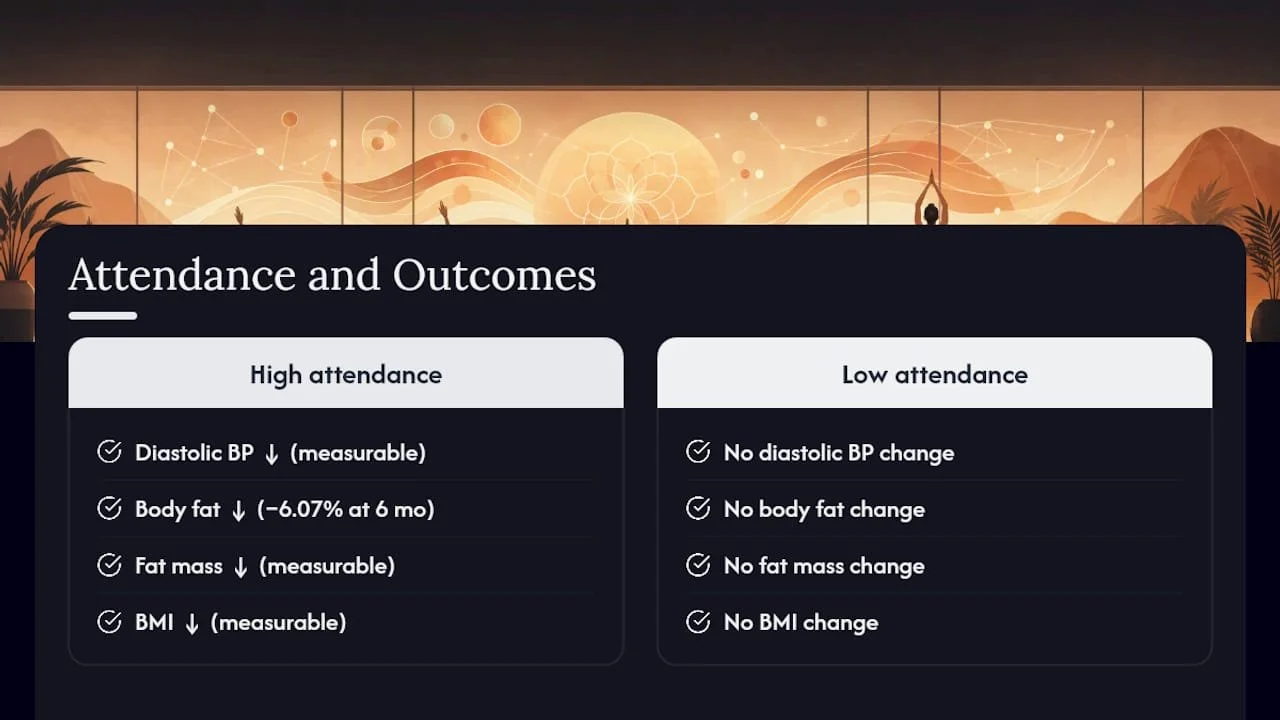
VO2max, a standard marker of cardiorespiratory fitness, increased in at least one controlled trial, though not universally across the literature. Some studies found non-heated yoga produced comparable or even greater vascular improvements, suggesting the postures and breathing, not the heat, drive a good share of the benefit.
The honest takeaway: hot yoga can produce real chronic adaptations, but attendance is the variable doing most of the work.
Can Hot Yoga Improve Your Mood and Mental Health?
People who practice hot yoga regularly often report lower perceived stress and improved wellbeing, and there's a biological thread that may explain part of it. Yoga, heated or not, has been associated with increases in BDNF (brain-derived neurotrophic factor), a protein tied to mood regulation and neural growth.
Here's where the evidence gets murkier: heat doesn't consistently add anything extra to that BDNF response. Several studies found comparable increases in non-heated yoga groups, which suggests the mental health benefits may come primarily from the mindfulness, breathwork, and movement, not the temperature.
Reduced perceived stress is a common finding, but measurement tools vary widely study to study
BDNF increases appear tied to yoga practice broadly, not heat specifically
Sample sizes in psychological outcome studies tend to be small, which limits how confidently anyone can generalize
None of this means the mental benefits aren't real. It means the heat probably isn't the active ingredient people assume it is.
What Are the Risks of Hot Yoga, and Who Should Be Cautious?
Heat changes the risk profile of yoga in ways a regular studio class doesn't. Case reports referenced in the 2025 systematic review document isolated instances of heat-related illness, which is why screening and pacing deserve real attention, not an afterthought.
Dehydration and electrolyte imbalance from heavy sweating, especially in classes lasting 60 to 90 minutes.
Dizziness or fainting, often tied to standing up too fast from floor postures in a heated room.
Overstretch injuries, since heat increases tissue laxity and can trick you into pushing past your joint's actual capacity.
Heat exhaustion, rare but documented, particularly in poorly ventilated rooms or among first-time practitioners.
Anyone who is pregnant, has cardiovascular disease, uncontrolled hypertension, severe respiratory conditions, or takes medications that affect heat regulation (some diuretics and blood pressure drugs, for instance) should talk to a doctor before booking a heated class.
Pro Tip: Don't use how deep a stretch looks as your gauge in a heated room. Heat loosens connective tissue temporarily, so lean on internal sensation and controlled, progressive loading instead of chasing a deeper shape than your body is actually ready for.
How to Start Hot Yoga Safely and Get the Most Out of It
Getting the benefits without the setbacks comes down to preparation and pacing, not toughing it out.
Before class: hydrate well in the hours beforehand, eat something light 1 to 2 hours prior, and skip alcohol or diuretics that day. If you're in an at-risk group, get medical clearance first.
During class: breathe steadily through your nose when possible, modify or skip any pose that feels wrong, and sit down if you feel dizzy. A good instructor will cue students to listen to their bodies rather than match the person next to them.
Building consistency: if you're new to heat, start with a shorter or less-heated class, then work up. Track your attendance, since the research consistently shows that people who attend more often see meaningfully better results than occasional visitors.
Pro Tip: If you're transitioning from a regular yoga practice, try two heated classes a week for a month before committing to a higher-frequency schedule. Your body adapts to heat tolerance gradually, and rushing that timeline is how injuries happen.
How Strong Is the Research on Hot Yoga, Really?
The 2025 systematic review pooling 43 studies and 942 participants is the most comprehensive look at hot yoga's effects to date, and it's honest about its limits. Session temperatures across included studies ranged from 30 to 52°C, and intervention lengths ranged from just 6 sessions up to 36 sessions spread over 1 to 16 weeks. That's a lot of variation to average together.
Short interventions and low attendance are recurring culprits behind null results. The 16-week Bikram trial illustrates this well. Looking only at intention-to-treat data hides real benefits that show up once you isolate the people who actually attended consistently.
Gaps that remain:
Few trials directly compare hot yoga against matched-intensity non-heated yoga
Sample sizes in most individual studies are small
Long-term follow-up beyond six months is rare
Study populations skew toward younger, generally healthy adults, limiting how well findings generalize
Treat hot yoga's benefits as plausible and partially proven, not settled science.
How Amrita Yoga & Wellness Puts the Research Into Practice
We built our hot yoga offerings around what the evidence actually supports: staged heat exposure, not a baptism-by-fire approach for newcomers.
Instructors screen new students for at-risk conditions before their first heated class
Room temperatures are controlled and monitored, not left to guesswork
New practitioners get guidance on hydration, pacing, and modification before they ever step on the mat
Our hot yoga safety guidance and step-by-step practice resources walk through exactly what to expect.
A Studio's Honest Take on Heat and Consistency
The research keeps pointing to the same thing: showing up matters more than the thermostat. If you're new to heat, start slow, hydrate seriously, and treat a supervised beginner class as your safest entry point.
— Juiced
Try Hot Yoga With Guidance That Matches the Science
If the research says attendance and pacing matter more than raw heat, the smartest way into hot yoga is a studio that builds both into the experience from day one. Amritayogawellness designs beginner-friendly hot classes around staged heat exposure and instructor screening, so you're not guessing your way through your first 105-degree session alone.

Our instructors watch for signs of overstretching and dehydration in real time, something no solo home practice or unsupervised video series can offer. If you're curious about the mental and spiritual side of wellness beyond the mat, our tarot readings sessions are worth exploring too. Ready to see how a properly paced hot class feels? Check current class times and book your first session on our studio schedule.
Sources
The physiological and safety claims throughout this article draw on a small set of peer-reviewed sources, each supporting a specific type of finding.
This article is general information, not a substitute for advice from a qualified doctor. Consult a qualified healthcare professional about your own circumstances before acting on anything here.