Aerial Yoga for Weight Loss: What Actually Works

TL;DR:
Aerial yoga can aid weight loss by burning around 300 calories per session and building muscle. Consistent practice combined with proper nutrition enhances fat reduction and improves strength within weeks. It is suitable for beginners and benefits from progression, but should be part of a broader healthy lifestyle to maximize results.
If you've ever dragged yourself to another treadmill session and felt zero motivation, aerial yoga for weight loss might be the change you've been looking for. Suspended in a fabric hammock, you engage your core, build real strength, and get your heart rate up. All while doing something that genuinely feels exciting. Aerial yoga sessions burn around 300 calories per 50-minute class, which makes it a legitimate workout, not a novelty act. This guide covers everything from getting started safely to tracking your real progress.
Table of Contents
Key Takeaways
| Point | Details |
|---|---|
| Calories and consistency | Aerial yoga burns roughly 300 calories per class, but weekly consistency drives real fat loss. |
| Strength plus cardio combo | The hammock adds resistance that builds muscle, which supports long-term metabolic health. |
| Realistic expectations matter | Aerial yoga works best as part of a full plan including nutrition and additional activity. |
| Safety screening first | Medical clearance and knowing your contraindications prevents injuries that derail progress. |
| Progressive challenge is key | You must increase intensity and complexity over time to keep seeing results. |
Aerial yoga for weight loss: what you need before starting
Before you show up to your first aerial yoga class hoping to lose weight, a bit of preparation goes a long way. Aerial yoga is accessible to most fitness levels, but it's not entirely without prerequisites.
Physical readiness and medical clearance
You don't need to be fit to start, but you do need to be honest about your health. People with hypertension, vertigo, recent surgeries, or musculoskeletal injuries should consult a doctor first. Safety screening for conditions like hypertension and pregnancy-related concerns is vital to keeping your practice consistent and injury-free. Getting cleared upfront isn't bureaucratic. It's what keeps you in the studio week after week instead of sidelined.
For a thorough breakdown before your first session, reviewing aerial yoga contraindications gives you a clear picture of what to watch out for.
What to wear and bring
Keep it simple. Fitted clothing that covers your armpits and the backs of your knees protects your skin from friction against the silk hammock. Avoid zippers, belts, or anything with hard edges. Go barefoot or wear grip socks.
Here's what to have ready before your first aerial workout for weight loss:
Fitted leggings and a long-sleeved fitted top
Grip socks (optional but helpful)
Water bottle
Light snack eaten 90 minutes beforehand
An open mind about being upside down
Choosing the right class
Not all aerial yoga classes are structured the same way. Some focus on flow and flexibility. Others emphasize strength and conditioning, which aligns better with aerial yoga weight loss goals. Look for classes that describe themselves as "aerial fitness" or "aerial conditioning." When searching for aerial yoga classes near me, filter for studios that have certified instructors with training in both yoga and aerial arts. The instructor's background matters more than the studio's decor.
Pro Tip: Ask the studio directly whether the class targets cardiovascular endurance or primarily flexibility. A strength-focused class will do more for your weight loss goals than a slow, restorative one.
| Class type | Weight loss benefit | Best for |
|---|---|---|
| Aerial fitness/conditioning | High | Fat loss, muscle tone |
| Aerial flow yoga | Moderate | Flexibility, stress relief |
| Aerial restorative | Low | Recovery, relaxation |
| Aerial acrobatics | High | Strength, coordination |
Best aerial yoga poses and routines for fat loss
The hammock is a tool. What you do with it determines your results. These seven movements specifically target major muscle groups, spike your heart rate, and build the lean muscle that keeps your metabolism active.
Inverted core crunches. Hang face-down with your hips in the hammock. Use your core to pull your knees toward your chest repeatedly. This targets the entire abdominal wall while your stabilizer muscles work overtime to keep you balanced.
Aerial squats. Stand with the hammock at hip height behind you. Sit back into it and lower into a squat, then press back up. This loads the glutes and quads with the added instability of the fabric, recruiting more muscle fibers than a regular bodyweight squat.
Plank pulls. Start in a plank position with your feet in the hammock. Pull your knees to your chest and extend back out. Your core, hip flexors, and shoulders all fire at once.
Hip hinge swings. Standing, hold the hammock overhead and hinge forward at the hip, letting the momentum build. This trains the posterior chain, specifically the glutes and hamstrings, and gets your heart rate climbing.
Aerial side planks. Thread one foot into the hammock, extend into a side plank, and hold. The instability from the silk turns a static hold into an active full-body stabilization challenge.
Seated backbend pulses. Sit in the hammock and lean back into a backbend. Pulse up and down to activate the spinal extensors, glutes, and core. This one opens the chest and builds real back strength.
Hammock pull-ups. Grip the fabric and perform assisted or full pull-ups. Your back, biceps, and shoulders work hard here, and training all major muscle groups consistently is the core principle behind effective strength-based fat loss.
A sample 50-minute aerial yoga weight loss routine
Warm up for 8 minutes with light swinging and hip circles in the hammock. Move into the hip hinge swings and aerial squats for 15 minutes, running each for 3 sets of 12 repetitions. Shift to core work with inverted crunches and plank pulls for another 15 minutes. Finish with aerial side planks, backbend pulses, and hammock pull-ups for 10 minutes, then cool down with 5 minutes of gentle spinal traction in an inverted hang.

Pro Tip: Track how hard each move feels on a scale of 1 to 10. For weight loss, you want most of your working sets to land between 6 and 8. If every exercise feels easy, it's time to add reps, slow the tempo, or ask your instructor for a harder variation.
Common mistakes that slow aerial yoga weight loss results
Getting into the hammock is the fun part. Staying consistent and avoiding the pitfalls below is what separates people who see real change from those who don't.
Believing aerial yoga alone is enough
This is the most common mistake. Yoga contributes to weight loss as part of a full lifestyle plan that includes nutrition and other activity. One or two weekly classes won't hit the minimum 150 minutes of moderate aerobic activity per week recommended for weight management. You need to layer aerial yoga into a larger plan, not treat it as the plan itself.
Common mistakes to watch for:
Expecting to lose weight without adjusting your diet
Skipping strength-focused flows in favor of only restorative classes
Going too hard too soon and burning out within three weeks
Neglecting sleep and recovery between sessions
Falling for wellness hype
The aerial yoga world has its share of exaggerated claims. Detox and lymphatic drainage claims from inversions have no credible physiological backing. The real benefits are spinal decompression, strength development, and a genuine mood lift from the novelty and challenge of the practice. Chase the real results, not the Instagram-friendly promises.
"The best exercise plan is the one you actually stick to. Aerial yoga earns its place in a weight loss program by being something people genuinely look forward to. That consistency is worth more than the perfect protocol you never follow."
Not progressing your workouts
Repeating the same beginner flow every week is one of the fastest ways to plateau. Intensity progression and total weekly volume are what drive continued fat loss. Add minutes, increase repetitions, reduce rest periods, or try a more advanced variation every two to three weeks.
For tips on practicing safely as you advance, the aerial yoga safety resources at Amritayogawellness walk through how to scale up without risking injury.
Expected results and how to track progress
Setting the right expectations is what keeps you going when the scale moves slowly or not at all for a week.
Most people notice improved core strength and better posture within two to three weeks. Fat loss becomes visible around weeks six to eight when combined with a calorie-conscious diet. Yoga's improvements in cardiometabolic health markers like blood pressure and lipid profiles develop over consistent months of practice, not weeks.
| Metric | When to expect change | How to measure |
|---|---|---|
| Core strength | 2 to 3 weeks | How long you hold a plank or aerial side plank |
| Posture | 3 to 4 weeks | Observation or posture photos |
| Body fat percentage | 6 to 8 weeks | Body composition scale or tape measure |
| Cardiovascular fitness | 4 to 6 weeks | Resting heart rate trends |
| Cardiometabolic markers | 3 to 6 months | Bloodwork with your physician |
The number on the scale is the least interesting metric here. Track how your clothes fit, how your resting heart rate drops, and how far your endurance has improved mid-class. These tell you far more about what's actually changing in your body.
Pairing aerial yoga with nutrition and other movement
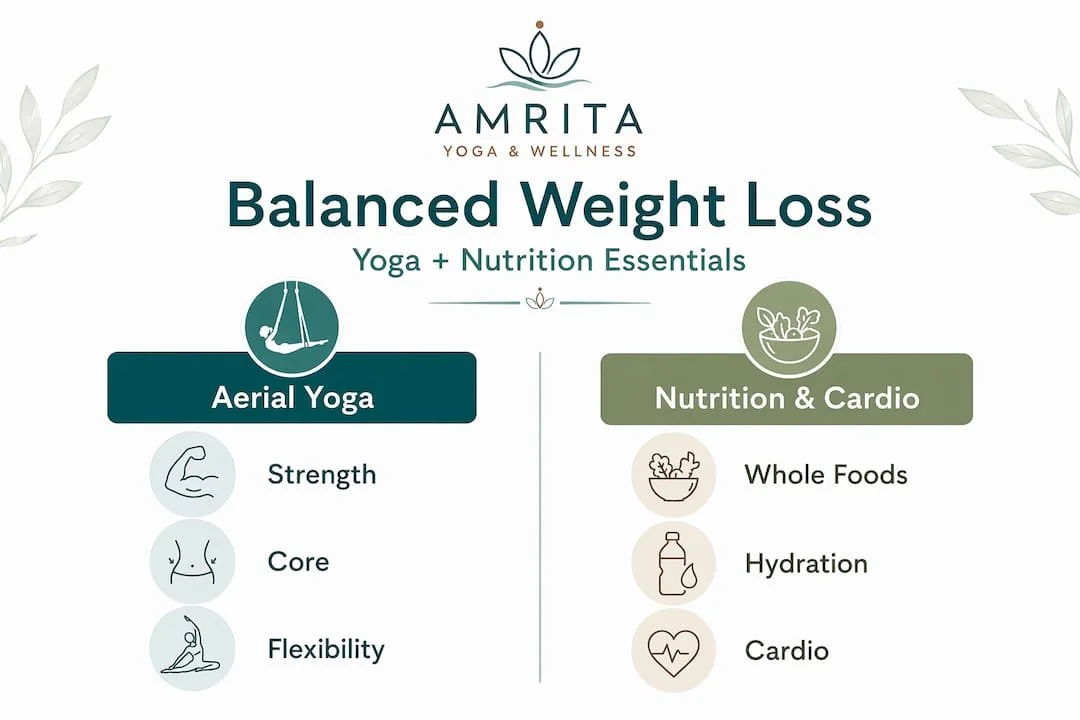
Aerial yoga works best alongside clean eating and additional cardio activity. Think of it as your strength and skill training session, then supplement with walks, cycling, or swimming on other days. For most people, aerial yoga two to three times per week plus 30 to 40 minutes of cardio on two other days puts you solidly within the recommended activity guidelines. Explore how your overall yoga wellness benefits stack up when you combine multiple modalities.
My honest take on aerial yoga and fat loss
I've watched people come to aerial yoga expecting magic and leave frustrated because they treated one weekly class like a silver bullet. Here's what I actually believe: aerial yoga is one of the most underrated strength training tools for people who hate the gym. The hammock creates instability that activates muscles your standard workout never touches, and the resistance from body weight plus gravity in unusual positions builds functional strength fast.
What I've seen work consistently is using aerial yoga as the anchor of a fitness routine, not the whole thing. The people who show up three times a week, push into harder flows every few weeks, and pair it with reasonably clean eating. They lose fat, get noticeably stronger, and, most critically, they keep coming back. That last part is everything.
I'm also straightforward about the wellness noise that follows aerial yoga around. Detox claims, lymphatic flushing, spiritual weight release. These real benefits are strength and psychological, not mythological. Reduced anxiety, real spinal decompression, and genuine calorie burn. That's more than enough to build on without fabricating extra claims.
If you're tired of workouts that feel like punishment, aerial yoga gives you something to actually practice and get better at. Progress in skill is its own motivator, and that motivation is what ultimately drives the weight loss.
— Juiced
Start your aerial yoga journey with Amrita Yoga & Wellness
If you're ready to try aerial yoga in a structured, supportive setting, Amrita Yoga & Wellness in Philadelphia has classes designed for all experience levels, from total beginners to those ready for advanced aerial conditioning. The instructors understand how to scale aerial workouts for weight loss goals specifically, not just flexibility. You'll be in a community that shows up consistently and pushes each other forward.
Beyond the mat, Amritayogawellness also offers tarot readings and other holistic wellness services for those who want to explore the mental and spiritual side of their health journey alongside the physical. You can browse class schedules, sign up online, and connect with the studio community directly at amritayogawellness.com.
FAQ
Can aerial yoga help you lose weight?
Yes. Aerial yoga helps with weight loss by burning around 300 calories per 50-minute session while building muscle through resistance-based movements. Combined with a sensible diet and additional cardio, it's a real tool for fat loss.
How many times per week should you do aerial yoga for weight loss?
Two to three sessions per week is the sweet spot for most people. Pair them with additional cardio activity to meet the recommended 150 minutes of weekly exercise for weight management.
Is aerial yoga good for beginners trying to lose weight?
Absolutely. Starting any regular resistance training produces meaningful strength and metabolic benefits even for beginners, and aerial yoga is beginner-friendly because instructors can modify every pose to match your starting fitness level.
Are there health conditions that prevent practicing aerial yoga?
Yes. Hypertension, vertigo, recent surgeries, and pregnancy may require modifications or medical clearance before you begin. Review contraindications with your doctor and inform your instructor of any conditions before your first class.
How long before you see results from aerial yoga?
Core strength improvements typically appear within two to three weeks. Visible fat loss usually takes six to eight weeks with consistent practice and a calorie-conscious diet supporting the work you do in the hammock.