
Infrared Hot Yoga Benefits: What Science Actually Says

TL;DR:
Infrared hot yoga warms the body directly at lower temperatures, making breathing easier and tissues more deeply affected. Its physical benefits include improved cardiovascular health, joint pain relief, and temporary flexibility gains, with mental benefits like better sleep and mood regulation. Safe practice requires hydration, gradual heat exposure, and realistic expectations, emphasizing consistency over instant results.
You've probably heard the claims: infrared hot yoga melts toxins, supercharges flexibility, and delivers results that regular yoga can't touch. Some of those claims are worth taking seriously. Others aren't. The real benefits of infrared hot yoga are meaningful but more specific than the marketing suggests, and knowing the difference protects both your health and your expectations. This article breaks down exactly what the research supports, what it doesn't, and how to practice infrared hot yoga in a way that genuinely improves your physical and mental well-being.
Table of Contents
Key Takeaways
| Point | Details |
|---|---|
| Infrared heat works differently | Infrared panels warm your body directly at lower room temperatures than traditional hot yoga, making breathing easier. |
| Physical benefits are real but nuanced | Flexibility gains during sessions may be temporary; cardiovascular and muscle recovery benefits have stronger support. |
| Mental health benefits are significant | Research links infrared heat exposure to improved REM sleep, lower cortisol, and better mood regulation. |
| Safety requires preparation | Hydration, gradual heat adaptation, and knowing your limits are non-negotiable for safe practice. |
| Set realistic expectations | Infrared hot yoga builds on yoga's core benefits; it does not dramatically outperform room-temperature practice across every measure. |
Benefits of infrared hot yoga: how the heat actually works
Most people assume infrared hot yoga is just regular hot yoga with fancier equipment. That assumption leads to a lot of confusion about what you should actually expect from a session.
Traditional hot yoga heats the air in the room, pushing temperatures to 95-105°F or higher with significant humidity. Infrared yoga takes a different approach. Instead of heating the surrounding air, infrared panels warm your body directly at room temperatures typically between 90 and 98°F. The heat penetrates the skin and soft tissue rather than just sitting on the surface.
That distinction matters for a few reasons:
Easier breathing: Lower humidity and cooler air mean you are not fighting to inhale during poses. This makes infrared yoga significantly more accessible for beginners and anyone with respiratory sensitivities.
Deeper tissue warming: The penetrating quality of infrared heat reaches muscles and joints more directly than heated air alone, which affects circulation and muscle pliability.
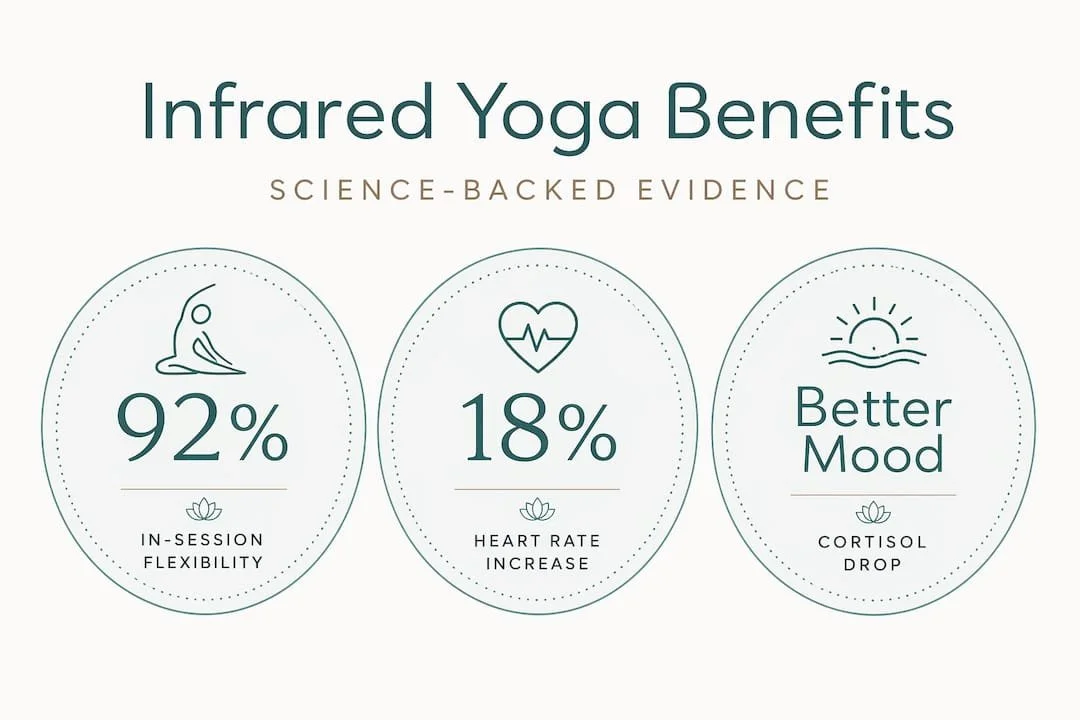
Heart rate elevation: Your cardiovascular system responds to the thermal load by increasing heart rate, a response similar to what you see with moderate aerobic exercise.
Nervous system response: The gentler temperature rise tends to feel less aggressive, reducing the sense of panic some people experience in a traditional hot yoga room.
The physiological result is a warm, penetrating environment that nudges your body into a state of increased circulation and mild cardiovascular stress without the oppressive humidity that turns off many practitioners.
Pro Tip: If you are new to infrared yoga and searching for an infrared yoga studio near me, ask specifically about room temperature and humidity levels before booking. A studio running at 92°F with low humidity will feel completely different from one pushing 105°F.
Physical health benefits: what research supports
Here is where the evidence gets interesting, and sometimes inconvenient for enthusiasts.
The benefits of infrared heat yoga for the body are real, but several popular claims are overstated. A study tracking experienced practitioners found that only 1 of 13 flexibility measures improved with heat compared to room-temperature yoga, and caloric burn was similar between the two conditions. That does not mean infrared hot yoga is pointless. It means you need to understand precisely where the value lies.
Flexibility: session gains vs. lasting change
Heat genuinely increases range of motion during a session. Warmer muscles and joints move more freely, and you will feel more pliable in class. What the research makes clear is that flexibility gains from heat may reflect temporary tissue warming rather than permanent structural change. Think of it as your muscles becoming more cooperative for the hour you are on the mat, not a guaranteed long-term upgrade over standard practice.
To get real, lasting flexibility improvements, consistency matters more than heat.
Cardiovascular and metabolic effects
This is where infrared hot yoga earns genuine credit. The heat-stress physiology of a session places real demand on your heart and vascular system. Heart rate elevation during class functions similarly to moderate cardio exercise, which supports heart health over time. There is also some evidence suggesting modest increases in fat metabolism with heat exposure, though the caloric expenditure difference between infrared and room-temperature yoga is not dramatic.

Joint and muscle recovery
Infrared heat reduces joint fluid viscosity, which translates to easier, less painful movement for people dealing with arthritis or chronic stiffness. Gentle infrared heat combined with yoga stretching offers meaningful pain relief for joint-related conditions. For muscle soreness, improved circulation from the warmth clears metabolic waste faster, which speeds recovery between training sessions.
| Benefit | Evidence strength | Notes |
|---|---|---|
| In-session flexibility | Strong | Temporary thermal effect; not necessarily permanent |
| Cardiovascular conditioning | Moderate to strong | Heart rate elevation comparable to moderate exercise |
| Calorie burn vs. standard yoga | Weak | Differences are minimal per research |
| Joint pain and stiffness relief | Moderate | Particularly for arthritis and chronic pain |
| Muscle recovery | Moderate | Improved circulation supports faster recovery |
Pro Tip: Track your flexibility by testing the same pose in a room-temperature setting every few weeks. This gives you a baseline that separates actual progress from in-session thermal facilitation.
Mental and holistic benefits you should not overlook
The physical story is only half the picture. The mental and emotional benefits of infrared yoga may actually be where this practice delivers its most consistent value.
Infrared heat has a measurable calming effect on the nervous system. When your body warms gradually and the heat penetrates deeply without the suffocating humidity of a traditional hot yoga room, your stress response tends to quiet rather than spike. That shift has real downstream effects on mood, anxiety, and cognitive function.
Here is what the research shows:
Improved sleep quality: A randomized crossover study found that far-infrared heat exposure lowered core body temperature during sleep and increased the proportion of REM sleep. Better REM sleep means sharper memory, improved emotional regulation, and less reactivity the following day.
Cortisol reduction: Combining yoga's mindfulness component with the calming effect of infrared heat creates a double-down effect on stress hormones. Lower cortisol after class is a predictable outcome for regular practitioners.
Endorphin release: The mild physical exertion of yoga poses combined with heat triggers endorphin production, which contributes to the mood lift many practitioners describe after class.
Mindfulness in a warm environment: Practicing movement and breath in a comfortably warmed space tends to deepen the meditative quality of yoga. The heat becomes a sensory anchor that keeps you present.
"The mental benefits of infrared yoga may stem from subtle thermoregulatory effects that enhance sleep quality and emotional regulation, not just the movement itself."
One honest note: claims about infrared yoga for detox are popular but lack strong clinical backing. Sweating is primarily a thermoregulatory mechanism. Your liver and kidneys handle actual detoxification. The mental clarity you feel after class is real. Attributing it to toxin removal is not accurate based on current evidence.
Safety considerations before you start
Infrared hot yoga is safe for most healthy adults. It is not automatically safe for everyone, and ignoring the risks is how people end up dizzy on their mat or worse.
Here are the steps to practice safely, especially if you are new:
Hydrate aggressively before class. Drink at least 16 to 24 ounces of water in the two hours before your session. Bringing water into the room is not optional; it is expected.
Start with shorter sessions. Your first few classes should be 30 to 45 minutes rather than a full 60 to 75 minutes. Heat adaptation takes time, and pushing too hard early increases dizziness and overheating risk.
Know your medical history. People with cardiovascular conditions, pregnancy, low blood pressure, or heat sensitivity need physician clearance before attending an infrared hot yoga class.
Recognize warning signs. Lightheadedness, nausea, sudden fatigue, or an abnormal heartbeat during class means you step out and cool down. These are not signs to push through.
Avoid overstretching under heat. This is underrated as a risk. When everything feels more flexible in the warmth, it is easy to push a joint or muscle past its actual structural limit. Thermal facilitation can mask discomfort until after the session.
Compared to traditional hot yoga, infrared hot yoga carries a slightly lower risk profile because of lower humidity and room temperature. That relative gentleness does not eliminate heat-related risk. You will still sweat heavily and your cardiovascular system will still be working.
Pro Tip: Review hot yoga safety tips before your first class. Knowing what to expect physiologically makes a significant difference in how you respond when your heart rate spikes midway through a pose sequence.
How to integrate infrared hot yoga into your routine
Knowing the benefits of infrared yoga is one thing. Building a practice that actually delivers those benefits over time requires a more structured approach than "go when you feel like it."
Here is a framework that works based on what practitioners consistently report:
Weeks one to three: Attend once or twice per week. Keep sessions to 45 minutes. Focus entirely on breathing and acclimating to the heat. Do not worry about pose depth.
Month two onward: Move to two or three sessions per week with full-length classes once your body has adjusted. This is when cardiovascular conditioning and consistent flexibility work begin to compound.
Complement your practice: Infrared hot yoga pairs particularly well with strength training, which benefits from the improved recovery circulation provides, and with meditation or breathwork, which deepens the mental calm you carry out of class.
Track progress realistically: Test your range of motion in a non-heated setting every few weeks. Note energy levels, sleep quality, and stress. These markers give you a clearer picture of actual progress than how bendy you felt in Tuesday's class.
Rest and recover: Two days between sessions is a reasonable minimum for newcomers. Infrared heat places genuine demand on your cardiovascular and nervous systems, and recovery is where adaptation happens.
Setting realistic expectations protects your motivation. Infrared hot yoga builds on everything yoga already offers. You get a more forgiving heat environment, added cardiovascular stimulus, and real mental health support. You do not get a miracle that bypasses consistent practice.
My honest take on infrared hot yoga
I've spent enough time around practitioners and in wellness research to say this plainly: infrared hot yoga is genuinely good for you, and it is also genuinely overhyped in specific ways.
What I've observed most consistently is that the heat does something yoga alone sometimes struggles to do. It shuts off the noise. People who find it hard to quiet their minds during a room-temperature class often report that the warm, penetrating environment of infrared yoga forces a level of bodily presence that makes mindfulness almost automatic. That's a real benefit. It just isn't the detox miracle some studios advertise.
The physical gains that hold up over time are cardiovascular conditioning, joint mobility support for people with chronic pain, and muscle recovery. Flexibility improvements? Those require honest measurement. I've seen too many practitioners assume they're making structural progress when they're really just feeling the thermal effect wear off after class.
What newcomers miss most often is the hydration and pacing piece. It sounds boring, but heat and overstretching together cause more setbacks in new practitioners than any other factor. The warmth makes everything feel easier than it is, and that gap between perceived and actual capacity is where injuries happen.
My recommendation: go in with curiosity, not hype. Measure your progress honestly. Give it eight weeks of consistent practice before you judge it. And drink more water than you think you need.
— Juiced
Experience infrared hot yoga at Amrita Yoga & Wellness
If you are ready to put these benefits to the test, Amrita Yoga & Wellness in Philadelphia offers infrared hot yoga classes designed for every level, from curious first-timers to seasoned practitioners.

The studio's experienced instructors guide you through sequences that make the most of the infrared heat environment while keeping safety and pacing front of mind. Whether your focus is stress relief, flexibility, cardiovascular health, or simply finding a practice that fits your life, the supportive community at Amrita Yoga & Wellness meets you where you are. For something that extends your wellness practice beyond the mat, explore tarot reading services as a complement to your physical practice. Visit Amrita Yoga & Wellness to browse class schedules and book your first session.
FAQ
What is infrared yoga and how does it differ from hot yoga?
Infrared yoga uses infrared panels to heat your body directly at lower room temperatures (90-98°F) rather than heating the surrounding air to 95-105°F or higher as in traditional hot yoga. The result is lower humidity, easier breathing, and deeper tissue warming without the oppressive heat of a conventional hot yoga studio.
Does infrared hot yoga actually help with flexibility?
Heat does increase range of motion during a session, but research shows only 1 of 13 flexibility measures improved significantly over room-temperature yoga. Long-term flexibility gains require consistent practice regardless of heat.
What are the mental health benefits of infrared yoga?
Infrared heat exposure is linked to lower cortisol, improved mood through endorphin release, and better REM sleep quality. These effects, combined with yoga's inherent mindfulness component, make infrared hot yoga a strong tool for managing stress and anxiety.
Is infrared hot yoga safe for beginners?
Yes, with preparation. Beginners should start with shorter sessions of 30 to 45 minutes, hydrate thoroughly before and during class, and avoid pushing into extreme ranges of motion while the heat masks discomfort. People with cardiovascular conditions or heat sensitivity should consult a physician first.
How often should I practice infrared hot yoga to see results?
Start with one to two sessions per week for the first three weeks to build heat tolerance, then progress to two to three sessions per week. Most practitioners notice meaningful changes in energy levels, sleep, and recovery within six to eight weeks of consistent practice.