Pilates Specialization: Building a Fitness Career
A Pilates specialization is the clearest route from "fitness instructor" to a sustainable, better-paid career. Comprehensive certification gets you hired. A niche, such as rehabilitative, prenatal or athletic-performance work, is what keeps you booked, paid well and out of burnout. Below you'll find what training costs, what instructors earn, which revenue streams matter and how to plan the first two years.
Amritayogawellness
Explore Pilates in Philadelphia
Experience Pilates classes at Amrita Yoga & Wellness as you consider how this practice could fit into your fitness career.
TL;DR
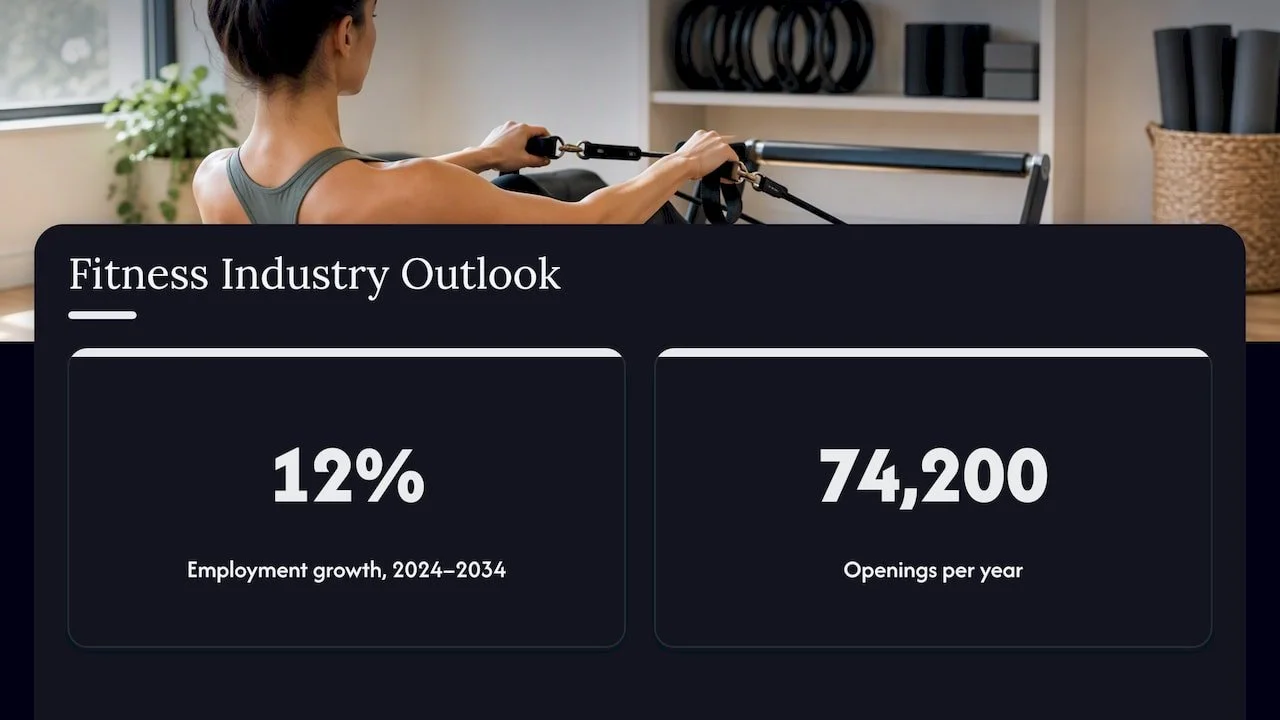
Fitness instructor employment is projected to grow 12 percent from 2024 to 2034, and Pilates sits inside that demand.
Comprehensive certification means at least 450 hours, roughly $3,700 to $6,000+ and 9 to 18 months, before you factor in books, exam fees and practice teaching.
Pay is usually per class or per session. Private and duet work generally pays more per hour than group classes, and specialists tend to out-earn generalists.
The careers that last combine group teaching with a specialty and a small, loyal client base.
If you're in Philadelphia, taking classes and a few private sessions before you commit is the cheapest way to test the path.
Table of Contents
Why Pilates is a strong specialization right now
General fitness instruction is a big, crowded field. The U.S. Bureau of Labor Statistics projects 12 percent employment growth for fitness trainers and instructors between 2024 and 2034, much faster than the average across occupations, with about 74,200 openings a year. Pilates benefits from the same pull: people want low-impact training that builds core strength, posture and control without pounding the joints.
That demand is a reason to specialize, not just to enter. Broad growth also means broad competition. A Pilates instructor who can explain why an exercise suits a particular body, adapt it in real time and measure progress is much harder to replace than one who can lead a generic class.
The job boards that rank for this topic make the point from another angle. Listings in states from Alabama to Connecticut to California show wide hourly ranges for the same job title. The gap between the bottom and the top of those ranges is largely a gap in training, format and setting.
What a Pilates specialization actually means
In practice, you specialize on two axes: the equipment you teach and the clients you serve.
Equipment: mat, reformer and comprehensive
Pilates Matters describes instructors as specializing in one or more formats. Mat Pilates uses bodyweight and needs no equipment. Reformer Pilates uses spring-based resistance and is described there as the most in-demand format in the industry right now.
A comprehensive program goes further. The National Pilates Certification Program says candidates must be at least 18 and must complete a comprehensive education covering Mat, Reformer, Trapeze Table, Wunda Chair, Ladder Barrel, Spine Corrector and Magic Circle.
If you want to understand the machine you'd be teaching on, our guides to what a Pilates reformer does for your body and the types of Pilates reformer are a good starting point.
Clients: the niche that sets your rate
This is where income separates. According to The Pilates Business, reformer certification is now close to a baseline hiring requirement at professional studios, while specialization is what supports career longevity and premium pay. Their analysis puts instructors in niches such as prenatal and postnatal care, athletic performance or rehabilitative Pilates at 20 to 30 percent above general fitness instructors. Treat that as an industry estimate, not a guarantee. It will vary with your city, your studio and your client base.
Common specialty directions include:
Rehabilitative and clinical Pilates: working alongside physical therapists, or with clients returning to movement after injury.
Prenatal and postnatal: a defined, motivated client group with clear needs.
Athletic performance: runners, golfers and gym-goers who want better mobility and control.
Posture and mobility for desk workers: a good fit for busy professionals in a city like Philadelphia.
Cross-training with yoga or barre: teaching several formats makes you easier to schedule.
What does a Pilates instructor earn?
There is no single number, and any article that gives you one is simplifying. Here is what the sources say.
| Source | What it reports |
|---|---|
| BLS, fitness trainers and instructors | 2025 median pay of $47,160 per year, or $22.67 per hour, for the broad occupation |
| Gymdesk | Typical Pilates instructor range of $48,000 to $86,000; top earners above $118,500; established studio owners $100,000 to $200,000+ |
| Salary.com, Philadelphia | Average of $78,876 for a certified Pilates instructor in Philadelphia as of April 2026, with a typical range of $68,130 to $93,210 |
These figures measure different things. BLS covers all fitness trainers and instructors. The other two are Pilates-specific estimates drawn from job postings and industry data, so treat them as ranges to plan around, not promises. Notice also that a salary is rarely what you receive. Gymdesk notes that earnings are generally structured per session or class rather than as a fixed salary, which matters for how you plan your month.
Why hours worked don't equal income
The common assumption is that more classes means more money. Pilates Matters argues the opposite: group classes often pay a flat fee regardless of attendance, so your income is capped by the studio's capacity. Private and duet sessions let you keep a larger share of the session fee.
A simple, hypothetical illustration (not a figure from any source): if a studio pays a flat rate per group class, adding a tenth class to your week adds the same pay as the first, and it also adds fatigue. A private client who books weekly for a year adds income that compounds with each referral and package renewal.
The revenue streams that make up a Pilates career
Most sustainable Pilates careers are built from several streams, not one job.
Group classes (mat and reformer). Reliable, good for building a name and a base of students. Pay is capped by the room.
Private one-to-one sessions. Higher pay per hour, deeper client relationships, more assessment and programming work.
Duets and small groups. A middle path: two or three clients share a session, so the client pays less each and you earn more per hour than in a large class.
Specialty programs. Prenatal series, post-injury programs, athletic mobility blocks.
Workshops and teaching other teachers. Once you have experience, you can lead continuing education or mentor apprentices.
Studio ownership or a rented independent space. The top end of the range, with the most risk and the most business work.
The 80/20 idea that readers ask about fits here. Pilates Matters is not the page to cite for the rule, so we'll state our own reading: a small share of your clients, the loyal long-term ones, tends to provide most of your stable income. Spend your energy keeping them progressing, not only chasing new sign-ups.
The cost and timeline of getting certified
Plan this like any career change, with real money and real months.
Hours: the National Pilates Certification Program requires at least 450 hours of comprehensive education for the NCPT route.
Cost: programs typically run about $3,700 to $6,000+, according to the same program requirements as summarized in our research, and take 9 to 18 months.
Hidden costs: The Pilates Business points out that books, exam fees and the many hours of self-practice and apprentice teaching push the real total higher. Those hours often can't be done alongside a full-time job without strain.
That last point is the one people underestimate. If you're working full time, build a 9 to 18 month runway: protect savings, tell your employer what you can, and keep a realistic weekly training schedule.
Does the name on the certificate matter?
Less than most people think. The same guide says that what you can do as a teacher often matters more than the name on your certificate: cueing clearly, managing mixed-level classes safely and adapting exercises on the spot. Studio owners are hiring for those skills. Choose a program with plenty of observation, practice teaching and feedback, not just the most recognizable brand.
If you're weighing local options, our breakdown of Pilates certification programs in Philadelphia covers in-person routes in the city.
A realistic two-year path
This is an example of how the pieces can fit together, not a guarantee of any result.
Months 0 to 3: be a student first. Take mat and reformer classes regularly. Notice how good teachers cue, correct and modify. Book a few private sessions to see how assessment works from the client side.
Months 3 to 12: train. Enroll in a comprehensive program. Start logging observation and practice-teaching hours early, because they take longer than you expect.
Months 12 to 18: sit the exam and start teaching. Look for part-time group classes at studios while you finish your hours, so you learn to manage mixed levels.
Year 2: choose a niche. Pay attention to which clients you enjoy and who rebooks. Add continuing education in that area, such as prenatal or rehabilitative work.
Year 2 onward: shift the mix. Move gradually toward private, duet and specialty work before your group schedule exhausts you.
The pacing matters. The Pilates Business describes an industry problem that is less a shortage of jobs than a shortage of long-term teachers: instructors become booked solid within one to two years, then burn out from stacking too many group sessions before moving into higher-paying private or specialty work. Plan your transition before you need it.
Employee or independent: choosing a model
Both models can work. The same source argues that the most successful careers treat Pilates as holistic movement education, not just an exercise format, and that people who build business skills do well under either model. Those skills are client assessment, programming and long-term client development.
| Factor | Employee at a studio | Independent or studio owner |
|---|---|---|
| Client flow | Provided by the studio | You build it |
| Pay structure | Often per class or session | Your pricing, minus costs |
| Upside | Capped by room capacity | Higher, but with more risk |
| Business work | Minimal | Marketing, scheduling, insurance, rent |
| Best for | New teachers learning the craft | Experienced teachers with a loyal client base |
Most teachers start as employees and add independent clients on the side. That gives you a steady base while you test your specialty.
Our perspective
We teach and host Pilates alongside yoga, barre, tai chi and massage therapy, so we see how a movement career is built from the inside. Our view is simple: the best teachers are first excellent students and then excellent observers.
We've also seen that the people who flourish aren't the ones who pack their calendar. They're the ones who know whom they serve. A teacher who understands recovery, posture or mobility can sit down with a client, assess, program and see change over months. That's more satisfying than a seventh class of the week, and it tends to be more durable.
And don't underestimate community. Studios are small ecosystems. The teachers who get hired, referred and rebooked are the ones who show up warm, prepared and curious, and who treat a beginner's first class as seriously as an advanced one. If you're considering this path, spend time in rooms where it's done well, and ask the teachers how they got there.
— Juiced
Test the path in Philadelphia before you commit
Before you pay for a 450-hour program, find out whether you like being in the room every week. At Amrita Yoga & Wellness in Philadelphia, you can take group classes starting at $11 for a community class drop-in or $28 for a group class drop-in, or go unlimited for $169 per month. Browse the group classes and memberships, check the class schedule, or read the class descriptions to pick a level.
If you want to see how a teacher assesses and programs for one body, book a private one-to-one session, listed from $85 per hour. New to the studio? Check the new student specials first. Teacher trainings are also part of what we offer, so ask us what's coming up.
Questions to settle before you enroll
Ask yourself these, and ask any program the same.
Who will I be teaching in two years? Name the client, not just the format.
How many observation and practice-teaching hours are built in? Look for the specifics.
What does the exam path look like? Confirm whether the program prepares you for third-party credentialing.
Can I afford the whole timeline? Add books, exam fees and unpaid practice hours to the tuition.
Where will I get my first classes? Talk to local studio owners now, not after graduating.
For more on reformer work specifically, our Pilates reformer articles and the guide to core strength and flexibility benefits help you understand what your future clients are looking for.
FAQ
How long does it take to become a Pilates instructor?
For a comprehensive certification, expect 9 to 18 months and at least 450 hours, per the National Pilates Certification Program. Shorter mat-only courses exist and can get you teaching sooner, but they cover less. Your timeline also depends on how many hours a week you can train around work.
How can a Pilates instructor make more money?
Shift part of your schedule from group classes to private and duet sessions, and develop a niche such as rehabilitative, prenatal or athletic-performance work. Gymdesk lists specialization and strong fill and retention rates among the factors that raise earnings. Keeping long-term clients matters as much as finding new ones.
Is fitness instruction a good career?
It can be, with caveats. BLS projects 12 percent growth through 2034, but the broad occupation's median pay is modest, and income is often per class. A specialty like Pilates, with a clear client niche, gives you more control over both pay and workload.
Do I need a reformer certification to get hired?
Often, yes. The Pilates Business says reformer certification is now essentially expected at most professional studios. Some studios still hire mat instructors, so check local listings and talk to studio owners in your area.
Sources
U.S. Bureau of Labor Statistics: Fitness Trainers and Instructors (projections)
U.S. Bureau of Labor Statistics: Fitness Trainers and Instructors (median pay)
The Pilates Business: Classical vs Contemporary Pilates Certification
The Pilates Business: Instructor Shortage and Sustainability
Salary.com: Certified Pilates Instructor Salary in Philadelphia