Spiritual Tools for Wellness: Practices to Try First
A spiritual tool is anything you use on purpose to connect with your values, your sense of meaning, or something larger than yourself. That can be as quiet as five minutes of silence or as physical as a yoga class. Nothing here requires a religion, a special purchase or a belief you do not hold. This guide sorts the main types of spiritual wellness tools, says what each one helps you explore, and shows how a beginner can pick one and start this week.
Amritayogawellness
Explore Wellness Practices in Philadelphia
Amrita Yoga & Wellness offers classes and workshops in yoga, tai chi, and other practices for exploring movement, reflection, and community.
TL;DR
Spiritual wellness is about meaning, purpose and values. It may or may not involve religion, so the right tools depend on you.
The main types are stillness (meditation, breath, mantra), movement (yoga, tai chi), reflection (journaling, gratitude), connection (community, service), nature, and ritual or bodywork.
Start with one tool, at your own pace, and give it a few weeks before judging it.
Research on spiritual practices is promising but uneven. Treat them as support alongside medical and mental health care, not a replacement.
If you live near Philadelphia, a class is an easy way to try movement and meditation with a teacher beside you.
Table of Contents
What spiritual wellness actually means
The phrase sounds vague, but health organizations define it fairly consistently. The University of Colorado describes spiritual wellness as purpose, meaning and spirituality, which can include exploring your values and beliefs, accepting differences, and examining your relationship with spirituality, a higher power or religion. Northwestern University puts it as expanding purpose and meaning in life, including morals and ethics, and notes that it may or may not involve religious activity.
The federal Substance Abuse and Mental Health Services Administration (SAMHSA) adds a few more words to the picture in its wellness guide: personal beliefs and values, balance, peace, and an appreciation for life and nature.
So a spiritual tool is not defined by what it looks like. A candle, a mantra and a walk by the river can all qualify if they help you reflect on what matters and feel connected to it. The test is the effect, not the equipment.
Types of spiritual wellness tools
Lists of spiritual tools tend to blur together. It helps to group them by what they ask of you. Here are six groups, with real examples from public health and wellness sources.
Stillness: meditation, breath and mantra
Meditation is the most common entry point. Massachusetts state guidance lists meditation among possible spiritual practices, alongside prayer, retreats, nature walks, yoga, tai chi and qigong.
There is more than one way to meditate, and a poor fit with one style often just means you have not found yours. Mindfulness meditation rests attention on the present moment. Mantra meditation repeats a word or sound. Chakra meditation moves attention through the body's energy centers. We break these down in our guide to types of meditation for holistic wellness, and you can browse our posts on mantra meditation and chakra meditation if one of them appeals.
If your mind races when you sit still, start with a short guided practice. Some readers find that mindfulness exercises for anxiety make a gentler on-ramp than silence, because they give the attention something specific to do.
Movement: yoga, tai chi and mindful exercise
For many people, the body is the easiest door into stillness. Yoga and tai chi both appear on the Massachusetts list of possible spiritual practices. The same page advises people with health conditions to ask their doctor or care team which forms of yoga are suitable, and to check before trying strenuous styles.
Movement tools work best when the movement is paired with attention: following the breath, noticing sensation, staying with a pose instead of rushing through it. The same applies to Pilates. Slow, controlled reps with full attention are a form of mindfulness, which we cover in mindfulness techniques for yoga and Pilates.
Reflection: journaling, gratitude and self-inquiry
Reflection tools need only a pen. Unity's spiritual tools collection includes journaling, self-reflection, silence, forgiveness, creative work and affirmative prayer. SAMHSA's guide suggests reflecting on which values and beliefs are important to you, which is a good journaling prompt on its own.
Try three questions: What did I care about today? When did I feel most like myself this week? What would I regret not making room for? Write for ten minutes, no editing.

Connection: community and service
Spiritual wellness is not only solitary. The SAMHSA guide lists joining a suitable community and helping others among its examples. That might be a faith community, a volunteer group, a meditation circle or a regular class where people recognize your face. Connection is also the tool beginners most often skip, and it is often the one that keeps a practice going when motivation dips.
Nature: walks, quiet and attention
Appreciating nature appears in both the SAMHSA guide and the Massachusetts guidance. It is the lowest-barrier tool on this page. A twenty-minute walk with your phone in your pocket, noticing trees, light, weather and sound, counts. City dwellers can use a park bench, a riverfront trail or even a window.
Ritual objects and bodywork
This is the category many people mean when they type "spiritual tools": candles, incense, crystals, prayer beads, tarot or oracle cards, singing bowls. They are not required, and they carry no proven effect on their own. What they can do is mark a moment. Lighting the same candle before you meditate tells your mind that this time is different, and many people find that cue useful.
Bodywork can serve the same purpose. Ayurvedic therapies such as shirodhara, a slow stream of warm oil across the forehead, are offered as deeply relaxing rituals rather than medical treatments. If you try one, treat it as a restorative experience and tell the practitioner about any health conditions first.
Spiritual tools at a glance
| Tool type | Examples | Helps you explore | Easy first step |
|---|---|---|---|
| Stillness | Mindfulness, mantra, chakra meditation, breathwork | Presence, inner calm | 5 minutes, same time daily |
| Movement | Yoga, tai chi, mindful Pilates | Body awareness, balance | One beginner class a week |
| Reflection | Journaling, gratitude, self-inquiry | Values, purpose | 10 minutes, three prompts |
| Connection | Community, volunteering | Belonging, meaning through service | Join one recurring group |
| Nature | Walks, gardens, parks | Awe, perspective | 20 minutes, phone away |
| Ritual and bodywork | Candles, cards, beads, Ayurvedic therapy | Intention, rest | Pick one object for one practice |
How to choose and start as a beginner
The SAMHSA guide makes a point worth remembering: wellness steps can be taken at your own pace, in your own time and within your own abilities. You do not need a perfect routine. You need one you will repeat.
Name what you want. Calm? Purpose? Belonging? Rest? The answer points to a tool type in the table above.
Pick one tool, not five. A single practice done weekly beats a stack of half-started ones.
Attach it to something you already do. Meditate after brushing your teeth. Journal with your morning coffee. Walk after lunch.
Keep it small. Five to ten minutes is enough to begin.
Try it for three or four weeks, then ask whether it left you steadier, clearer or more connected. If not, change the tool, not your opinion of yourself.
Learn respectfully. If you borrow a practice from a tradition that is not your own, take time to understand where it comes from, which echoes SAMHSA's advice to learn respectfully about other beliefs.
A teacher shortens the learning curve. In a class you get posture cues, pacing and permission to be a beginner, which is hard to replicate from a video.
What research says about spiritual practices
The evidence is encouraging, but it is more specific than headlines suggest.
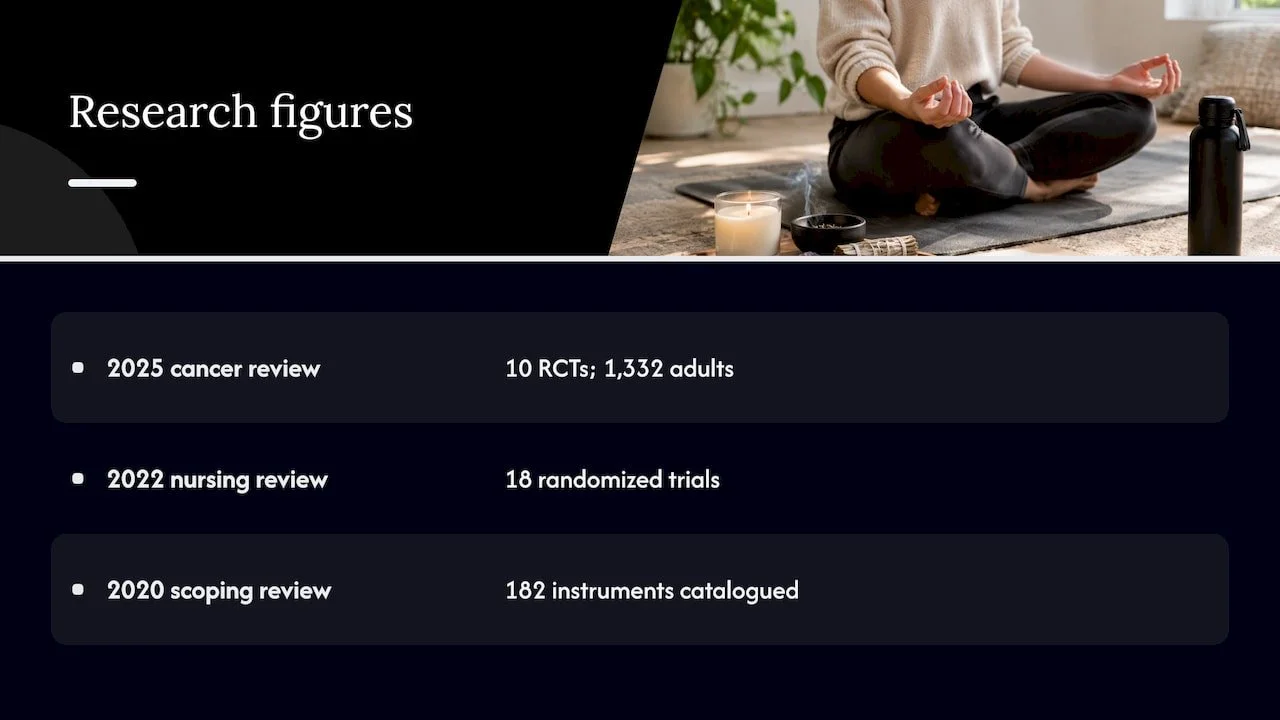
A 2025 systematic review and meta-analysis of 10 randomized controlled trials with 1,332 adults with cancer found improved spiritual well-being and quality of life after spiritual interventions. Those interventions included meaning-centered work, mindfulness, dignity therapy, yoga, spiritual counseling and body-mind-spirit groups.
A 2022 systematic review of nursing-care interventions covering 18 randomized trials reported lower mental health symptoms, greater well-being and higher spirituality compared with controls. The same review cautioned that more than half of the included studies had a high risk of bias and that the interventions and outcomes varied widely.
Massachusetts guidance, written in the context of cancer survivorship, says spiritual practices may help people cope with diagnosis and treatment and may reduce anxiety, stress, anger and depression while increasing inner peace and hope.
What that means for you: there is reasonable evidence that these practices can support well-being, especially for people facing serious illness. There is not strong proof that any single tool works better than another, and much of the research is not about everyday wellness in healthy adults. Part of the problem is definitional. The authors of a 2022 taxonomy project note that religious practices in health interventions have often been poorly defined, which limits replication and evidence synthesis. A 2020 scoping review catalogued 182 spiritual-care instruments and stressed that their validity and cultural acceptability differ.
When a spiritual tool is not enough
Spiritual tools are support, not treatment. If you are living with persistent anxiety, depression, trauma, grief that will not ease or thoughts of self-harm, see a licensed mental health professional or your doctor. In the US you can call or text 988, the Suicide & Crisis Lifeline, at any hour.
Massachusetts recommends discussing your spiritual questions and preferences with your doctor or care team, and checking with them about strenuous forms of yoga if you have a health condition. The 2020 scoping review makes a related point: spiritual needs and distress vary by culture and context, so spiritual care deserves to be handled with professional care. Use your practice alongside that help. Good clinicians often welcome it.
Our perspective: practice you can feel in your body
At Amrita Yoga & Wellness we see the same pattern with new students in Philadelphia. People arrive curious about "the spiritual side" and a little nervous that they will do it wrong. Most of them are not looking for a doctrine. They want a quiet hour, a body that feels better and people who do not make them feel behind.
So we start with the body and the breath. A hot yoga class, a mat Pilates session, a tai chi flow or a breathwork workshop gives your attention somewhere to land. Meditation then becomes less of a performance and more of a natural next step. Our classes run from beginner to advanced, because we have found that safety, clear guidance and a welcoming room matter more than how flexible you are on day one.
We also believe tools should be chosen, not collected. A shelf of crystals will not do the work of ten honest minutes of breathing. Tarot, cards, incense and other ritual objects can be lovely for setting intention, and we offer some of them in our shop and workshops, but we would always put the practice first and the object second.
Finally, community is part of the tool kit. People who attend the same class week after week tend to keep going, and the friendly faces are half the reason. If you are new, come to something low-pressure and see how it feels.
— Juiced
Try spiritual practice with a teacher in Philadelphia
If you would like to try movement and meditation in a room with other people, our class descriptions explain each style and level, and the class schedule shows what is on. Current drop-in prices on our classes and memberships page are $28 for a group class, $11 for a community class and $35 for the Nurtured Beginnings pass. Monthly memberships start at $119 for Earth.
For a deeper ritual, our Ayurvedic therapies include Shirodhara at $90 per session and Abhyanga at $120 per session. If you prefer personal attention, one-to-one yoga or mat Pilates sessions start at $85 per hour on our private sessions page. Prices are as published on our site and can change, so check the page before you book.
FAQ
What are examples of spiritual tools?
Common examples include meditation, prayer, journaling, gratitude, reflecting on your values, spending time in nature, joining a community and helping others. Government and university guides also list yoga, tai chi and qigong. Physical items such as candles, beads or cards are optional supports, not requirements.
What are the spiritual components of wellness?
Spiritual wellness generally involves purpose, meaning, personal values and beliefs, and a sense of connection to something beyond yourself. For some people that is religion, for others nature, community or philosophy. Northwestern University notes it may or may not involve religious activity.
Do I need to be religious to use spiritual wellness tools?
No. Most tools on this page, such as breathwork, walking, journaling and mindful movement, are secular in practice. Choose the ones that fit your own beliefs, and learn respectfully about traditions you borrow from.
Can spiritual tools replace therapy or medical care?
No. Research suggests they can support well-being, but they are not a substitute for treatment. Talk with your doctor or care team about what you are trying, especially if you have a health condition or are considering strenuous yoga.
How long before a spiritual practice helps?
There is no fixed timeline, and research does not give a universal one. Many beginners try a practice for three or four weeks of regular, short sessions before deciding. If it feels forced after that, switch to a different type of tool.
Sources
Creating a Healthier Life: A Step-by-Step Guide to Wellness, SAMHSA
Spiritual Interventions to Improve Quality of Life, 2025 meta-analysis
Efficacy of religious and spiritual interventions in nursing care, 2022
Catalogue of Spiritual Care Instruments, 2020 scoping review