The Amrita Journal
Explore thoughtful stories, practical wellness guidance and inspiring ideas to support your movement, mindfulness and everyday wellbeing at Amrita.
Club Pilates Explained: A Beginner's Complete Guide
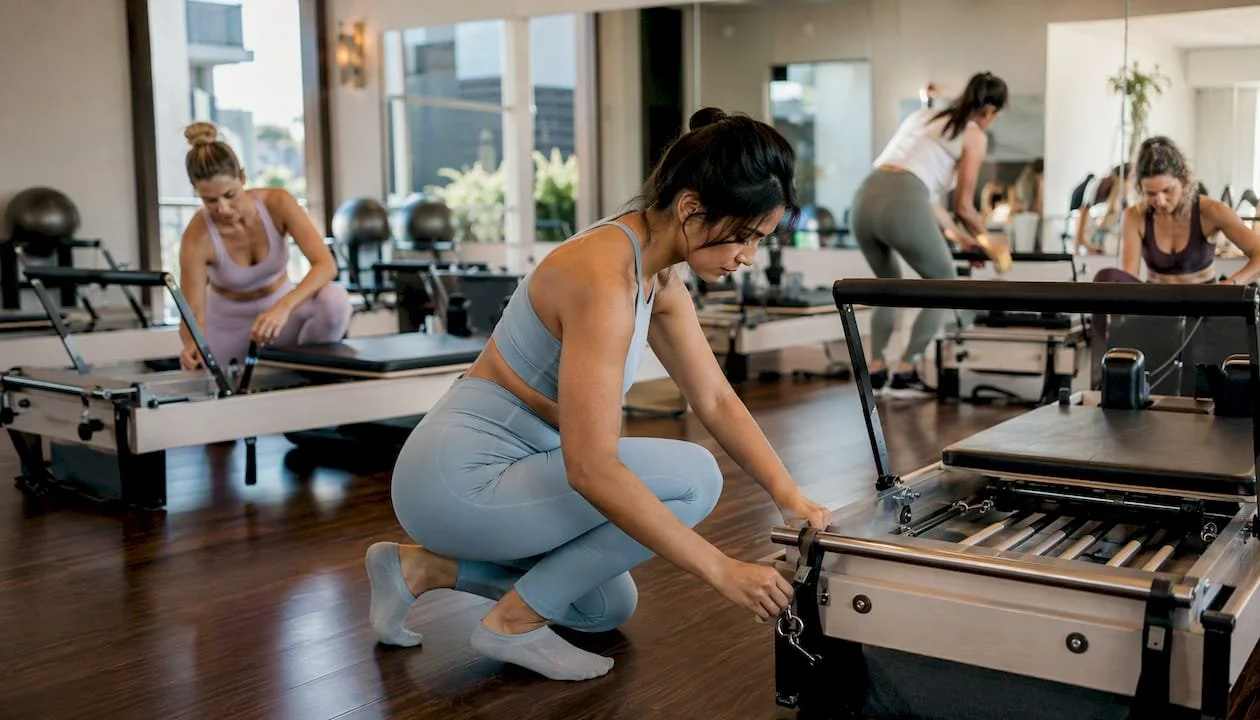
Club Pilates is a nationwide reformer-centered fitness franchise that runs instructor-led group classes using the Reformer as the primary apparatus, supplemented by the EXO-Chair, Springboard, TRX, and other equipment. Owned by Xponential Fitness, it operates as a studio franchise network with locations across the United States. Here is what you get at a glance:
Format: Group classes of roughly 45–50 minutes, reformer-based
Equipment: Balanced Body Allegro 2 Reformers plus complementary apparatus
Class levels: Four progressive levels, nine class formats
Entry point: A 30-minute Intro Reformer session, often complimentary for first-timers
Instructors: Certified with 500+ hours of Pilates training per brand claims
Table of Contents
How are Club Pilates instructors trained and how do they keep classes safe?
Why does Club Pilates rotate between multiple apparatus in one session?
Amrita Yoga & Wellness: a local complement to reformer Pilates
What is Club Pilates and how does the brand work?
Club Pilates launched in 2007 in San Diego, California, and has since grown into one of the largest Pilates franchise chains in the country. Xponential Fitness, the parent company behind several boutique fitness brands, owns and operates the franchise system. Individual studios are franchisee-owned, which means the experience is standardized at the brand level but managed locally.
The positioning is deliberate: reformer Pilates made accessible at a membership price point rather than the private-session rates that traditional Pilates studios typically charge. Group classes keep costs lower while still delivering instructor attention and equipment-based training. Every studio carries a locator on the Club Pilates website so you can find a nearby location, check class schedules, and book an intro session before committing to a membership.
Pro Tip: Before visiting, use the Club Pilates studio locator to confirm which class formats your nearest location offers. Not every studio runs every format on every day.
What classes and equipment will you find at Club Pilates?
The Reformer is the centerpiece. Club Pilates primarily uses Balanced Body Allegro 2 Reformers, chosen for their smooth carriage performance, durability, and compatibility with tower attachments. Balanced Body is the dominant brand in commercial Pilates studios, and franchise standardization is a key reason: every location gets the same machine, which keeps maintenance predictable and the client experience consistent across studios.
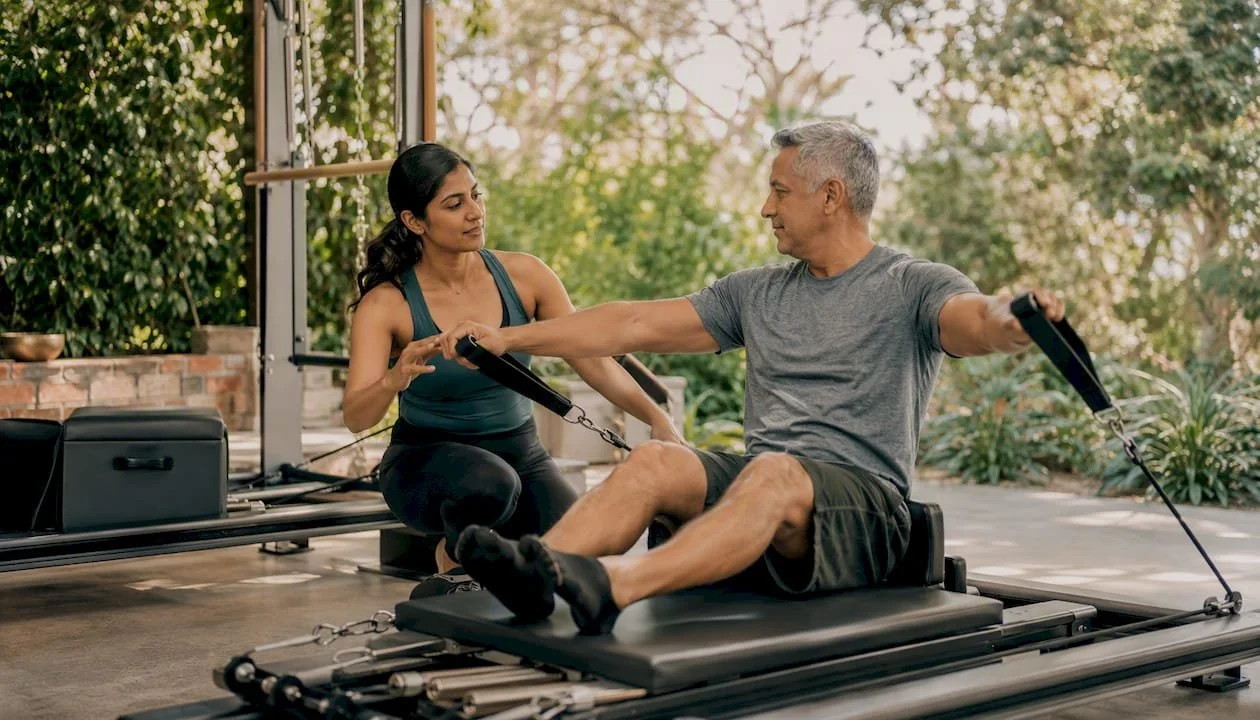
Beyond the Reformer, a typical Club Pilates studio includes the EXO-Chair, Springboard, TRX suspension system, Bosu balance trainer, and foam rollers. Each piece targets something specific. The EXO-Chair challenges single-leg stability and hip strength. The Springboard adds spring-resistance wall work for upper body and spinal mobility. TRX shifts load to bodyweight suspension, raising the core demand. Bosu work tests balance under instability.
Class formats and levels
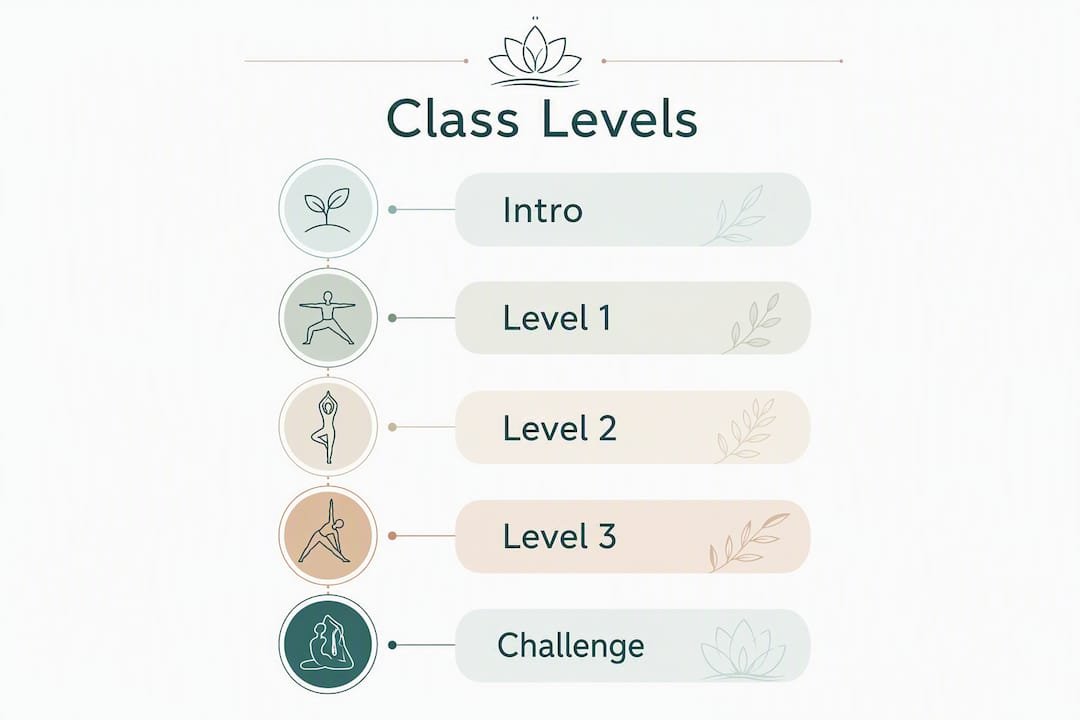
Club Pilates offers nine formats organized across four levels. The level structure matters more than most beginners realize.
| Level | Who it suits | Focus |
|---|---|---|
| Intro | Absolute beginners | Equipment orientation, basic spring settings |
| Level 1 | New clients, foundational movers | Core fundamentals, reformer basics |
| Level 1.5 | Clients with solid Level 1 base | Increased pace, added apparatus |
| Level 2+ | Experienced reformer clients | Complex sequences, multi-apparatus flow |
Core formats include Reformer Flow (the standard group class), CP F.I.T. (higher-intensity conditioning), and dedicated stretch and cardio trampoline options at select studios. The Intro class sits outside the level system and is specifically designed for first-timers.
Pro Tip: Stay at Level 1 longer than you think you need to. Resistance settings and flow transitions on the Reformer rely on muscle memory. Rushing to Level 1.5 before those patterns are automatic is the most common beginner mistake.
What should you expect at your first Club Pilates class?
A first-timer should book the Intro session, a 30-minute Reformer experience where an instructor walks you through the machine, spring resistance settings, and basic movement patterns. It is not a full workout. Think of it as a safety orientation that also gives you a real feel for the apparatus before you step into a group class.
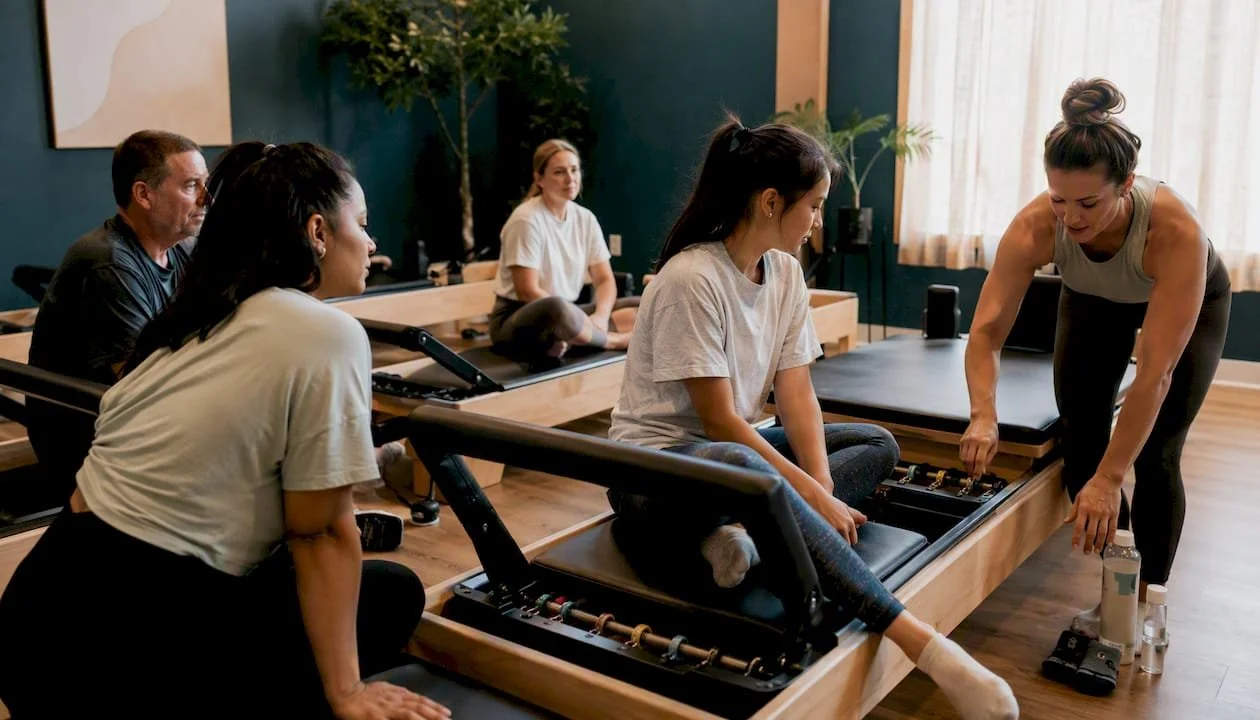
Standard group classes run roughly 50 minutes. The instructor cues the room verbally and demonstrates when needed, moving between clients to check form and offer modifications. Class sizes are kept small enough that you are not anonymous. If you have a knee issue, a shoulder limitation, or you are coming back from an injury, tell the instructor before class. Modifications are a normal part of the session, not an exception.
Wear grip socks (most studios sell them if you forget), arrive five minutes early, and bring water. The studio will assign you a Reformer. You will not spend the whole class on it. Depending on the format, you may rotate to the Springboard or EXO-Chair mid-session.
Pro Tip: Grip socks are required at most Club Pilates locations. Pack a pair or budget a few dollars to buy them at the front desk on your first visit.
Who benefits most from Club Pilates workouts?
Club Pilates describes its method as suitable for a wide range of backgrounds, from sedentary beginners to competitive athletes using it for cross-training. That claim holds up in practice for several specific groups:
Beginners and deconditioned clients: The level system and intro session remove the intimidation factor. You are not expected to know anything walking in.
Athletes cross-training: Reformer work builds the stabilizer muscles that heavy compound lifting tends to neglect, particularly around the hips, shoulders, and spine.
Rehab and injury-prevention clients: The low-impact, spring-assisted resistance is easier on joints than free weights. Pairing reformer sessions with therapeutic exercise principles can support recovery from movement-limiting injuries.
Older adults: Low-impact, balance-focused, and scalable. The EXO-Chair and Springboard work especially well for clients prioritizing functional strength over aesthetics.
Where Club Pilates is not the right fit: if your primary goal is maximal hypertrophy or heavy barbell strength, reformer classes will not get you there. The resistance levels are meaningful but not comparable to progressive overload training. Think of it as a complement to strength work, not a replacement. Exploring different types of Pilates classes can help you figure out where reformer work fits in your broader fitness picture.
How does Club Pilates pricing and membership work?
Pricing is not set at the national level. Individual franchisees set their own rates, so what you pay in Philadelphia will differ from what a studio in Austin charges. That said, the purchase structures are consistent across locations.
Most studios offer three options: a drop-in single class, a class pack (typically 5 or 10 sessions), and a monthly membership with a set number of classes per month. Monthly memberships generally offer the lowest per-class cost. The Intro session is often complimentary or offered at a reduced rate for first-timers.
Before signing anything, ask three specific questions: What is the cancellation policy for the membership? Can you freeze the membership if you travel or get injured? What does a private training session cost if you want one-on-one instruction? The answers vary by studio and are not always posted online.
Pro Tip: Ask about the freeze policy before you sign a monthly membership. Most studios allow a temporary hold, but the terms differ. Knowing this upfront saves a frustrating conversation later.
How are Club Pilates instructors trained and how do they keep classes safe?
Club Pilates references 500+ hours of comprehensive Pilates training as the standard for its instructors, a figure that appears in official brand materials including the studio intro class description. That training depth is above the minimum required by most general fitness certifications, which typically run 20–40 hours.
Key safety and modification practices across Club Pilates studios:
Instructors are trained to offer movement modifications for common injuries and mobility limitations
Class size is kept small to allow instructors to observe and correct form
Equipment is maintained and cleaned between sessions
Level-based class structure prevents beginners from being placed in sequences beyond their current ability
The certified instructor model and progressive class levels are the two structural features that most directly affect your safety as a client. The level system is not just marketing. It is what keeps a Level 1 client from attempting a Reformer sequence that requires hip flexor control they have not yet built.
500+ hours of Pilates training is the instructor standard Club Pilates cites. For context, a standard personal training certification requires roughly 20 hours of study.
Why does Club Pilates rotate between multiple apparatus in one session?
Rotating between the Reformer, EXO-Chair, and Springboard within a single class is not just variety for its own sake. Each apparatus changes the stability demand on your body. The Reformer moves under you. The EXO-Chair requires you to hold position against spring resistance from a seated or standing base. The Springboard anchors you to a wall while you work against horizontal resistance. Switching between them forces your neuromuscular system to recalibrate constantly, which accelerates balance, core stability, and mobility gains compared with staying on one machine the entire session.
For first-timers, this is worth knowing before you walk in. A Reformer Flow class stays primarily on the Reformer. A multi-apparatus format like CP F.I.T. will move you around the room. If you are still learning spring settings and carriage control, start with Reformer Flow before adding the complexity of apparatus rotation.
Pro Tip: If neuromuscular adaptation and postural recovery are your goals, ask the front desk which formats include the most apparatus rotation. That information is usually not on the class description card.
Should you try Club Pilates?
For most people asking this question, yes. Club Pilates is a well-structured entry point into reformer Pilates, with a level system that genuinely protects beginners and enough format variety to stay interesting as you progress. The Intro session removes the financial risk of committing before you know whether you like it.
Try it if: — You are new to Pilates, returning from an injury, cross-training alongside another sport, or looking for low-impact strength work
Key Takeaways
Club Pilates is a reformer-centered franchise offering nine class formats across four levels, with certified instructors and a complimentary Intro session that makes it one of the most accessible entry points into reformer Pilates in the United States.
| Point | Details |
|---|---|
| Reformer is the core apparatus | Club Pilates uses Balanced Body Allegro 2 Reformers, supplemented by EXO-Chair, Springboard, and TRX. |
| Nine formats, four levels | Start at Level 1 or the Intro session; advancing too quickly is the most common beginner mistake. |
| Pricing varies by studio | Drop-in, class packs, and monthly memberships are all available; ask about freeze and cancellation policies locally. |
| Instructors hold 500+ hours of training | That standard is above most general fitness certifications and directly affects class safety. |
| Amitayoga wellness complements reformer work | Amrita Yoga & Wellness in Philadelphia offers mat Pilates, private sessions, and rehab-focused classes that pair well with reformer training. |
A local studio's perspective on where Club Pilates fits
Club Pilates fills a real gap: affordable, equipment-based group Pilates with a clear level structure. For someone who has never touched a Reformer, that structure is genuinely useful. The franchise model means you get a consistent experience regardless of which location you visit, which matters when you are still learning.
Where it gets interesting is what happens after the intro phase. Reformer group classes are excellent for building a movement foundation, but some clients eventually want more individualized attention, particularly those working around an injury or trying to address a specific postural pattern. That is where a smaller studio setting, private instruction, or mat-based work becomes a meaningful complement rather than a replacement.
At Amrita Yoga & Wellness in Philadelphia, the Pilates for beginners approach emphasizes that foundation work. Whether you are just starting out or looking to deepen what you have built in a reformer class, mat and private sessions can address the gaps that group formats naturally leave.
Amrita Yoga & Wellness: a local complement to reformer Pilates
If you are exploring reformer classes and also want a community-focused studio experience in Philadelphia, Amrita Yoga & Wellness offers mat Pilates, private sessions, and wellness workshops that work alongside what you build in a reformer class. The focus is on accessible, personalized practice, whether you are a complete beginner or someone recovering from an injury who needs more individualized guidance than a group class allows.
Posture recovery, core rebuilding, and movement retraining are areas where smaller-group and private instruction genuinely outperform the group format, especially when you are working around a specific limitation. Amrita Yoga & Wellness brings that depth to Philadelphia practitioners. Visit amritayogawellness.com to browse classes and book a session that fits where you are right now.
Useful sources
What Brand of Reformer Does Club Pilates Use — Gymfrog: explains the Balanced Body Allegro 2 selection and commercial studio reasoning
Club Pilates Equipment Suite — Balanced Body: Balanced Body's own page listing equipment used in Club Pilates locations
Recommended
Explore Club Pilates Class Types for Strength and Flexibility
TL;DR:
Pilates offers diverse formats like mat, reformer, tower, and chair to suit various goals and levels.Choosing the right class depends on your fitness goals, experience, injuries, and preferred intensity.Instructor quality, class environment, and your post-class feelings are crucial factors for long-term success.
Choosing the right Pilates class feels straightforward until you're staring at a schedule packed with terms like "reformer flow," "mat foundations," "tower strength," and "fusion cardio." The variety is genuinely exciting, but it can also stop you from booking your first session. The good news: once you understand what each format offers and how it maps to your actual goals, the decision becomes much simpler. This guide breaks down every major Club Pilates class type, compares them honestly, and helps you figure out which one fits where you are right now.
Table of Contents
Key Takeaways
| Point | Details |
|---|---|
| Class type matters | Different Pilates formats target unique needs, so choosing the right type maximizes results. |
| Difficulty varies | Mat classes can be as challenging as reformer sessions, depending on class structure. |
| Equipment influences outcome | Reformer Pilates allows for adjustable resistance, supporting rehab and advanced strength. |
| Try multiple formats | Experimenting with various class types helps you find the best fit for your personal goals. |
How to choose the right Club Pilates class
Now that you recognize the range of class options, let's pinpoint how to narrow your choices to what fits best for you. Before diving into specific formats, it pays to think through a few personal criteria. Jumping straight to "reformer because everyone says so" often leads to frustration, especially if your body or goals need something different.
The four main types of Pilates equipment you'll encounter are:
Mat: A padded floor surface, sometimes with small props like resistance bands, circles, or balls.
Reformer: A sliding carriage on a frame, driven by an adjustable spring system that adds or reduces resistance.
Tower: A vertical frame with wall-mounted springs, straps, and bars attached to a mat or reformer base.
Chair: A compact box-like apparatus with a spring-loaded pedal that challenges balance and core stability in a very focused way.
Before booking, ask yourself five questions:
What's my main fitness goal? Core strength, flexibility, injury rehab, weight management, or athletic cross-training?
What's my experience level? Brand new to Pilates, returning after a break, or already consistent?
Do I have any injuries or movement restrictions? Some formats are more forgiving than others.
How intense do I want the class to feel? Sweaty and challenging, or controlled and methodical?
Do I prefer small group attention or a larger class energy?
Here's something many people don't realize: difficulty varies by instructor, not just equipment. A tough mat class with a skilled instructor can leave you more sore than a beginner reformer session. Keep that in mind as you read through the formats below.
Pro Tip: Try at least two or three different class types before settling on a regular format. Your preferences after class, not just during, are the most reliable guide.
Mat Pilates classes: Foundation and intensity
With your criteria in mind, let's start with the classic mat Pilates class and why it remains a favorite after more than a century of practice. Mat Pilates is the original format Joseph Pilates developed, and it requires no large equipment whatsoever. You work entirely with your bodyweight, floor space, and occasionally small props like foam rollers, magic circles, or light resistance bands.
The benefits are real and well-established. Mat work builds foundational core strength by forcing your muscles to stabilize without external support. It improves flexibility, body awareness, and breathing patterns. Because there's no machine involved, you can practice the same movements at home once you learn them, which makes it genuinely portable.
Mat Pilates is especially good for:
True beginners who want to learn Pilates principles before adding equipment complexity
People on a budget, since mat classes tend to be less expensive
Anyone wanting a home-friendly practice they can maintain between studio visits
Those working on postural awareness and foundational alignment
"Mat classes can sometimes feel more challenging than reformer, depending on instructor cues and props. Without the reformer's spring assistance, your muscles have to work without mechanical support, which can be humbling even for experienced movers."
The honest pros and cons of mat Pilates:
Pros:
Highly accessible, no equipment required
Teaches body awareness from the ground up
Often available at a lower price point
Great entry point for a beginner Pilates guide
Cons:
Less resistance customization than equipment-based classes
Challenge depends heavily on instructor skill
Harder to modify for certain injuries without props
Reformer Pilates: Versatile, scalable strength
After understanding the mat class foundation, explore how equipment like the reformer builds upon and expands Pilates possibilities. The reformer is arguably the most versatile piece of Pilates equipment ever designed. Its sliding carriage moves along a track, controlled by a spring system that lets you increase or decrease resistance with a simple adjustment. That single feature changes everything.
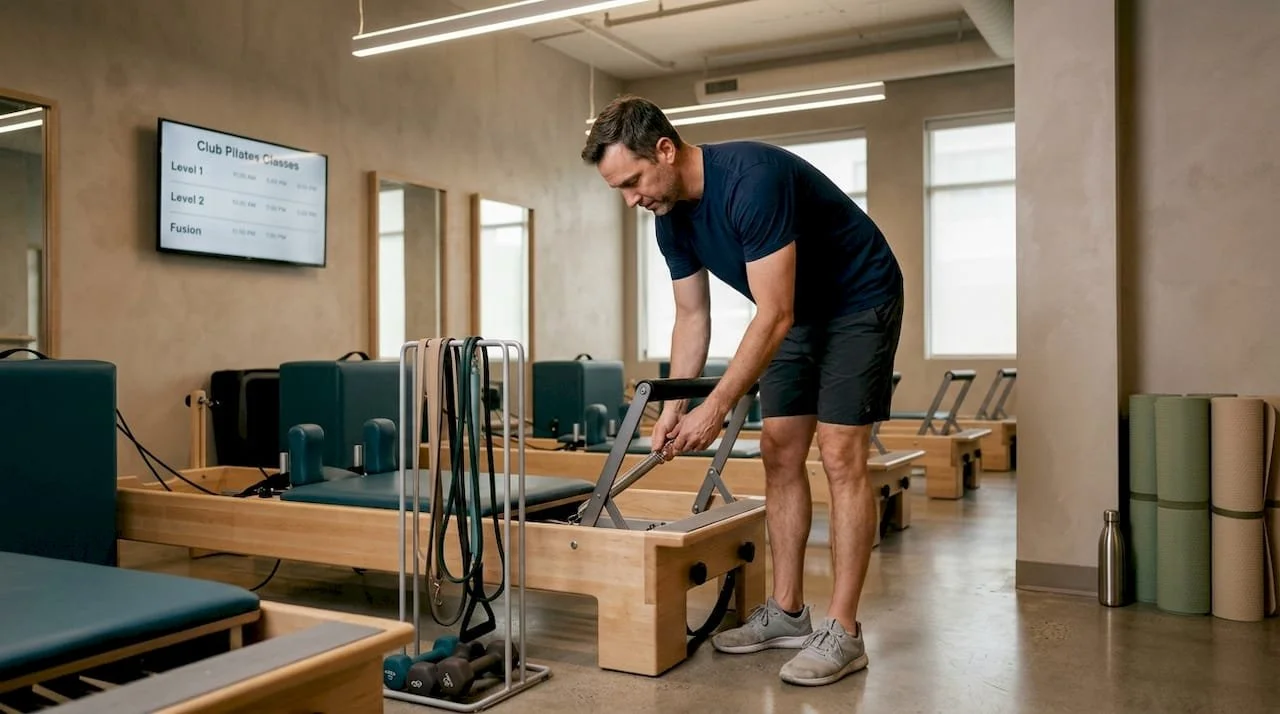
Because resistance is adjustable, reformer Pilates supports everyone from someone recovering from knee surgery to a competitive swimmer building functional strength. The machine guides your movement through a fuller range of motion than most floor exercises allow, which means your muscles work through positions they rarely access in daily life or traditional gym training.
Signature benefits of reformer classes include:
Deeper range of motion through spring-assisted and spring-resisted movement
Scalable resistance for both gentle rehab and serious strength building
Low-impact loading that protects joints while still challenging muscles meaningfully
Full-body integration where arms, legs, and core work together in nearly every exercise
Feedback from the machine that teaches alignment and muscle activation patterns quickly
Understanding the different Pilates Reformer types can also help you understand what to expect when you walk into a studio, since not all reformers feel the same to use.
Reformer classes work best for:
People with specific fitness goals like glute strength, shoulder stability, or spinal mobility
Anyone recovering from an injury who needs supervised, low-impact progression
Intermediate and advanced practitioners who want structured progression
Athletes looking for cross-training that builds stabilizer muscles
Pro Tip: Always start with a "Level 1" or "Intro to Reformer" session before jumping into intermediate classes. The spring tension and footbar adjustments feel intuitive after a few sessions, but they're genuinely confusing on day one.
The reformer Pilates core benefits also extend beyond the studio: the movement patterns you train carry over into better posture, reduced lower back tension, and more efficient movement in sports and everyday activities.
Beyond the basics: Tower, chair, and fusion classes
Once you're familiar with mat and reformer options, consider how specialty classes add variety and target specific skills. These formats aren't just for advanced practitioners. They offer genuinely different experiences that can address specific weaknesses or simply keep your practice from going stale.
Tower Pilates uses a vertical frame mounted to a wall or attached to a reformer, with springs, straps, push-through bars, and roll-down bars. The setup creates resistance from above and below, which creates a training stimulus you can't replicate with mat or reformer alone.
Benefits and considerations of tower classes:
Pros: Excellent for spinal mobility, shoulder flexibility, and balance; spring-loaded resistance challenges the body from new angles; often feels like a deeply therapeutic session
Cons: Equipment is less common than standard reformers; can feel confusing without a proper introduction; requires good body awareness to use safely
Chair Pilates uses a small box-like apparatus with a spring-loaded pedal. It sounds simple. It's not. The chair demands exceptional core stability and coordination because the base of support is small and the lever arms are long. Exercises like the footwork series on the chair will challenge your balance in ways that mat and reformer simply don't.
Benefits and considerations of chair classes:
Pros: Highly effective for core stability and functional leg strength; great for addressing asymmetries between left and right sides; compact equipment means many studios include it as part of circuit-style classes
Cons: High skill demand; not ideal for complete beginners without guidance; can feel frustrating before you develop the proprioception (your body's position sense) it requires
Fusion classes blend elements from reformer, chair, tower, and mat into a single session. These formats are creative, often fast-paced, and require a foundation in at least one Pilates apparatus before they feel manageable. The main advantage is variety: your body doesn't adapt as quickly when the stimulus keeps changing.
Benefits and considerations of fusion formats:
Pros: Prevents training plateaus; keeps class energy high; works more muscle groups in a single session
Cons: Can feel overwhelming without baseline experience; harder to focus on specific weaknesses; quality depends heavily on instructor sequencing skill
Mat vs. reformer: Which Club Pilates class suits your goals?
To help you decide, here's a clear comparison and guidance for picking what fits your needs. It's worth remembering that perceived intensity depends heavily on individual class delivery and instructor style, not just which piece of equipment you're using.
| Feature | Mat Pilates | Reformer Pilates |
|---|---|---|
| Equipment needed | None (small props optional) | Reformer machine |
| Difficulty range | Beginner to advanced | Beginner to advanced |
| Resistance customization | Low (bodyweight only) | High (adjustable springs) |
| Rehab suitability | Moderate | High |
| Home practice friendly | Yes | No |
| Cost per class | Lower | Moderate to higher |
| Best for | Foundations, flexibility, beginners | Strength, rehab, progressive goals |
Based on your goals, here's a quick recommendation guide:
Beginners: Start with mat Pilates to learn the vocabulary of movement, then transition to a reformer Pilates beginner guide once you feel comfortable.
Athletes: Reformer classes, especially intermediate or advanced levels, for targeted stabilizer work.
People with injuries: Reformer, particularly if the studio offers clinical reformer options with instructors trained in rehabilitation.
Flexibility focus: Tower and mat classes tend to emphasize long, lengthening movements.
Strength focus: Reformer and chair classes deliver more resistance-based challenge.
Both mat and reformer Pilates are excellent. Neither is universally "better." The format that gets you consistent, is the format that works.
What most miss when choosing a Club Pilates class
Here's a perspective that doesn't come up often enough: most people spend too much time obsessing over equipment and not nearly enough attention on the instructor and the class community. That's a real mistake.
We've seen it play out repeatedly. Someone tries reformer Pilates with an instructor who gives mechanical cues focused on position only, feels nothing, decides reformer "isn't for them," and walks away. Then they take a mat class with an instructor who cues from sensation and breath, and suddenly they're hooked. Same person. Different instructor. Completely different result.
The perceived difficulty is based on more than equipment: it varies by instructor, studio context, and even class energy. A great instructor makes a basic exercise feel profound. A disengaged one makes an advanced machine feel pointless.
Practically speaking, here's what we'd tell anyone starting their Pilates search:
Pay attention to how you feel an hour after class, not just during. If you feel accomplished, clear-headed, and like your body moved well, that's a green flag for that format and instructor. If you feel confused, embarrassed, or disconnected, that's information too, and it may have nothing to do with the equipment.
Notice the class culture. Is it competitive or encouraging? Do people help each other? Does the instructor remember your name? Small things like this determine whether you'll actually keep showing up, and consistency is the only thing that drives real results in Pilates.
Exploring deeper Pilates reformer types can also shift your perspective from "which machine" to "which experience," which is ultimately the more useful question. Your Pilates journey is long. The best class type is the one you genuinely look forward to attending.
Ready to discover your ideal Pilates class?
You've done the research. Now it's time to feel it in your body.
At Amrita Yoga & Wellness in Philadelphia, we believe the right class isn't just about equipment or intensity levels. It's about finding a space where you feel supported, challenged, and genuinely seen. Whether you're drawn to mat work, curious about the reformer, or ready to explore specialty formats, our studio offers class options designed to meet you exactly where you are. Joining the Karma Yoga Club is a great way to access a curated variety of classes at a value that makes consistent practice sustainable. Come find your format, and let the practice do the rest.
Frequently asked questions
Which Pilates class type is best for beginners?
Beginners often start with mat Pilates or introductory reformer classes to learn foundational techniques in a supportive setting. Mat classes focus on fundamentals that transfer naturally to equipment-based formats later.
Can Pilates reformer classes help with injury recovery?
Reformer Pilates is widely used for rehabilitation because its adjustable resistance supports gentle, guided movement. Studios offering clinical reformer options often work with instructors trained specifically in restorative applications.
Is mat Pilates less challenging than reformer Pilates?
Not always. Some people find mat classes more intense because difficulty depends on instructor style and props rather than the equipment itself.
What's unique about tower or chair Pilates classes?
Tower and chair classes add unique resistance and balance challenges that reformer and mat work simply can't replicate, making them ideal for practitioners who want targeted, specialized training stimulus.
How do I know which Pilates class is right for me?
Consider your fitness goals, experience level, and comfort with equipment, then try two or three formats before committing. How you feel in the hour after class is your most reliable guide.