10–20 Minute Home Routines to Learn Yoga for Beginners and Studio Tips
Start with short, gentle practices lasting a moderate amount of time that pair steady breath with a handful of basic poses like Mountain, Cat-Cow, and Child's Pose. If you want feedback on form, book a class labeled "foundational," "gentle," or "beginner" at a local studio rather than jumping into a fast-paced flow. Either way, the rule that matters most on day one: breathe through your nose without straining, and back off the instant you feel sharp or radiating pain. Soreness is fine. Pain is a stop sign.
TL;DR:
Starting with gentle, short sessions helps establish a habit that promotes steady progress without risking injury, especially when focusing on breath and alignment.
Most beginner classes rely on a common structure of centering, warming, a flow sequence, and cool-down, which remains consistent across studios and home routines.
Core poses like Mountain, Cat-Cow, Downward Dog, and Child's Pose form the foundation, with modifications and props essential for safe practice and progression.
Breath techniques such as diaphragmatic breathing and Ujjayi help deepen focus, improve movement safety, and are integral from the first class onward.
Studio classes labeled "foundational," "gentle," or "beginner" offer the safest environment for learning, with advance booking, early arrival, and instructor guidance enhancing the experience.
Amritayogawellness
Find Your Beginner Yoga Class
Amrita Yoga & Wellness offers accessible yoga classes and studio guidance for beginners and experienced practitioners in Philadelphia.
Table of Contents
What Learning How to Do Yoga Actually Looks Like Week One
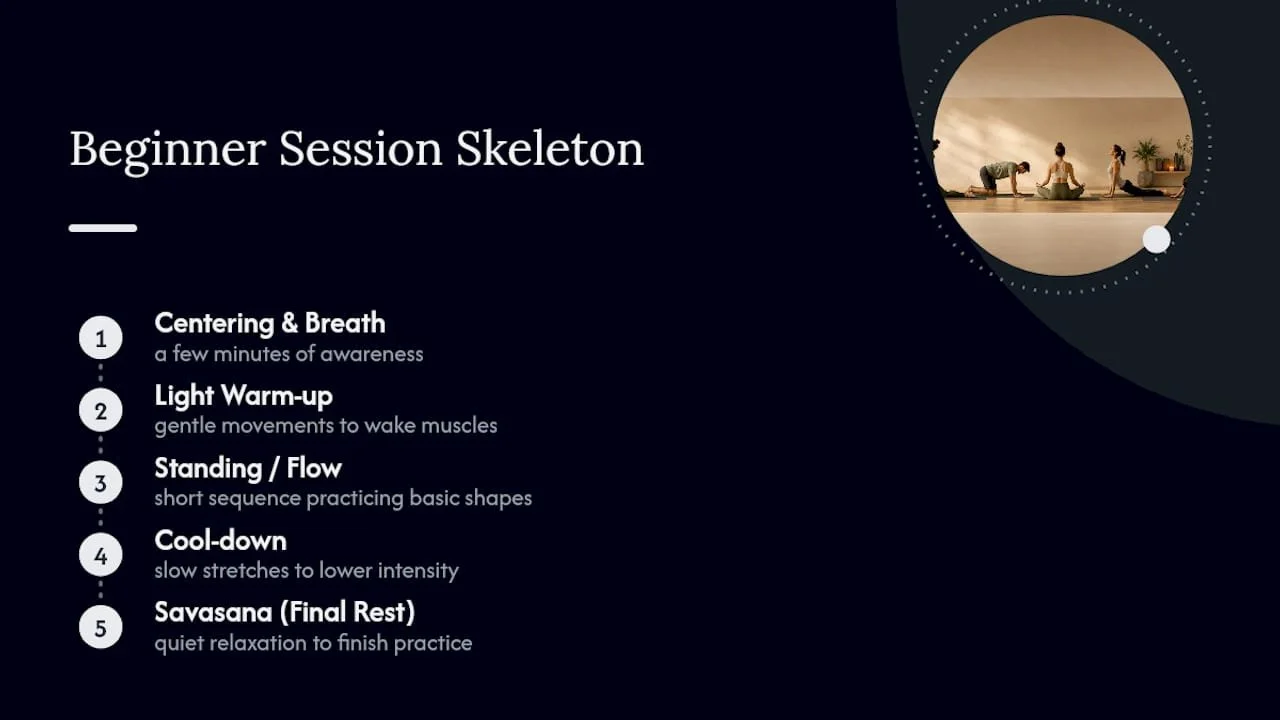
Most beginner classes and home routines follow the same skeleton: a few minutes of centering and breath awareness, a light warm-up, a short standing or flow sequence, a cool-down, and Savasana (final rest) at the end. That shape holds whether you're on a studio floor or your living room rug, and once you recognize it, no class will feel unfamiliar for long.
At home, short sessions are plenty. Consistent, brief practices build the habit without wearing you out, and that consistency matters more than any single long practice. Studio classes typically run moderate durations with warm-up time and hands-on instruction. Aim for a few sessions a week to start. That's frequent enough to notice progress, not so frequent that your body never gets a recovery day.
Not every style suits a first-timer. Hatha, gentle yoga, restorative, and slow flow are built for learning alignment at a pace where you can actually think about what your body is doing. Faster-paced styles like Vinyasa or power flow ask you to transition quickly between poses, which is much easier once the basic shapes are already in your muscle memory. There's no rush to get there.
If you're heading to a studio, know that most operate on a reservation system, so check the schedule and book your spot in a foundational or beginner class ahead of time rather than showing up and hoping for a mat. It also gives the teacher a heads up that a new face is coming, which tends to mean a warmer welcome and a quick check-in before class starts.
Foundational Poses and Two Sequences You Can Do Today
You don't need forty poses to start. You need about a dozen that show up in nearly every beginner class, plus the confidence to modify them. These core shapes form the backbone of most beginner routines:
Mountain Pose (Tadasana): Stand tall, feet hip-width apart, weight even across both feet. This is your reset button between poses.
Cat-Cow: On hands and knees, arch your back on the inhale, round it on the exhale. Great for waking up the spine.
Downward-Facing Dog: Hands and feet on the floor, hips lifted. Bend your knees generously if your hamstrings are tight.
Child's Pose: Kneel and fold forward, arms extended or by your sides. Your rest pose whenever you need one.
Low Lunge: One foot forward, back knee down. Place a folded blanket under the back knee if it's sensitive.
Warrior I and II: Wide stance, front knee bent. Shorten your stance if your balance feels shaky.
Tree Pose: Balance on one foot, other foot resting on your ankle, calf, or thigh. Skip the thigh placement until your balance is solid.
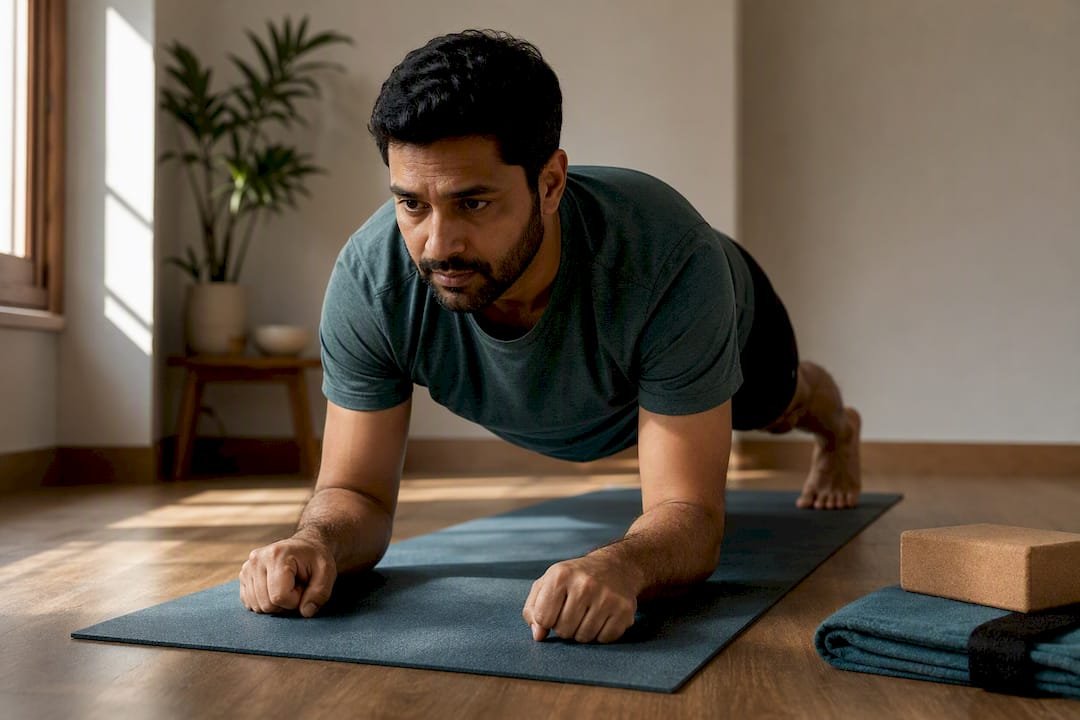
Plank: A straight line from shoulders to heels. Drop to your forearms or knees if your wrists complain.
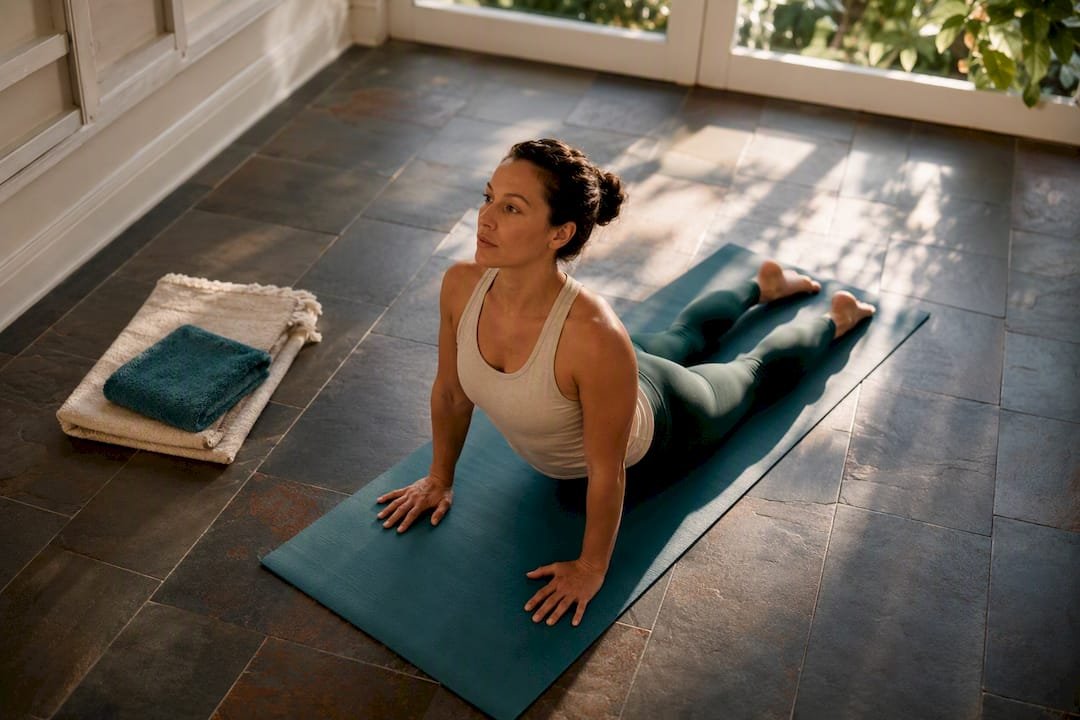
Cobra: Lying face down, press up gently through your hands. Keep the lift small at first.
Bridge Pose: Lying on your back, feet flat, lift your hips. A block under your sacrum turns this into a restful variation.
Seated Forward Fold: Legs extended, hinge from the hips. Bend your knees as much as needed. Flexibility is not a prerequisite here. It's the outcome you're working toward, not the ticket to get in the door.
Savasana: Flat on your back, arms loose, eyes closed. Non-negotiable at the end of every practice.
A 10-minute gentle flow: Mountain Pose (1 minute of breathing) → Cat-Cow (1 minute) → Downward-Facing Dog (1 minute) → Low Lunge, both sides (2 minutes) → Child's Pose (2 minutes) → Seated Forward Fold (1 minute) → Savasana (2 minutes).
A 15 to 20 minute beginner sequence: Add Warrior I and II on both sides, Tree Pose on both sides, and Plank into Cobra before your cool-down stretches and Savasana. Move slowly enough that you can name each body part doing the work.
Common mistakes at this stage: rushing transitions before you've found your breath, locking the knees in standing poses, and comparing your Downward Dog to whatever shape you saw online. Alignment and breath matter far more than how the pose looks, and chasing a visual instead of a feeling is the fastest way to strain something.
Props help more than pride ever will. A yoga block brings the floor closer for tight hamstrings. A strap extends your reach in seated folds. A folded blanket cushions knees and wrists. No blocks or straps at home? A stack of books and a bathrobe belt work just as well.
Breathing Basics That Change Everything
Breath is not a footnote to the poses. It's the thing that makes them yoga instead of stretching. Beginner practice centers on breath awareness, and two techniques cover almost everything you'll need early on.
Diaphragmatic (belly) breathing: Sit or lie down, one hand on your belly. Inhale so your belly rises, exhale so it falls. Your chest should barely move.
Ujjayi breath: A soft, ocean-like sound made by slightly narrowing the back of your throat as you breathe through your nose. It's easier to feel than to explain. Try whispering "ha" with your mouth closed and you'll find the sensation.
Practical drills to link breath and movement:
Sit for 3 to 4 full breath cycles before you move at all. Just notice the inhale and exhale.
In Cat-Cow, inhale as you arch (Cow), exhale as you round (Cat). One breath, one movement.
In a simplified sun salutation, inhale to reach your arms up, exhale to fold forward. Let the breath set the pace, not the other way around.
Never hold your breath through a pose, and never force air in or out so hard that you feel light-headed. If a pose makes you gasp instead of breathe, it's a sign you've gone too far. Ease back.
Setting Up a Home Practice That Actually Sticks
You need less space than you think. A clear patch of floor about the size of a yoga mat, away from furniture corners, is enough. A rug or carpet works if you don't own a mat yet. Skip the fancy gear until you know you'll stick with it: a folded towel substitutes for a blanket, a broomstick or belt substitutes for a strap, and a stack of hardcover books substitutes for a block.
Here's a simple weekly structure to try:
Monday: 10-minute gentle flow (Mountain, Cat-Cow, Downward Dog, Child's Pose, Savasana).
Wednesday: 15-minute sequence adding Low Lunge and Seated Forward Fold.
Friday: 20-minute full sequence including Warrior poses and Tree Pose.
Weekend (optional): A slower 10-minute breath-focused session, no standing poses, just to reset.
Rotate which day gets more standing work and which stays restorative. Your body will tell you which one it needs most that week.
Check in with yourself the same way every time: Is my breath steady? Is this sensation stretch or pain? Am I gripping muscles I don't need to grip? If you can answer those honestly, you're doing the self-assessment that matters more than any pose photo. A short video call with a teacher, or even recording yourself on your phone, can catch alignment issues you can't feel from the inside.
Progress in the first month rarely looks like new flexibility. It looks like steadier breath, less wobble in Tree Pose, and showing up on the days you said you would. Those are the markers worth tracking.
Pro Tip: Anchor your practice to something you already do daily, like right after brushing your teeth or right before your morning coffee. A 10-minute mat session tacked onto an existing habit survives far longer than one floating alone on your calendar.
Finding a Beginner-Friendly Class and Studio Etiquette
Class descriptions are coded, and once you know the code, picking the right one gets easy. Words like "foundational," "gentle," "restorative," and "beginner" signal a slower pace and more instruction. Anything labeled "power," "advanced," or unlabeled by level is a gamble for week one.
A few habits make your first studio visit smoother:
Reserve your spot ahead of time. Most studios run on a booking system, and popular beginner classes fill up.
Arrive 10 to 15 minutes early to set up your mat and get oriented to the room.
Tell the teacher about any injuries or limitations before class starts, not mid-pose.
Ask directly: "What modifications are available for this pose if I need one?"
A good teacher offers variations without being asked twice, and that willingness is one of the clearest signs you're in the right room. A red flag worth noticing: an instructor who pushes everyone toward the same advanced version of a pose regardless of experience level, or offers no alternative when you ask for one. That's a class to skip next time. For help figuring out timing and how often to show up, Amritayogawellness has a scheduling guide and a guide to finding classes nearby worth a look before you book.
Safety Rules Every Beginner Should Know By Heart
One distinction solves most beginner anxiety about getting hurt: soreness that eases within a day or two is normal, but sharp, radiating, or breath-limiting pain is not. If a pose makes you catch your breath or sends a shooting sensation anywhere, come out of it immediately.
The most common beginner mistakes are fixable in seconds. Holding your breath during a hard pose? Consciously exhale and keep breathing. Forcing a deeper stretch than your body wants? Grab a block or bend your knees instead of pushing. Skipping the warm-up because you're short on time? Even 60 seconds of Cat-Cow wakes up the spine enough to prevent strain later in the sequence.
Specific joints need specific care. Sensitive wrists do better in Plank or Downward Dog on the forearms, or in fists instead of flat palms. Cranky knees appreciate a folded blanket underneath in kneeling poses. A tender lower back benefits from bent knees in forward folds and a block under the hips in Bridge Pose.
Medical evidence supports yoga as a generally safe, low-impact practice for most adults when it's approached gradually, but that gradual part matters. If you have a chronic condition, a recent injury, or you're pregnant, check with a doctor before starting, and treat yoga as a complement to medical care rather than a substitute for it.
Pro Tip: Keep a one-line note after each session: how your breath felt, any tight spots, anything that hurt. Three weeks of these notes will tell you more about your progress than any single class ever could.
Why Amritayogawellness and Juiced Back This Approach
This guide reflects how Juiced approaches beginner content across the board: practical steps first, safety cues built in, no assumption that you already know the vocabulary. It draws on established beginner frameworks from yoga and medical sources rather than guesswork, because a first-timer deserves accurate information, not filler.
Amritayogawellness, the Philadelphia studio behind this content, builds its beginner offerings around the same principle. Class descriptions spell out pacing and difficulty upfront, so you're never guessing whether "flow" means gentle or grueling. If you want a low-pressure entry point before committing to a full membership, the studio's free beginner class is built exactly for that first visit.
A Personal Note on Getting Started
Progress in yoga rarely arrives the way you expect. You won't wake up one day suddenly flexible. You'll just notice, three or four weeks in, that Downward Dog doesn't feel like a fight anymore, or that you caught yourself breathing instead of holding your breath during Warrior II. That's the whole game.
Comparing your first month to anyone else's, especially the confident-looking people two mats over, wastes energy you could spend on your own breath. Yoga rewards the people who keep showing up small and steady, not the ones who show up impressive once and burn out.
— Juiced
Ready to Take Your First Class?
Amritayogawellness is the alternative to figuring this out alone from a phone screen: a real room, a real teacher watching your alignment, and modifications offered the moment you need one, not after you've already strained something. That's a meaningful difference from a solo home routine when you're still learning what your body is supposed to feel like in these shapes.
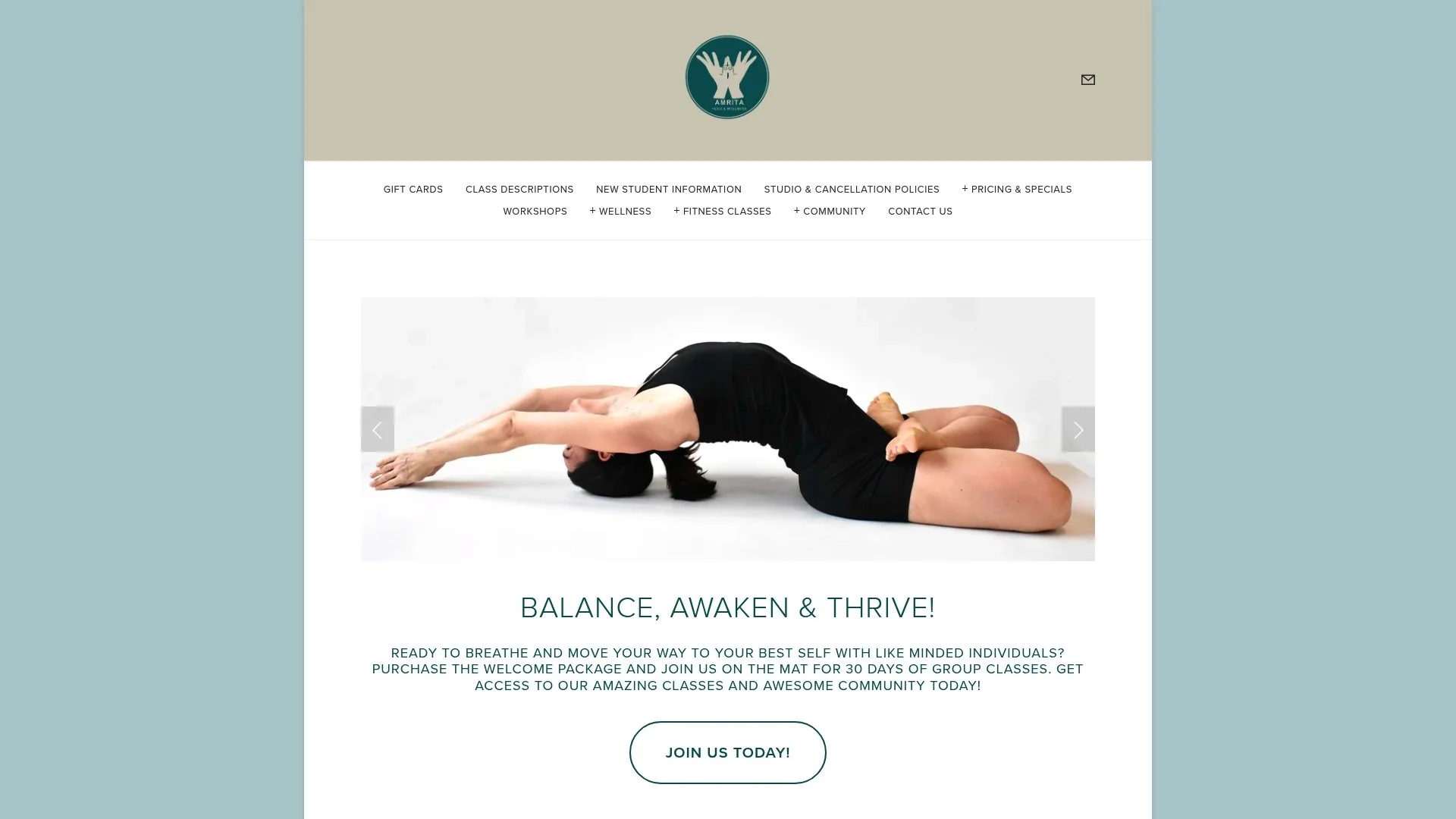
If you're ready to try a class in person, a Group Class Drop In at $28 per session is a low-commitment way to test the format with a teacher who can adjust poses for you on the spot. Want more individual attention before joining a group? A One to One Session starting at $85 per hour lets you move at your own pace with someone watching your form the whole time. New to the studio entirely? Check the new student specials before you book your first visit.
Sources
For deeper detail beyond this guide, consult Yoga Journal for foundational pose breakdowns, Cleveland Clinic for medically grounded beginner postures, and the NCBI-published safety research for evidence on injury prevention.
Yoga for Beginners: The Ultimate Guide to Start Your Practice - Yoga Journal
Yoga for Beginners: 6 Postures To Get Started - Cleveland Clinic
Yoga for Beginners: A Complete Guide to Starting Your Practice - ClassPass Blog
FAQ
How long should a beginner practice yoga each session?
Ten to 20 minutes is enough to build a habit without exhausting a beginner. Studio classes tend to run 45 to 75 minutes since they include more warm-up and instruction time.
Do I need to be flexible to start yoga?
No. Flexibility develops through consistent practice; it isn't a requirement to begin. Beginners are better served focusing on breath and alignment than on how deep a stretch looks.
What yoga style is best for absolute beginners?
Hatha, gentle yoga, restorative, and slow flow are the friendliest starting points because they move at a pace that allows you to learn alignment. Faster styles like Vinyasa are easier once basic poses feel familiar.
How much does a beginner class cost at Amritayogawellness?
A Group Class Drop In costs $28 per session, and a Community Class Drop In is available for $11 per session for a lower-cost entry point.
What should I do if a pose hurts?
Stop immediately if the pain is sharp, radiating, or interrupts your breathing. Mild, fading soreness is normal, but any pain beyond that means the pose needs a modification or a prop.