15 Minute Home Yoga Plan for Adult Beginners, Three Times a Week
Start with a 10 to 20 minute repeatable sequence, three times a week, using props and modifications wherever a pose feels off. That single habit, more as any fancy studio setup, is what separates people who stick with yoga from people who quit in week two. Roll out a mat somewhere quiet, follow the same short sequence for a few weeks, and skip advanced inversions until you have in-person guidance.
TL;DR:
Practicing the same 15-minute sequence three times a week for several weeks helps build strength and confidence through habit and repetition.
Setting up a dedicated, clutter-free space with a rolled-out mat near a wall encourages consistency and minimizes setup obstacles.
Using simple props like books, towels, or blankets can provide support, prevent injury, and improve the effectiveness of poses without requiring expensive equipment.
Recording yourself performing poses weekly reveals misalignments and form issues that feedback from a mirror or app can’t detect.
After consistent practice, consulting a teacher for a private session or joining beginner classes can correct subtle habits and accelerate progress.
Amritayogawellness
Build Confidence With Guided Yoga
Explore yoga classes, workshops, and wellness offerings at Amrita Yoga & Wellness in Philadelphia, for beginners and experienced practitioners.
Table of Contents
How Do You Set Up a Home Yoga Space?
You don't need a dedicated yoga room. You need about 2 by 2 meters of clear floor, a surface that won't wobble under you, and a spot where you can practice with minimal interruptions.
Firm flooring beats a thick, plush carpet for balance work. A cushy rug lets your ankle roll under you in tree pose; hardwood, tile, or a thin rug under your mat gives your feet something honest to push against. If your bedroom, living room corner, or a hallway nook can fit a mat without you bumping into furniture, that's your spot.
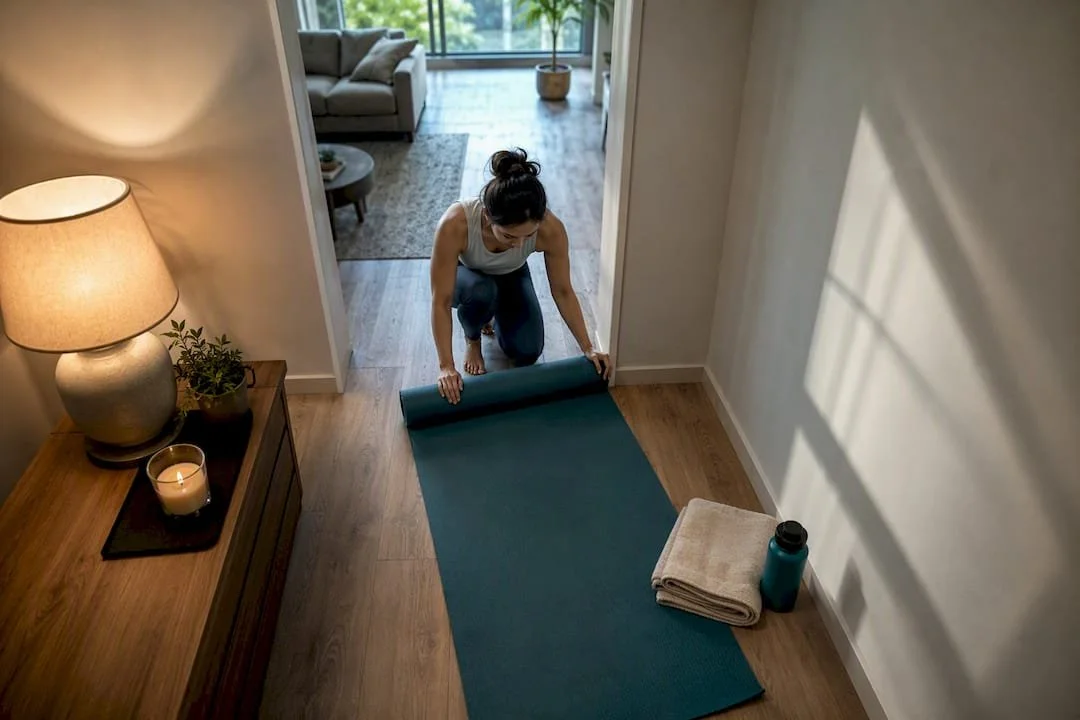
A 15 minute home sequence is far easier to start when your mat is already out. Setup friction, meaning the two minutes it takes to find your mat, clear space, and silence your phone, is often the real reason a planned session never happens.
A few setup habits make a real difference:
Pick a spot near a wall you can use for balance poses like tree pose or standing splits.
Leave your mat rolled out and visible instead of stashed in a closet.
Put your phone on do not disturb before you start, not after you're already distracted.
Give pets or family a heads up so you're not renegotiating your ten minutes halfway through.
Keep the space reserved for practice only, even if it's just a corner you clear for fifteen minutes a day.
Pro Tip: Treat your mat like a doormat, not a suitcase. If it's rolled up in a bag in the closet, you'll skip practice on the days you're tired. If it's already unrolled on the floor, you'll step onto it almost without deciding to.
What Equipment Do You Actually Need to Start Yoga at Home?
A mat is the one thing worth buying before you do anything else. Look for a mat that offers moderate cushioning, enough to protect your knees in low lunge but thin enough that you still feel the floor for balance. Skip the premium mat until you know you'll stick with this for more than a month.
Everything else, you can improvise on day one.
Blocks help you reach the floor in a forward fold or lunge without straining your hamstrings. A stack of hardcover books works nearly as well.
A strap extends your reach in seated forward folds or shoulder stretches. A bathrobe belt or a long towel does the same job.
A blanket cushions your knees in tabletop poses or supports your hips in a seated twist. Any folded towel or throw blanket will do.
Props aren't training wheels you graduate out of. Teachers use blocks and blankets constantly, not because they're weak, but because props protect joints and let a pose work for the body in front of them instead of the body in a photo. If a pose doesn't feel right, reach for a prop immediately rather than pushing deeper into discomfort.
A Simple 15-Minute Beginner Sequence You Can Repeat
This is the sequence to run for your first three or four weeks, unchanged. Repetition, not variety, is what builds the muscle memory and confidence that make yoga feel less awkward each time.
Centering (1 to 2 minutes). Sit cross-legged or on your heels, close your eyes, and breathe slowly through your nose. This is where you set an intention for the session, even something as simple as "I'm here to loosen my shoulders."
Child's pose (1 minute). Knees wide, big toes touching, arms stretched forward. This is your reset pose. Return to it anytime during the sequence if you need a break.
Cat-cow (1 minute, slow and continuous). On hands and knees, arch and round your spine with your breath. Inhale to arch, exhale to round.
Downward dog (30 to 45 seconds). Bend your knees generously if your hamstrings are tight. This isn't a flexibility test.
Mountain pose to standing forward fold (3 rounds). Stand tall, then hinge at the hips and let your torso hang, knees soft.
Low lunge, each side (30 seconds per side). Step one foot back, back knee down, and sink your hips forward gently.
Warrior II, each side (30 seconds per side). Wide stance, arms extended, front knee tracking over the ankle.
Tree pose, each side (20 to 30 seconds per side). Use the wall for support if balance is shaky. That's not a fallback, it's the smart version.
Plank, knees down if needed (20 to 30 seconds). Focus on a straight line from shoulders to knees, not the floor.
Baby cobra (2 rounds, 10 seconds each). Lift just your chest, elbows bent and close to your ribs.
Seated forward fold (1 minute). Legs extended, reach toward your feet without forcing it.
Supine twist, each side (30 seconds per side). Lying on your back, drop bent knees to one side, then the other.
Savasana (2 to 5 minutes). Lie flat, arms loose at your sides, and do nothing at all.
Run through this once and you're close to 15 minutes. Repeat any section that felt good, or shorten the standing series on days you're pressed for time.
How Often Should Beginners Practice Yoga at Home?
Frequency beats duration. A 10 to 20 minute session done three or more times a week builds flexibility and lowers stress more reliably than one long, exhausting Sunday session followed by six days of nothing.
A realistic first month looks like this:
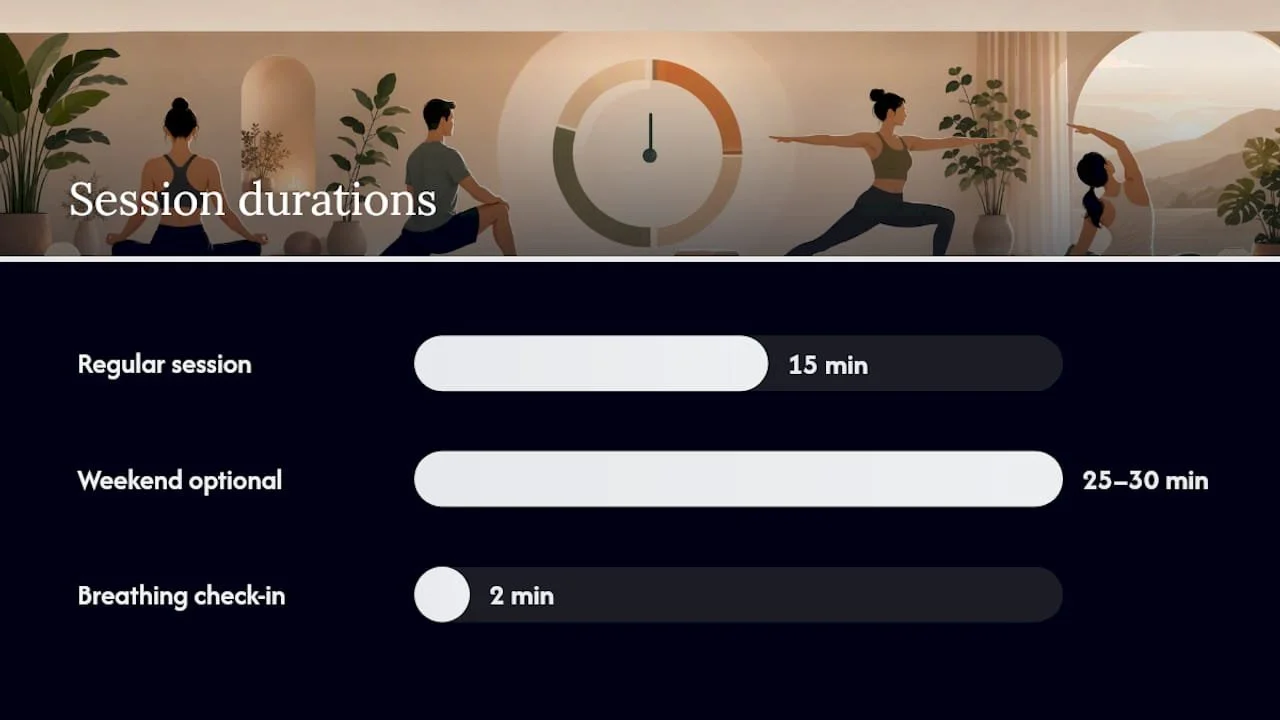
Monday, Wednesday, Friday: the 15 minute sequence above, same order, same poses.
One weekend day (optional): a slightly longer session, 25 to 30 minutes, or a beginner-friendly live class if one is available near you.
Everything else: rest, or a short two minute breathing check-in if you want to stay connected to the habit without a full session.
After three or four weeks of that same sequence, start scaling gradually. Add five to ten minutes to your existing routine, or introduce one new pose at a time rather than overhauling the whole sequence. Fitting short sessions into a packed schedule gets easier once the sequence itself stops requiring thought.
Habit researchers and yoga teachers agree on one trick that works better than willpower: anchor practice to something you already do daily, as outlined in the New Mom Self-Care Checklist: Your Postpartum Guide. Right after you brew coffee, right before your evening shower, right after you close your laptop for the day. The anchor matters more than the exact time of day.
Alignment Basics and When to Use a Modification
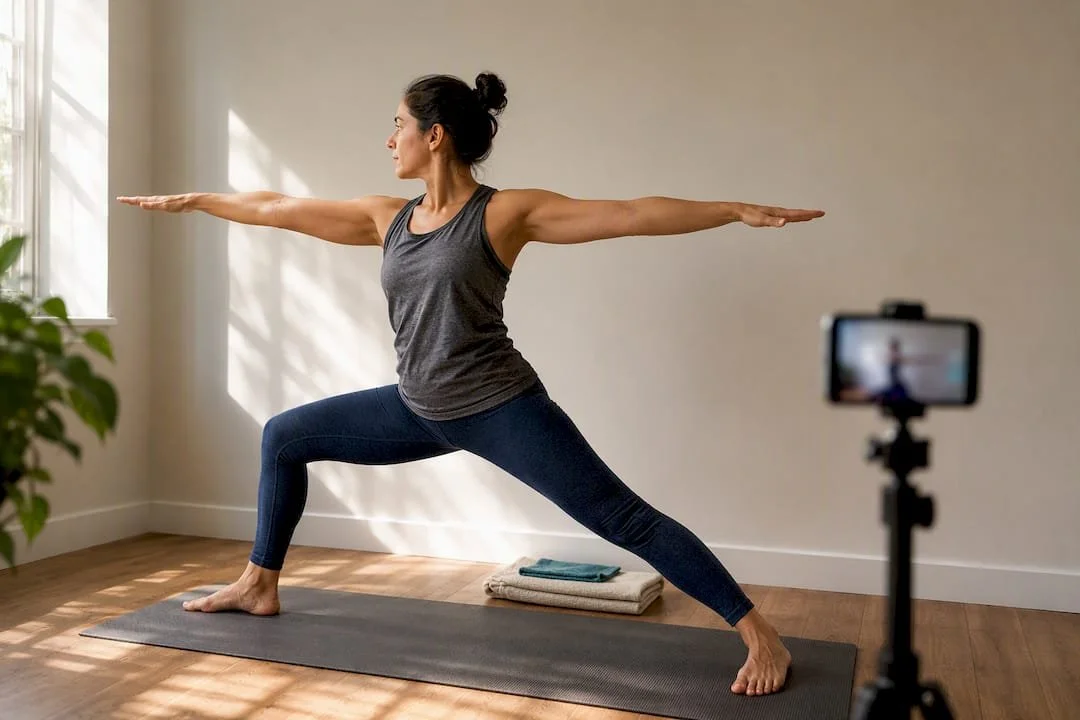
Three simple checkpoints cover most beginner poses: ears stacked over shoulders, knees tracking over ankles (not collapsing inward), and a neutral spine rather than an over-arched or slumped one. Check these in a mirror or a phone video during your first few weeks, since it's genuinely hard to feel misalignment from the inside.
There's a real difference between a stretch and a warning sign. Muscle tension that eases as you breathe into it is normal. Sharp, pinching, or joint-specific pain is not, and it means back off or grab a prop immediately.
If your hamstrings scream in a forward fold, bend your knees generously.
If your wrists ache in plank or downward dog, drop to your forearms.
If your shoulder catches in a twist, shrink the range of motion.
If a knee complains in low lunge, add a folded blanket under it.
Beginners should also stay away from unsupported inversions and deep backbends without guidance, since these advanced poses carry real injury risk when attempted alone before you understand proper setup. If a pose consistently feels wrong even with modifications, that's a signal to get in-person feedback rather than push through it solo.
Pro Tip: Film yourself doing warrior II or tree pose once a week. You'll often catch a collapsed knee or a leaning torso on video that you couldn't feel in the moment.
Beginner Mistakes That Derail a Home Practice
Most people don't quit yoga because it's too hard. They quit because of a handful of avoidable setup mistakes.
Starting with 45 minute sessions. It sounds ambitious, but it's also exhausting and easy to skip on a busy day. Shorten to 15 minutes and repeat it more often instead.
Changing the sequence every time. Novelty feels productive, but sticking with one sequence for several weeks builds the familiarity that makes poses start to feel natural.
Skipping the breath and jumping straight into poses. Two minutes of centering isn't filler. It's what tells your nervous system this is different from checking email.
Ignoring pain because "yoga is supposed to be uncomfortable." Discomfort from stretching, yes. Sharp joint pain, no. If it persists past a week of modifications, get in-person feedback before continuing on your own.
How Amrita Yoga & Wellness Supports New Practitioners
Home practice covers a lot of ground, but it has limits. If a pose still feels wrong after a few weeks of modifications, or you're managing a chronic issue like a stiff lower back or a recovering shoulder, a private session or beginner-focused class gives you something video and articles can't: a teacher watching your actual body in real time.
Yoga studios in Philadelphia often offer beginner-friendly classes alongside more advanced styles like hot yoga and aerial yoga, plus private sessions built around specific goals or limitations. Combining occasional studio time with your home routine tends to speed up progress. A single class can catch an alignment habit that would otherwise take months to notice on your own, and you bring that correction straight back into your next home session.
What a Month of Home Practice Actually Looks Like
Nobody's flexibility transforms in four weeks, and if a program promises that, be skeptical. What actually changes is smaller and more useful: your hips complain less in low lunge, your breath stops catching in forward folds, and you stop dreading the two minutes it takes to unroll your mat.
That's the realistic version of "progress," and it's worth trusting even when it doesn't look dramatic. Keep sessions short. Keep the sequence the same longer than feels necessary. The boredom of repetition is doing more for you than novelty would.
Once you hit that one month mark, consider booking a single in-person class or private session, not because your home practice failed, but because a teacher's eyes on your alignment can save you months of reinforcing a small habit that isn't quite right.
— Juiced
Ready to Take Your Practice Off the Mat and Into a Studio?
Home practice builds the habit. A studio class or private session at Amrita Yoga & Wellness builds the correction and community that a solo routine can't offer on its own. If you've been running the same 15 minute sequence for a few weeks and want a teacher's eyes on your alignment, or you're curious about styles like hot yoga or aerial yoga that genuinely require in-person instruction, that's the natural next step.
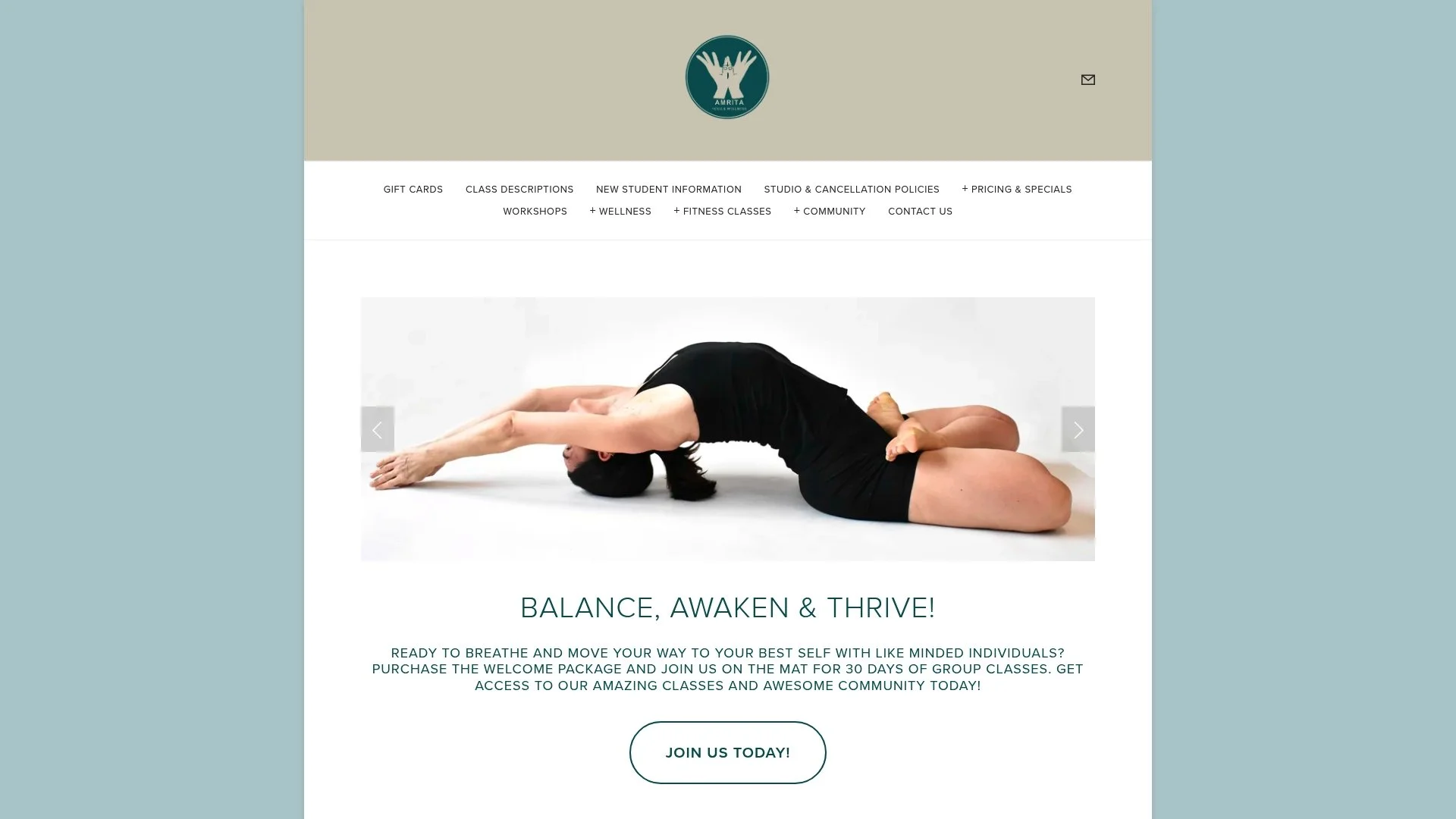
Some yoga studios also host wellness workshops beyond the mat, including tarot readings for readers who want to pair their physical practice with a little reflection and intention-setting. Booking a single class, private session, or workshop is a low-pressure way to see how in-person guidance sharpens what you've already started building at home.
Where This Advice Comes From
Cleveland Clinic's beginner pose guide for foundational poses and modification cues.
Cleveland Clinic's home practice safety guidance on avoiding advanced poses alone.
International Yoga Conference's setup and sequence guide for space setup and frequency recommendations.
Yoga International's beginner's guide for centering and sequence repetition advice.
Sources
FAQ
How Long Should a Beginner Practice Yoga at Home?
Aim for sessions lasting about 10 to 20 minutes, practiced regularly each week. Consistent short sessions build more flexibility and stress relief than occasional long ones.
Do I Need a Yoga Mat to Start Practicing at Home?
A mat is the one piece of gear worth buying, ideally of moderate thickness to cushion without losing stability in standing poses.
What Yoga Poses Should Beginners Learn First?
Start with mountain pose, tree pose, forward fold, a modified plank, cobra, and child's pose, since these cover balance, strength, and flexibility without requiring advanced flexibility.
Is It Safe to Do Yoga Alone at Home?
Most beginner poses are safe to practice alone with proper modifications, but unsupported inversions and deep backbends should wait until you've had in-person instruction.
How Do I Stay Motivated to Practice Yoga at Home?
Keep the same short sequence for three to four weeks, leave your mat visible instead of packed away, and anchor practice to an existing daily habit like your morning coffee.
When Should I Take an In-Person Yoga Class Instead of Practicing Alone?
If a pose still feels off after modifications, or you want alignment feedback, a beginner class or private session at a local yoga studio can fill that gap.