Learn 3–5 Words Before Class: Yoga Terms for Beginners
This glossary covers the yoga terms you'll actually hear in a beginner class, translated into plain, usable English. Learn three to five words before your first session, lean on props and modifications whenever a pose feels off, and treat the rest as vocabulary you'll pick up naturally. If you'd rather learn these terms in person, beginner sessions are available where an instructor walks you through them live.
TL;DR:
Most beginner classes emphasize core terms like asana, pranayama, and savasana, which can be learned quickly through basic practice and familiarization.
Learning Sanskrit names involves recognizing common prefixes and suffixes, making unfamiliar pose names easier to decode with practice.
Props, such as blocks and straps, are accessible tools used to improve alignment and support, not signs of inability or failure.
Starting with slower styles like Hatha or Restorative helps beginners build confidence in alignment and vocabulary before trying faster-paced classes.
Focusing on a few key terms each week and practicing with props and modifications enhances safety, confidence, and understanding in yoga sessions.
Amritayogawellness
Build Confidence In Your First Class
Explore yoga, Pilates, barre, tai chi, massage therapy, workshops, and retreats through Amrita Yoga & Wellness in Philadelphia.
Explore Amrita Yoga & Wellness
Table of Contents
What Do Common Yoga Terms Mean for Beginners?
You don't need to memorize Sanskrit before your first class. You need about twenty words that show up over and over, and a sense of when each one will come up so it doesn't catch you off guard. Plain-English breakdowns of these terms consistently show up in beginner glossaries, and the core list barely changes from studio to studio.
Asana: A pose or posture. Your teacher might say "come into your asana" or just name the pose directly.
Pranayama: Breathing exercises. Often taught at the start or end of class, sometimes as its own segment.
Vinyasa: A flow that links movement to breath, one breath per motion. You'll hear it as both a style name and an instruction ("vinyasa here" means flow through a mini sequence).
Savasana: Final relaxation pose, lying flat on your back. This closes almost every class, no exceptions.
Namaste: A closing greeting, often paired with palms pressed together at the heart. It signals class is wrapping up.
Drishti: A fixed focal point for your eyes, used to steady balance poses like Tree or Warrior III.
Mantra: A word or phrase repeated silently or aloud, sometimes used during meditation portions.
Mudra: A hand gesture, often used in seated meditation or pranayama work.
Bandha: An internal muscular lock or engagement, most commonly the core (uddiyana bandha) in flow classes.
Prana: Life force or breath energy. You'll hear it referenced in pranayama instruction.
Modification: A simpler or supported version of a pose. Teachers offer these constantly, and taking one is never a step down.
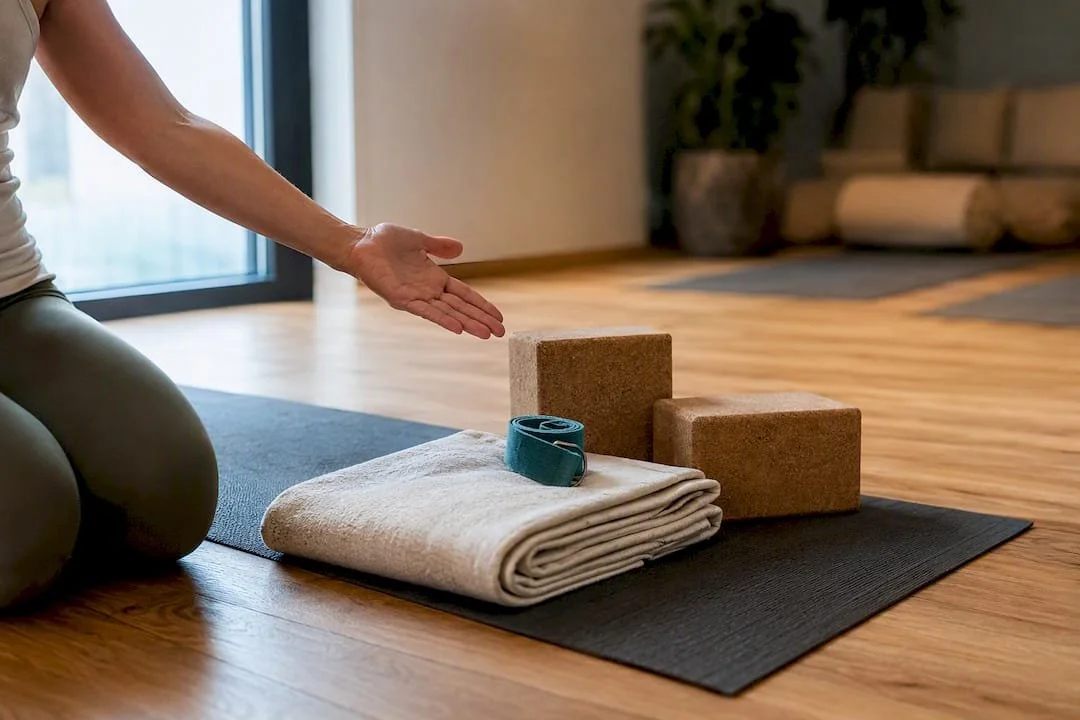
Props: Blocks, straps, bolsters, and blankets used to support your body in a pose.
Flow: A sequence of poses linked together, usually moving with breath.
Hold: Staying in a pose for a set number of breaths instead of moving through it.
Transition: The movement between two poses, like stepping from Downward Dog into a lunge.
Alignment: How your joints and bones stack in a pose, aimed at both safety and effectiveness.
Inhale/Exhale: Breath cues tied directly to movement. Teachers will say "inhale, lift" or "exhale, fold" constantly.
Chaturanga: A low plank pose, common in Vinyasa transitions between Downward Dog and Cobra or Upward Dog.
Om: A chanted sound sometimes used to open or close a class, symbolizing unity or grounding.
How Are Sanskrit Pose Names Built?
Sanskrit pose names look intimidating until you notice they're built from a small, repeating set of parts. Once you learn those parts, unfamiliar names stop being a wall and start being readable, the same way knowing "photo" and "graph" helps you decode new English words.
Most pose names end in asana (pose) and start with a descriptive prefix. Common prefixes include adho (downward), mukha (face), supta (reclined), urdhva (upward), vrksa (tree), vira (hero or warrior), and trikon (triangle).
Adho Mukha Svanasana breaks into adho (downward) + mukha (face) + svana (dog) + asana (pose): Downward-Facing Dog.
Tadasana is tada (mountain) + asana: Mountain Pose.
Uttanasana is ut (intense) + tan (stretch) + asana: Standing Forward Fold.
Balasana is bala (child) + asana: Child's Pose.
Virabhadrasana is Virabhadra, a warrior figure from Hindu mythology, + asana: Warrior Pose.
Trikonasana is trikon (triangle) + asana: Triangle Pose.
Pro Tip: Say the name in syllables and don't sweat the accent. Teachers care that you're trying, not that you sound fluent in Sanskrit.
Which Beginner Poses Should You Know First?
Ten poses cover most of what a beginner class throws at you. Each one below pairs its English and Sanskrit name with a single alignment cue and one easy modification, drawing on the same short, repeatable sequences Kaiser Permanente recommends for people learning at home.
Mountain (Tadasana): Stand tall, weight even across both feet. Modification: stand with feet hip-width apart for more stability.
Downward-Facing Dog (Adho Mukha Svanasana): Press hands flat, lift hips up and back. Modification: bend your knees generously to protect tight hamstrings.
Child's Pose (Balasana): Hips reach back toward heels, arms extended forward. Modification: place a bolster under your torso for support.
Plank (Phalakasana): Keep hips level with shoulders, don't let them sag. Modification: drop to your forearms or knees.
Cobra (Bhujangasana): Lift your chest using back strength, not just your arms. Modification: keep elbows bent and stay low.
Warrior II (Virabhadrasana II): Front knee tracks over the front ankle. Modification: shorten your stance if balance feels shaky.
Tree (Vrikshasana): Fix your gaze on one point to steady balance. Modification: keep your lifted foot's toes on the floor for support.
Forward Fold (Uttanasana): Bend from the hips, not the lower back. Modification: bend your knees or rest hands on blocks.
Bridge (Setu Bandha Sarvangasana): Press feet flat, lift hips without straining the neck. Modification: place a block under your sacrum.
Savasana: Let your whole body go heavy on the floor. Modification: place a blanket under your head or knees for comfort.
Props aren't a fallback for people who "can't do yoga properly." Cleveland Clinic lists blocks, straps, and bolsters as standard tools for making poses accessible and improving alignment, regardless of experience level.
Why Do Beginners Use Yoga Props?
Blocks, straps, bolsters, and blankets exist to close the gap between where your body is right now and where a pose wants it to go. That gap is normal, not a failure, and reaching for a prop is often the more advanced move because it keeps your alignment honest instead of forcing a stretch you're not ready for.
Blocks: Place one under your hands in a forward fold if the floor feels miles away.
Straps: Loop one around your foot in a seated forward fold to extend your reach without rounding your back.
Bolsters: Tuck one under your torso or hips in restorative poses to let tight areas soften gradually.
Blankets: Fold one under your knees in kneeling poses or under your head in Savasana for comfort.
Pro Tip: If a pose causes sharp pain anywhere, stop immediately and ask for a chair-supported variation. Sharp pain is your body's way of overriding the instruction, and no cue overrides that.
Which Yoga Style Should Beginners Try First?
Not every style moves at the same pace, and picking the wrong one on day one can sour you on yoga entirely when the real issue was just a mismatch.
Hatha: Slower pace, poses held longer. A gentle entry point for learning alignment without rushing.
Vinyasa: Breath-linked flow, faster pace. Fun once you know the basics, overwhelming before you do.
Restorative: Long, prop-supported holds designed to calm the nervous system. Excellent for stress or poor sleep.
Yin: Passive stretches held for minutes at a time, targeting connective tissue rather than muscle.
Iyengar: Precision-focused, heavy on props and alignment detail. Great for beginners who want to understand the "why" behind each cue.
Start with Hatha, Restorative, or Iyengar. Save hot yoga and fast Vinyasa for once your body knows the shapes, since heat and speed both raise the injury stakes for unfamiliar poses. Amrita Yoga & Wellness's guide to types of yoga breaks down more of these style differences if you want a fuller picture before booking.
How Can You Learn Yoga Vocabulary Without Flashcards?
You'll absorb this vocabulary faster in a room than from a screen, but a small routine speeds it up either way.
Pick three to five terms per week instead of trying to learn all twenty at once.
Jot down one new word after each class while it's still fresh.
Repeat the term silently to yourself the next time you hear it in class.
Use a prop the moment a cue mentions one, so the word and the action link together.
Practice a ten-minute sequence at home using essential beginner poses to reinforce both the shapes and their names.
How Amrita Yoga & Wellness Teaches Beginner Vocabulary
Vocabulary is built into the pose itself, naming both the English and Sanskrit terms as instructors cue alignment and offer modifications. Beginners get props from the first class, not as a last resort, and a community focus means questions about a term or a pose are always welcome, mid class or after.
Ready to Practice These Terms in Person?
A beginner class does three things a glossary can't: it puts a real body in front of you correcting your alignment, it shows you exactly when to grab a block, and it lets you hear these terms cued in real time until they stop sounding foreign.
Beginner-friendly sessions run across styles, from slower Hatha classes to prop-supported Restorative work, so you can match the pace to how new this all feels. If pelvic or joint concerns are part of your picture, this guide to pelvic girdle pain covers safe movement adjustments worth reading before you step on the mat. For something outside the physical practice entirely, the studio's tarot reading sessions are a low-pressure way to get familiar with the space before your first class. Check the current class schedule at Amrita Yoga & Wellness and book a beginner session to start putting these words into motion.
Where Can You Learn More About Yoga Terms?
Cleveland Clinic: safety context for props and modifications.
Yoga: plain-English breakdowns of Sanskrit terms.
Kaiser Permanente: beginner pose demos and sequences.
YogaBasics: deeper Sanskrit vocabulary reference.
Why This Beginner Glossary Skips the Jargon Overload
Most yoga glossaries try to teach you fifty terms at once, and that's backwards. The instinct to be thorough actually works against beginners, because a wall of Sanskrit is exactly what makes new students freeze up mid class instead of following the cue.
The smarter approach, and the one this glossary follows, is triage: learn the core yoga words that show up in nearly every class before touching the rarer ones. Everything else, including the pose-name prefixes, you can pick up by pattern recognition once you've got the core words locked in. That's also why prop use and modification language matter as much as pose names. A student who knows what "modification" means and reaches for a block without hesitation is going to have a better, safer class than one who's memorized ten Sanskrit terms but freezes when their hamstrings won't cooperate. Vocabulary is a tool for following instruction safely, not a fluency test.
— Juiced
Sources
FAQ
What Are the Most Important Yoga Terms for Beginners?
Asana, vinyasa, savasana, namaste, drishti, and pranayama cover most of what you'll hear in a first class. Learn those six before worrying about anything else.
How Do You Pronounce Sanskrit Yoga Pose Names?
Break the word into its parts (like adho, mukha, and asana) and say each syllable slowly. Teachers accept approximations, so precision matters far less than trying.
What's the Difference Between Asana and Vinyasa?
Asana refers to an individual pose or posture, while vinyasa describes a flowing sequence that links multiple poses together with breath.
Do Beginners Need to Use Yoga Props?
Yes. Blocks, straps, bolsters, and blankets make poses more accessible and help protect your wrists, hamstrings, and lower back from strain, according to Cleveland Clinic.
Which Yoga Style Is Best for a First Class?
Hatha, Restorative, or Iyengar classes suit most beginners best, since they move slower and give you time to absorb both alignment and vocabulary before speeding things up.