Power Flow Yoga Explained: What Beginners Need to Know
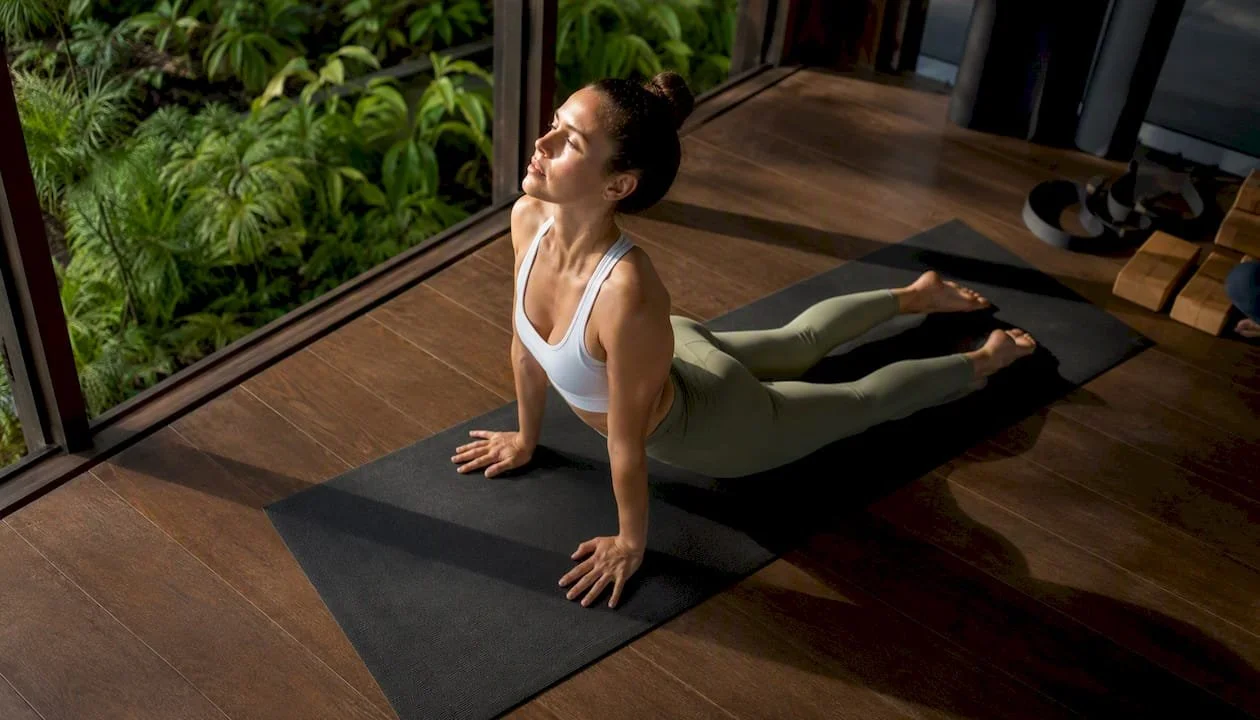
Power flow yoga is a vigorous, breath-synchronized practice that links postures in continuous movement sequences, building cardiovascular fitness and muscular strength simultaneously. Think of it as the athletic cousin of a standard yoga class: you rarely stop moving, your heart rate climbs, and the breath drives every transition. According to Asheville Yoga Center, power flow favors continuous movement over long static holds, which is what separates it from most other yoga styles at a glance.
Who benefits most: people who want a workout and a mindfulness practice in one session. The practice targets strength, endurance, and what experienced teachers call "moving meditation." At Amrita Yoga & Wellness in Philadelphia, power flow classes draw athletes, fitness-minded practitioners, and anyone who finds slower classes too passive.
Three things to know before you read further:
Intensity: moderate to high. Expect a sustained elevated heart rate, not a gentle stretch session.
Pacing: transitions happen quickly, often on the inhale or exhale, with minimal rest between poses.
Beginners: yes, you can join, but modifications matter. Starting with shorter sessions and communicating with your instructor makes a real difference.
Table of Contents
How does power flow compare to Vinyasa, Ashtanga, Hatha, and Slow Flow?
A teacher's honest perspective on what power flow actually demands
Amrita Yoga & Wellness offers guided power flow in Philadelphia
What is power flow yoga, and what defines it as a style?
Power flow yoga is not a single codified lineage the way Ashtanga is. It is a descriptive category, which means two instructors can teach "power flow" and produce noticeably different classes while sharing the same core principles: breath-linked movement, continuous sequencing, and an emphasis on aerobic conditioning.
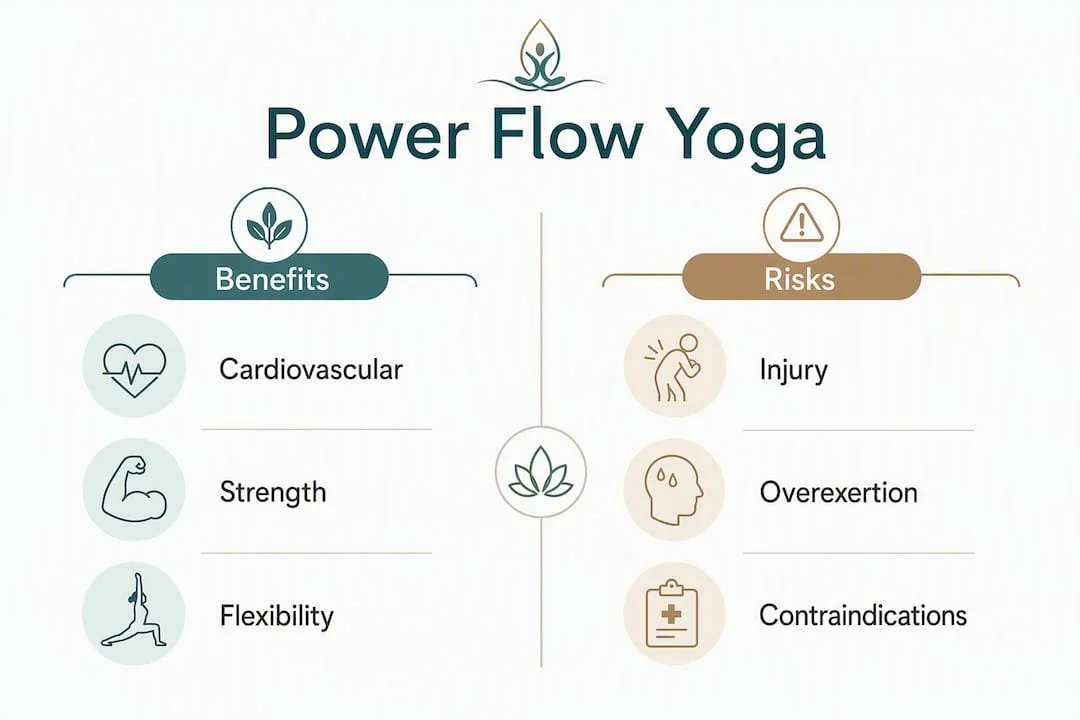
The foundational mechanic is the vinyasa principle: each movement is tied to either an inhale or an exhale. You move through a chaturanga (a low push-up transition) on the exhale, rise into upward-facing dog on the inhale, and press back to downward dog on the exhale. That rhythm repeats, building internal heat and cardiovascular load. Peloton's yoga resource describes power yoga as combining the athletic sequencing of Ashtanga with the creative freedom of vinyasa, which is a useful shorthand: structured enough to build skill, open enough to keep classes varied.
Common technical elements you will encounter in a power flow class:
Sun salutations (Surya Namaskar A and B) used as warm-up and as recurring anchors throughout the sequence
Chaturanga transitions repeated multiple times, loading the shoulders, chest, and triceps
Arm balances such as crow pose (Bakasana), introduced as peak poses in intermediate and advanced classes
Core-intensive sequences like boat pose holds and plank variations woven between standing flows
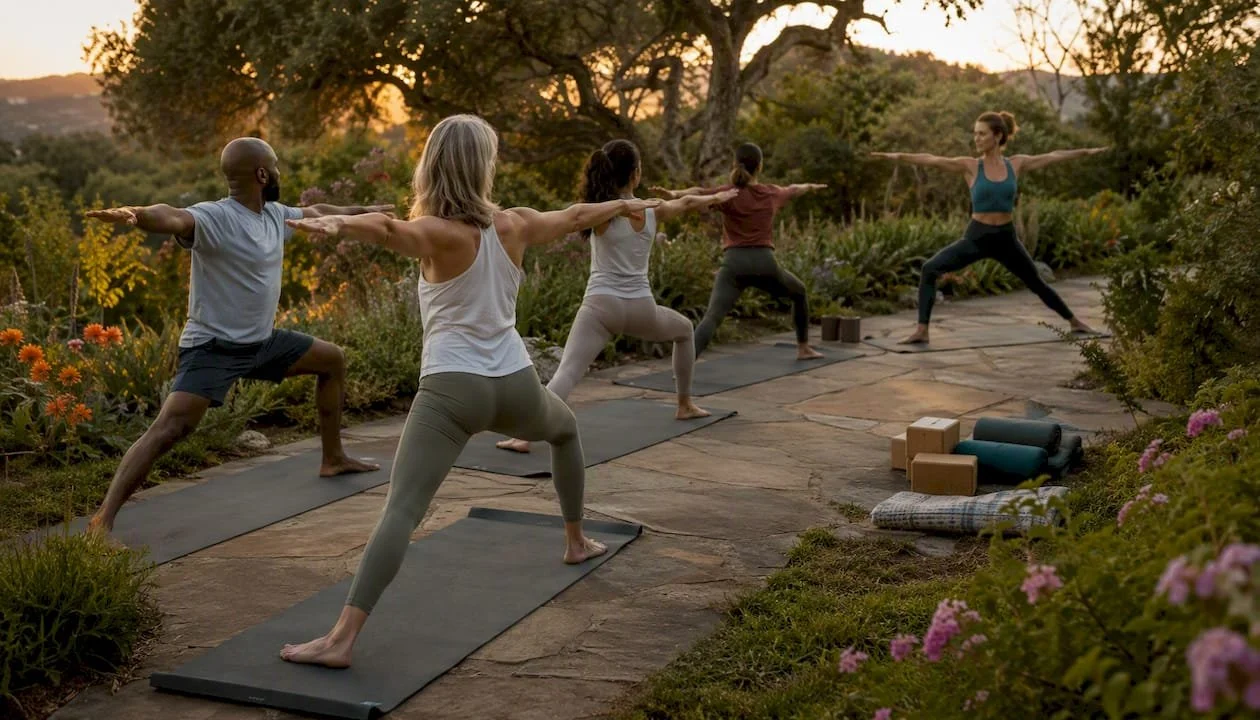
Standing pose series (Warrior I, II, III, crescent lunge) linked without pausing between sides
One important clarification: "hot" and "power flow" are not the same thing. Yoga Design Lab notes that "hot" refers to room temperature, not style. A studio can offer hot power flow (elevated temperature plus power sequencing) or a room-temperature power flow class. The heat is optional; the breath-linked movement is not.
Instructors also vary intensity by adjusting tempo, hold duration, and sequencing focus. A shoulder-focused power flow class looks different from a core-focused one, even at the same studio. That flexibility is a feature, not a flaw.
How does power flow compare to Vinyasa, Ashtanga, Hatha, and Slow Flow?
The differences come down to three things: pace, sequencing structure, and what the class is actually trying to accomplish.
| Style | Pace | Sequencing | Primary goal |
|---|---|---|---|
| Power Flow | Brisk, continuous | Creative, instructor-led | Cardio, strength, moving meditation |
| Vinyasa | Moderate to brisk | Creative, breath-linked | Breath awareness, flexibility, flow |
| Ashtanga | Structured, disciplined | Fixed series (Primary, Intermediate) | Strength, discipline, purification |
| Hatha | Slow to moderate | Pose-by-pose, static holds | Alignment, foundational technique |
| Slow Flow | Deliberate, unhurried | Flowing but paced | Restoration, deep stretching, mindfulness |
Power flow sits closest to vinyasa yoga on the spectrum, but with a deliberate push toward higher cardiovascular output. Where a vinyasa class might pause to explain alignment in warrior II, a power flow class keeps moving. The industry expert framing from Peloton's blog captures it well: Hatha treats the mat as a place for alignment and stillness; power flow treats it as an athletic training ground.
Ashtanga is the style power flow draws from most directly, but Ashtanga follows a fixed sequence that never changes. Power flow instructors build their own sequences, which means the class you take on Tuesday may look nothing like the one on Thursday. That creative variability is the clearest practical difference.
Signals to watch for in class descriptions:
"Dynamic," "athletic," or "strength-building" typically signals power flow territory
"Breath-to-movement" without "slow" or "restorative" usually means moderate-to-high intensity
"Fixed sequence" or "Mysore" points to Ashtanga, not power flow
"Gentle," "restorative," or "yin" indicates the opposite end of the spectrum
What benefits does regular power flow practice deliver?
The physical outcomes from consistent vigorous yoga practice are well-documented. Research summaries link regular vigorous yoga to improved upper-body endurance, reduced cortisol levels, and better body composition after several weeks of consistent practice. An ACE Fitness study found measurable improvements in muscular strength and endurance among yoga practitioners, supporting what power flow teachers observe anecdotally in class.
The primary benefits practitioners report and research supports:
Cardiovascular fitness: the interval-like structure of power flow, bursts of effort with brief transitions, elevates heart rate in a pattern similar to circuit training
Upper-body and core strength: repeated chaturangas, plank holds, and arm balance attempts build functional pushing and stabilizing strength
Flexibility: moving through full ranges of motion under mild muscular load improves active flexibility more effectively than passive stretching alone
Stress reduction: breath-linked movement keeps attention anchored to the present moment; mindfulness for yoga research consistently ties this attentional focus to lower perceived stress
Improved body composition: consistent practice over time tends to reduce fat mass and increase lean muscle, particularly in the core and upper body
Mental clarity: the moving-meditation quality of flow practice trains sustained focus, which practitioners often describe as carrying over into daily life
A realistic timeline: four to eight weeks of two to three sessions per week typically produces noticeable gains in upper-body endurance and a measurable reduction in resting tension. Flexibility improvements often appear sooner, within the first two to three weeks, because the practice moves joints through their full range every session.
What are the real risks and who should be cautious?
Power flow is demanding, and that demand creates specific injury patterns worth knowing before you walk into a class.
Wrist and shoulder strain top the list. Repeated chaturangas load the rotator cuff and wrist extensors in a way that accumulates quickly, especially if alignment breaks down under fatigue. YogaAnatomy's guidance on Chaturanga Dandasana is direct: there is one mechanically sound way to do this transition, and in fast-paced flow classes, instructors may not stop to correct it. That means the correction responsibility falls partly on you.
Other common risks:
Overuse injuries from practicing daily without adequate recovery, particularly in the shoulders, lower back, and knees
Dizziness or lightheadedness from rapid breathwork or overexertion, especially in heated rooms
Heat-related stress if you attend a hot power flow class before your body has adapted to the temperature
Medical contraindications: recent surgery (especially shoulder, wrist, or spine), uncontrolled hypertension, pregnancy (particularly second and third trimesters without prenatal modification), and acute joint inflammation. If any of these apply, consult a clinician before attending a standard power flow class.
Pro Tip: Before your first class, tell the instructor about any injuries or conditions. Ask specifically: "What's the modification for chaturanga if my wrists are sensitive?" A good instructor will give you an immediate answer (drop to knees, use fists, or skip the transition entirely). If they can't, that's useful information about the class.
Who is power flow yoga actually for?
The honest answer: power flow fits people who already have some movement baseline and want both a workout and a mindfulness practice. That does not mean beginners are excluded. It means beginners need to enter with realistic expectations and a willingness to modify.
Good fit indicators:
You have a regular exercise habit (gym, running, cycling, other sports) and want to add flexibility and breath awareness
You find slower yoga classes mentally difficult to sustain because the pace feels too low
You want cardiovascular conditioning without high-impact movement
You are an athlete looking for active recovery that still challenges strength and mobility
Who may prefer a gentler entry point: complete beginners with no movement background, people recovering from injury, those with significant joint hypermobility, and anyone who finds breathwork disorienting at first.
Modifications that keep the practice accessible without gutting the intensity:
Drop to knees in plank and chaturanga to reduce shoulder and wrist load
Use blocks under hands in standing forward folds and low lunges to shorten the lever arm
Skip arm balances and hold the preparatory pose instead
Take child's pose whenever needed, without waiting for the instructor to offer it
MyYogaTeacher's guide to power yoga notes that instructors can adjust tempo, hold duration, and sequencing focus to serve mixed-level groups. A well-run power flow class builds in these options naturally.
What does a typical power flow class look like?
Here is a realistic picture of a 45–60 minute class, broken into its working parts.
Warm-up (minutes 1–10): Child's pose, cat-cow, and seated breathwork to establish the breath rhythm. Two to three rounds of Sun Salutation A at a slower pace to warm the spine and shoulders.
Building heat (minutes 10–20): Sun Salutation B rounds, adding Warrior I and crescent lunge. Pace picks up. Chaturanga transitions begin repeating. Heart rate climbs into a moderate aerobic zone.
Standing flow sequence (minutes 20–35): Linked standing poses: Warrior II, extended side angle, triangle, half-moon. The sequence flows from one side to the other without stopping. This is the cardiovascular peak of most classes.
Peak pose work (minutes 35–45): Arm balance or inversion attempt (crow, headstand prep, or wheel depending on level). Instructors often build toward one challenging pose through a short preparatory sequence.
Floor sequence and cool-down (minutes 45–55): Boat pose, bridge or wheel, pigeon for hip opening, supine twists. Pace drops significantly. The body begins to recover.
Savasana (final 5 minutes): Complete stillness. This is not optional filler; it is where the nervous system integrates the session's work.
Common poses across nearly every power flow class: Downward-Facing Dog, Plank, Chaturanga, Upward-Facing Dog, Warrior I and II, Triangle, Crescent Lunge, and Pigeon. International Yoga Conference's power flow overview describes this interval-like structure, with bursts of effort and brief transitions, as the defining rhythm of the style.
How to start power flow yoga safely: a 4-week beginner plan
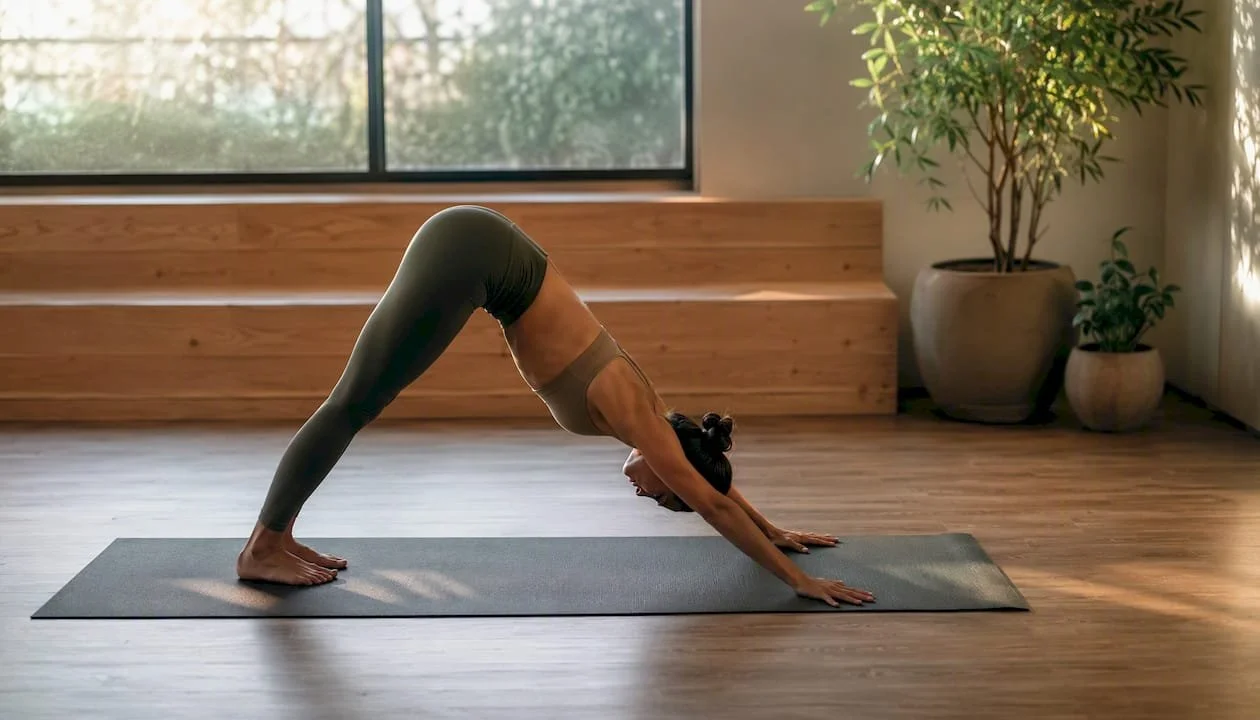
Starting with short sessions is not a compromise. It is the right call. Yoga Rove's beginner power yoga guide recommends exactly this: short routines one to two times per week, using a non-slip mat and props, with instructors informed to offer step-down options.
4-week starter plan:
Week 1: Two sessions of 15–20 minutes. Focus on Sun Salutation A only. Practice chaturanga with knees down every time. Rest at least two days between sessions.
Week 2: Two sessions of 20–25 minutes. Add Sun Salutation B. Attempt one standing pose series (Warrior I and II on each side). Still use knee drops in chaturanga unless wrists feel stable.
Week 3: Two to three sessions of 25–30 minutes. Add a short standing flow (three to four poses linked). Try one chaturanga without knee drop per round, then drop knees for the rest.
Week 4: Three sessions of 30–40 minutes. Attend a beginner-labeled studio class or follow a structured online sequence. Communicate your level to the instructor before class starts.
Equipment checklist:
Non-slip yoga mat (this is non-negotiable in a sweaty class)
Two yoga blocks for hand support in standing poses and low lunges
A strap for hamstring stretches and shoulder openers in the cool-down
A small towel if the room is heated or you run warm
Water bottle, filled before class
Safety rules for first classes: skip heated rooms until you have completed at least four weeks of room-temperature practice. Tell the instructor your experience level before class. Never push through sharp joint pain; dull muscular fatigue is normal, sharp pain is a signal to stop.
What does the evidence say about vigorous yoga?
The research base for vigorous yoga is growing, and the findings are consistent enough to be useful without overstating them.
A 2018 PubMed study found that regular yoga practice produced meaningful improvements in muscular strength and endurance. A 2016 PubMed review linked yoga practice to reductions in cortisol, the primary stress hormone, with effects comparable to other mind-body interventions. A PMC review found that yoga interventions improved body composition and cardiovascular markers across multiple study populations.
Key evidence-based takeaways for practitioners:
Practicing a few sessions per week appears to be the threshold at which measurable strength and flexibility gains emerge in most studies
Cortisol reductions are observed even in shorter practice periods (six to eight weeks), suggesting stress benefits arrive before peak fitness gains
Harvard Health notes that rhythmic, breath-linked exercise activates the parasympathetic nervous system, which is the physiological mechanism behind yoga's stress-reduction effect
The U.S. Department of Health and Human Services Physical Activity Guidelines recommend 150 minutes of moderate-intensity or 75 minutes of vigorous-intensity activity per week; three 45-minute power flow sessions comfortably meets the vigorous threshold
What the research does not yet tell us: optimal session length, ideal frequency for injury prevention, or how power flow specifically compares to other vigorous yoga styles in head-to-head trials. The evidence supports vigorous yoga broadly; the power flow label is a studio category, not a research variable.
Key Takeaways
Power flow yoga is a vigorous, breath-linked practice that builds cardiovascular fitness and muscular strength simultaneously, making it one of the most efficient hybrid workouts available in a studio setting.
| Point | Details |
|---|---|
| Core definition | Power flow links postures to breath in continuous sequences, emphasizing cardio and strength over static holds. |
| Beginner entry point | Start with 15–20 minute sessions one to two times per week, using blocks and knee drops to protect joints. |
| Evidence base | Studies link regular vigorous yoga to reduced cortisol, improved strength, and better body composition after six to eight weeks. |
| Key risks | Wrist and shoulder strain from repeated chaturangas; skip heated rooms until you have four weeks of baseline practice. |
| Amritayogawellness | Amrita Yoga & Wellness in Philadelphia offers power flow and related classes with instructor guidance suited to mixed-level groups. |
A teacher's honest perspective on what power flow actually demands
The most common misunderstanding about power flow yoga is that it is just a faster vinyasa class. Speed is not the point. Rhythm is.
When a class is running well, the breath is the metronome and the movement follows it, not the other way around. Students who try to keep up visually, matching what the person next to them is doing, tend to lose the breath connection within the first ten minutes. Once that happens, the practice becomes exercise with yoga shapes, which is fine, but it is not what power flow is designed to deliver.
The mindfulness techniques that underpin a strong power flow practice are the same ones that make it sustainable long-term. Practitioners who learn to pace themselves by breath rather than by visual cues report fewer injuries, better recovery between sessions, and a qualitatively different experience of the class. They also tend to stay with the practice longer.
There is also a sequencing reality that beginning students rarely hear: even in a beginner-labeled class, instructors may not stop to break down chaturanga. The pace of a flow class works against detailed technical correction. That is not negligence; it is the nature of the format. The practical implication is that you should learn the mechanics of chaturanga, plank, and downward dog before you walk into a power flow class, not during it. Ten minutes with a video or a single private session is enough to get the fundamentals right and protect your shoulders for the long term.
Power flow works. The evidence supports it, and the experience of thousands of practitioners confirms it. But it works best when you enter it with patience, a willingness to modify, and enough body awareness to know the difference between productive discomfort and a warning signal.
Amrita Yoga & Wellness offers guided power flow in Philadelphia
If you have read this far and want to experience power flow with an instructor who can cue modifications in real time, Amrita Yoga & Wellness in Philadelphia offers exactly that. Drop-in classes, beginner series, and private sessions give you options depending on where you are starting from. Guided instruction cuts the learning curve significantly: an instructor watching your chaturanga alignment in the first class can prevent the shoulder strain that sidelines self-taught practitioners weeks later.
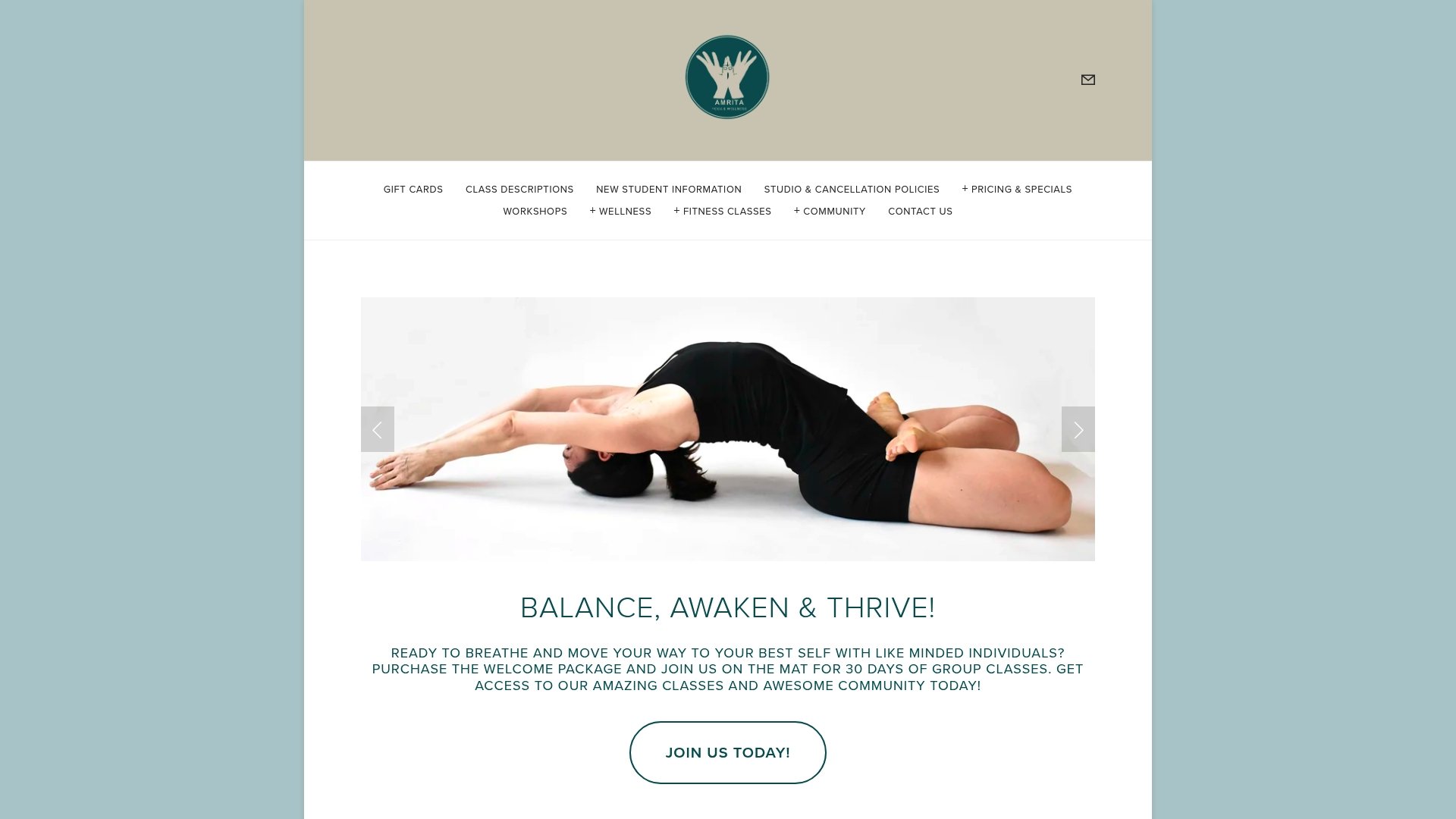
Amrita Yoga & Wellness also offers a range of complementary wellness services, from hot yoga to massage therapy, that pair naturally with a power flow practice for recovery and stress management. Whether you are brand new or returning after a break, the studio's class descriptions include level guidance so you can choose the right entry point.
Book a class or explore the full schedule at Amrita Yoga & Wellness and tell the front desk it is your first power flow class. That one sentence gets you the modifications you need from the start.
Selected sources and further reading
The following sources informed this article and are worth reading directly if you want to go deeper on any specific topic.
Peloton Blog: What Is Power Yoga? — Accessible overview of power yoga's lineage and its relationship to Ashtanga and vinyasa.
YogaAnatomy: Chaturanga Dandasana — Detailed anatomical breakdown of the most technically demanding transition in power flow; essential reading before your first class.
PubMed: Yoga and muscular strength (2018) — Peer-reviewed study on strength and endurance outcomes from regular yoga practice.
PubMed: Yoga and cortisol reduction (2016) — Review of yoga's effects on stress hormones across multiple study populations.
NIH/PMC: Yoga and body composition — Systematic review of yoga's effects on body composition and cardiovascular markers.
Harvard Health: Exercising to Relax — Explains the parasympathetic nervous system mechanism behind breath-linked exercise and stress reduction.
U.S. Department of Health and Human Services: Physical Activity Guidelines — The federal benchmark for vigorous physical activity that power flow practice can meet.
This article is general information, not medical or fitness advice. If you have a health condition, recent injury, or are pregnant, consult a qualified clinician before starting a vigorous yoga practice.