
Hot Yoga and Weight Loss: What the Research Actually Shows

Hot yoga can help you lose body fat, but only if you show up consistently and pay attention to what you eat. A six-month study of Bikram yoga practitioners found an average 6.17% reduction in body fat among women who attended three 90-minute classes a week. That's tied to this specific dosing regimen. Most trials show that sweating hard in a heated room does not automatically translate into fat loss unless attendance is high and diet stays in check.
TL;DR:
Consistent attendance of at least three hot yoga classes per week for three to six months is necessary to see meaningful body-fat reduction.
Higher practice volume correlates with better results, while sporadic attendance, such as once weekly, likely yields no fat-loss benefits.
The calorie-burning demand during hot yoga is similar to brisk walking, so fat loss likely results from behavioral changes and adherence rather than heat-induced calorie expenditure.
Stress reduction, improved sleep, and mindful eating patterns from regular practice contribute significantly to long-term fat loss.
Adequate hydration with electrolytes and medical clearance for at-risk individuals are essential for safe, sustainable hot yoga practice.
Table of Contents
How to Structure a Hot Yoga Routine That Actually Supports Fat Loss
How Amrita Yoga & Wellness Builds Safety Into Every Hot Class
Hot Yoga vs. Regular Yoga: What's Actually Different
Hot yoga is an umbrella term for any yoga class taught in a heated room, typically somewhere between 90 and 105 degrees Fahrenheit with humidity often pushed up to intensify sweating. Bikram yoga is the most rigid version of this, a copyrighted 26-posture sequence performed in a room heated to about 105°F with 40% humidity, always in the same order, always for 90 minutes. Other heated formats, sometimes called "power yoga" or "hot vinyasa," borrow the heat but drop the fixed sequence, letting instructors mix flows and intensity.
The heat itself does something measurable to your body almost immediately.
Heart rate climbs faster than it would during the same poses at room temperature, since your cardiovascular system works harder to move blood toward your skin for cooling.
Core temperature rises, which is part of why a 90-minute hot class feels far more demanding than a 90-minute unheated class covering identical postures.
Sweat output increases dramatically, sometimes to the point where a mat becomes genuinely difficult to grip without a towel.
None of that heat response is fat loss. It's water. Step on a scale right after a hot class and you'll likely see a lower number, but that's fluid you'll replace the moment you drink a glass of water. The actual physiological question, and the one the trials try to answer, is whether repeated exposure to that heat stress, combined with the physical demand of the postures, produces changes that stick around after rehydration. That's a different and much harder thing to measure than a post-class scale reading, and it's where the real evidence gets interesting.
Bikram Yoga for Weight Loss: What Trials and Reviews Found
The strongest single data point on hot yoga and body fat comes from a longitudinal study tracking women aged 20 to 65 through six months of consistent Bikram practice.
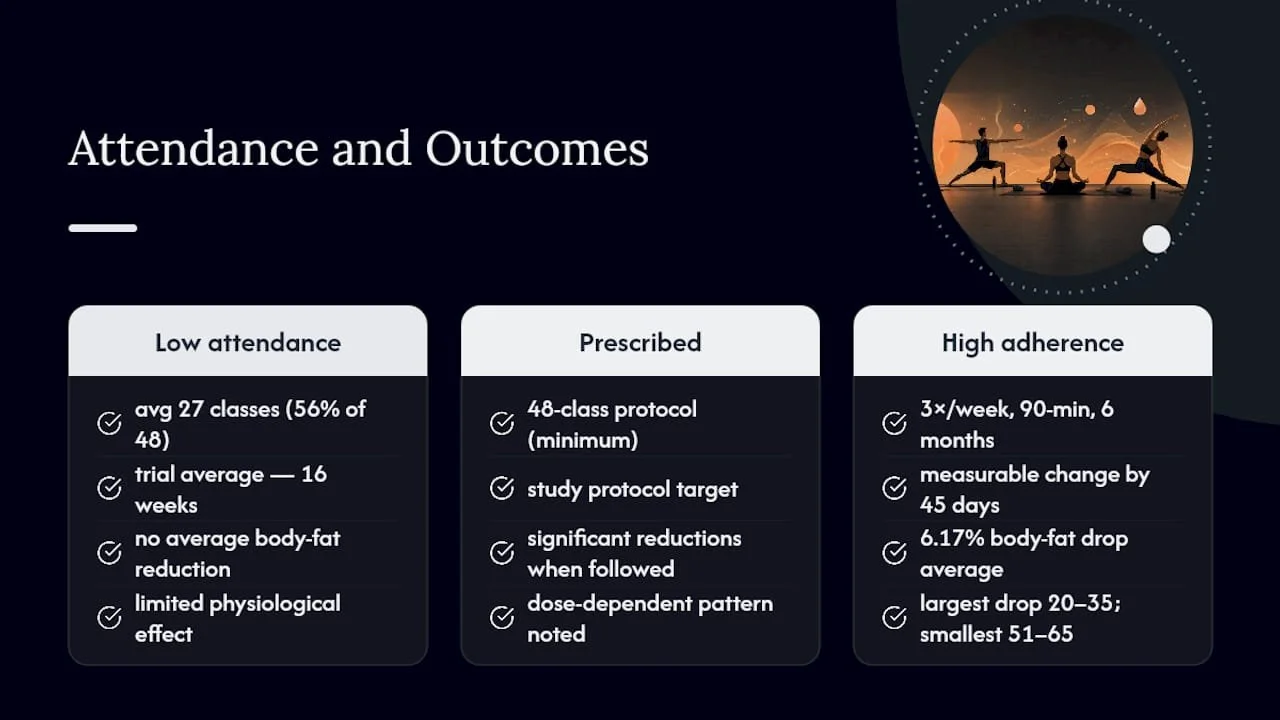
The 45-day signal: Researchers tracking three 90-minute Bikram sessions per week found measurable body-fat reductions appearing in as little as 45 days, with the effect growing to an average 6.17% drop in body-fat percentage by six months, according to the 2026 longitudinal study.
Women aged 20 to 35 saw the largest average drop, women 51 to 65 saw the smallest. Age didn't erase the benefit, but it did shrink it.
A separate 16-week randomized controlled trial complicates the picture in a useful way. But when they ran regression analysis on individual attendance, a different story emerged: people who attended more classes saw significant reductions in diastolic blood pressure, body fat percentage, fat mass, and BMI. The catch is that average attendance in that trial was only 27 classes, about 56% of the 48-class minimum the study protocol had prescribed. The people who followed the plan got results. The people who didn't, on average, didn't. That gap is the whole story of hot yoga research in miniature.
A broader systematic review pulling together 43 studies and 942 participants backs up that dose-dependent pattern. Body-composition results, by contrast, were mixed unless training volume and adherence were high enough to sustain a real physiological demand, according to the systematic review of hot yoga's physiological and functional effects.
That review comes with real caveats. Sample sizes across the 43 studies were often small, protocols varied widely in weekly frequency (anywhere from two to six sessions) and session length (20 to 90 minutes), and few trials controlled for what participants were eating outside of class. None of this invalidates the attendance signal. It does mean nobody should read "hot yoga reduces body fat" as a settled, universal fact rather than a pattern that shows up reliably only above a certain attendance threshold.
Why Hot Yoga Might Help Beyond Just Burning Calories
If heat alone drove the results in these trials, you'd expect hot yoga to torch dramatically more calories per session than the same sequence done at room temperature. It largely doesn't. Comparative research on energy expenditure shows that heated and non-heated yoga sessions often produce similar caloric demands, with single-session intensity for experienced practitioners landing somewhere near a brisk walk. The sweat feels like more work. The math doesn't back that feeling up as strongly as most people assume.
So what's actually driving the body-fat changes in the studies that do find them? A few plausible mechanisms, none of them mutually exclusive:
Behavioral spillover. People who commit to three classes a week tend to become more attentive to what they eat and how they sleep, and that mindfulness shift may matter more than the class itself.
Adherence as a filter. People who stick with a demanding 90-minute, 105°F practice for months are self-selecting into a higher overall activity and discipline level than casual exercisers.
Modest lean-mass gains. Some studies report small improvements in lean mass and metabolic markers with sustained practice, which nudges resting energy expenditure upward over time.
Sleep and stress effects. An eight-week uncontrolled study found faster time-to-fall-asleep and a trend toward improved blood pressure among Bikram participants, even though that same small cohort saw no change in body composition. Better sleep and lower stress hormones are both linked to easier fat-loss maintenance elsewhere in the literature.
Experts who study behavior change point to that last mechanism as underrated: stress reduction and mindfulness from a regular yoga habit often improve dietary choices and consistency more than the workout burns calories directly, according to Mayo Clinic's guidance on hot yoga. That's a less flashy explanation than "sweating melts fat," but it's the one the data actually supports. It also explains why the same postural sequence, done cold, can sometimes produce a comparable training effect for someone whose main issue isn't intensity, but showing up at all.
Pro Tip: Track how you eat on class days versus rest days for two weeks. Most people notice they naturally choose better meals after a hot class, not because of willpower, but because the mindfulness carries over. That pattern, more than the heat, is often what moves the needle.

How to Structure a Hot Yoga Routine That Actually Supports Fat Loss
The trials point to a fairly specific target, not a vague "practice regularly" suggestion.
Aim for three sessions a week, minimum, sustained for at least three to six months. The longitudinal Bikram study used exactly this frequency and duration to reach its 6.17% body-fat reduction, with initial changes visible around the 45-day mark.
Treat the first two to three weeks as acclimation, not performance. Your cardiovascular system needs time to adapt to sustained heat exposure. Pushing hard in week one, before you've built heat tolerance, is the fastest route to dizziness, nausea, or a skipped week two out of soreness and dread.
Build toward the class count the research actually used before judging results. The 16-week RCT prescribed 48 classes as its minimum effective dose. Participants who averaged only 27 didn't see the group-level benefits; the ones closer to the target did, on an individual basis. If you're attending once a week and wondering why nothing's changing, that's likely why.
Layer in strength training two to three times a week once you've built a heat-tolerance base. Hot yoga develops flexibility and balance impressively, per the systematic review's 16% to 33% flexibility gains, but it isn't a dedicated resistance-training stimulus. Pairing it with weights addresses the lean-mass side of the equation that yoga alone moves only modestly.
Add lower-intensity cardio on non-yoga days if your goal is faster fat loss. A brisk 30 minute walk or a bike ride creates additional energy deficit without competing with hot yoga's heat-adaptation demands, and it won't interfere with recovery the way another intense heated session might.
Reassess at 8 and 16 weeks, not weekly. Body-fat changes in the research trials showed up on a timeline of 45 days to six months. Weighing yourself daily during a hot-yoga routine measures water fluctuation far more than fat.
Hydration, Safety, and Who Should Talk to a Doctor First
Heat is the entire mechanism and the entire risk in this practice, and the two aren't separable. Before you build a three-times-a-week habit, it's worth understanding what can go wrong and how to head it off.
Heat-related illness has a recognizable progression, and catching it early matters more than any workout goal.
Early signs include lightheadedness, unusual fatigue mid-pose, or a racing heartbeat that feels out of proportion to the effort.
If you notice these, the correct response is to stop, sit or lie down, and leave the heated room if symptoms don't ease within a minute or two.
Nausea, confusion, or stopped sweating during a hot class are more serious red flags and warrant leaving the room immediately and seeking care if they don't resolve quickly.
Water alone often isn't enough for someone attending hot classes multiple times a week. Because you're losing sodium and other electrolytes through heavy, sustained sweating, clinicians recommend electrolyte replacement, not just plain water, for frequent hot-yoga attendees, according to Mayo Clinic's clinical guidance. A practical approach: drink 16 to 20 ounces of water in the two hours before class, sip electrolyte-enhanced water during longer sessions, and rehydrate with both water and electrolytes afterward rather than reaching only for plain water.
Certain people should get medical clearance before starting a heated practice. Anyone with cardiovascular disease, a history of heat-related illness, or who is pregnant should talk to a physician first, since heat stress adds cardiovascular strain that not every body handles the same way. The same goes for anyone on medications that affect sweating, blood pressure, or thermoregulation. None of this means hot yoga is off-limits for these groups. It means the modification (shorter first sessions, a spot near the door, permission to skip the most demanding postures) needs to be discussed before, not discovered mid-class.
First Time in a Heated Class? Do This
Walking into a 105-degree room for the first time is a genuinely different experience than any yoga class you've taken before, and a little preparation prevents most of the rookie mistakes.
Bring a large towel for your mat, a separate hand towel, and more water than you think you'll need. Most studios sell mats and towels, but bringing your own the first time removes one variable.
Eat a light meal one and a half to two hours before class, not immediately before. A heavy meal on a full stomach in a hot room is a fast route to nausea.
Arrive 10 to 15 minutes early to let your body start acclimating to the room temperature before the class demands anything of you.
Skip or modify any pose that produces sharp discomfort, not just intensity. Heat makes muscles feel more flexible than they are, which makes overstretching easier to do without noticing in the moment.
Book your next three classes before you leave the studio. Adherence research consistently shows that pre-scheduled sessions get attended far more reliably than "I'll go when I feel like it" plans.
Pro Tip: Bring a friend for your first month. A buddy who's also new tends to keep both of you showing up on weeks when motivation dips, and that consistency is exactly what the attendance data says matters most.
How Amrita Yoga & Wellness Builds Safety Into Every Hot Class
Amritayogawellness runs its hot yoga program with the attendance-and-safety relationship built into how classes are structured, not bolted on as an afterthought. At the Philadelphia studio, hot yoga sits alongside pilates, barre, tai chi, and massage therapy as part of a broader approach to helping students build a sustainable practice rather than chase a single intense session.
The studio's published guidance on hot yoga safety covers the same territory the clinical research flags: hydration timing, recognizing early heat-stress signs, and knowing when to modify a pose instead of pushing through it. That content exists because instructors see, week after week, which habits keep students coming back for the three-month stretch the research says actually moves body composition, and which habits burn people out by week three.

Beyond the mat, Amritayogawellness's studio model leans into the community side of adherence: workshops, retreats, and a retail counter for yoga gear all feed into the same goal of giving Philadelphia students enough reasons to keep their scheduled classes on the calendar. That's not incidental to the fat-loss conversation. It's the mechanism the trials kept pointing back to.
Our Take: Attendance Beats Intensity, Every Time
The research on hot yoga and weight loss keeps circling back to one uncomfortable truth: showing up matters more than sweating hard. It requires a more consistent one. That's a boring answer compared to the marketing around "detox sweat sessions," but it's the answer the data supports.
Where conventional advice on this topic goes wrong is treating the heat as the active ingredient. It isn't, or at least not primarily. The heat makes the class harder to skip once you've committed and harder to coast through once you're in it, but the actual physiological payoff comes from repetition over months, not degrees on a thermostat. If you take one thing from the evidence, prioritize a schedule you can actually keep over a studio with the most extreme heat setting. Adherence is the lever. Everything else is secondary.
— Juiced
Start a Safer, Smarter Hot Yoga Routine in Philadelphia
The research is clear that a sustainable hot yoga habit beats an occasional brutal session, and that's exactly what Amritayogawellness is built around. Rather than a single-format studio pushing one intense class style, Amrita Yoga & Wellness offers beginner-friendly hot yoga alongside pilates, barre, and tai chi, so you can build the attendance consistency the trials say actually drives results, with modifications and pacing suited to where you're starting from.

Every hot class follows the hydration and heat-safety practices covered in this guide, with instructors trained to cue rest and spot early signs of overheating before they become a problem. If you're ready to build the kind of three-times-a-week habit that showed measurable body-fat change in the research, check class schedules and beginner packages at Amrita Yoga & Wellness and book your first session this week.
Sources
The body-fat findings referenced throughout this guide come from a longitudinal Bikram yoga study tracking six months of consistent practice, a 16-week randomized controlled trial examining attendance and cardiovascular risk factors, and a systematic review covering 43 studies on hot yoga's physiological and functional effects. Comparative data on caloric demands come from research on heated versus non-heated yoga energy expenditure. For clinical context on hydration and medical clearance, Mayo Clinic's guidance on hot yoga remains a reliable starting point before beginning a heated practice.
Longitudinal study: Bikram yoga and body-fat reduction (2026)
Hot yoga systematic review: physiological, functional and psychological responses