Wall Yoga for Beginners: Build Strength Safely
TL;DR:
Wall yoga for beginners uses a wall as a prop to improve balance, alignment, and flexibility safely. Practicing 15 to 25 minutes, four to five days weekly, helps build strength and correct posture while emphasizing slow, breath-led movements. The wall provides tactile feedback that enhances proprioception and supports steady progress without dependency.
Wall yoga for beginners is a practice that uses a flat wall as a prop to improve balance, alignment, and flexibility while protecting your joints. You need no special equipment, no prior yoga experience, and no gym membership. The wall acts as a stable guide that lets you feel correct body position from your very first session. Practices rooted in Hatha and restorative yoga principles use this same concept, emphasizing slow movement and breath connection over speed or intensity. Amritayogawellness recommends 15–25 minutes of practice, 4–5 days per week, as the ideal starting point for building strength and flexibility safely.
What are the essential wall yoga poses for beginners?
Five foundational poses form the backbone of any beginner wall yoga routine. Each one teaches your body a key alignment principle while the wall keeps you steady enough to actually feel it.
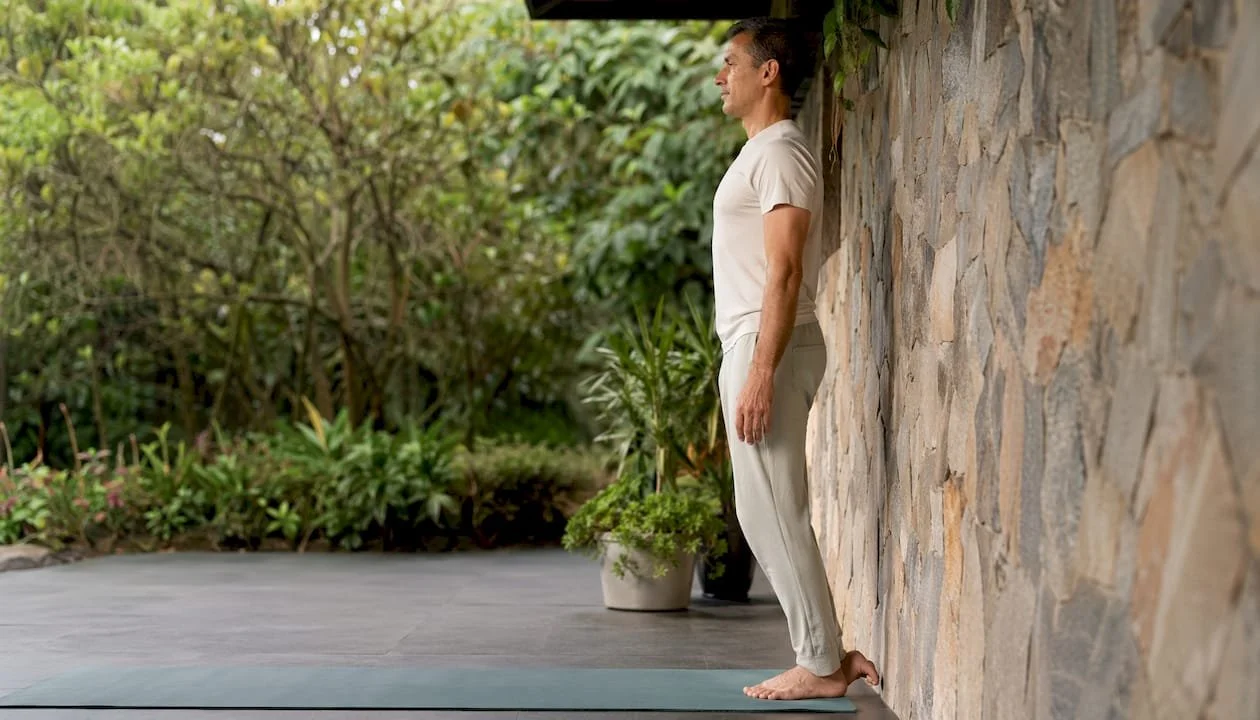
Wall Mountain Pose (30–60 seconds). Stand with your back flat against the wall, heels about two inches away from the baseboard, and feet hip-width apart. Press your shoulder blades and the back of your head lightly into the wall. This pose trains spinal stacking, the skill every other pose depends on. Hold for 30–60 seconds and breathe slowly.
Wall Forward Stretch (30 seconds). Face the wall and place both palms flat at shoulder height. Walk your feet back until your torso is parallel to the floor. Keep your spine long and your hips directly over your heels. This stretch opens the hamstrings and lengthens the entire back line of the body.
Wall Downward Dog (30–45 seconds). From the forward stretch position, walk your hands slightly higher on the wall and press your hips back and up. Your body forms an inverted V shape with the wall as your anchor. The wall distributes weight so you can explore the full length of the pose without straining your wrists or shoulders.
Wall Chair Pose (20–30 seconds). Stand with your back against the wall and slowly slide down until your thighs are parallel to the floor. Keep your knees directly over your ankles. This position builds quad and glute strength faster than most floor-based beginner poses. Hold for 20–30 seconds, then press through your heels to stand.
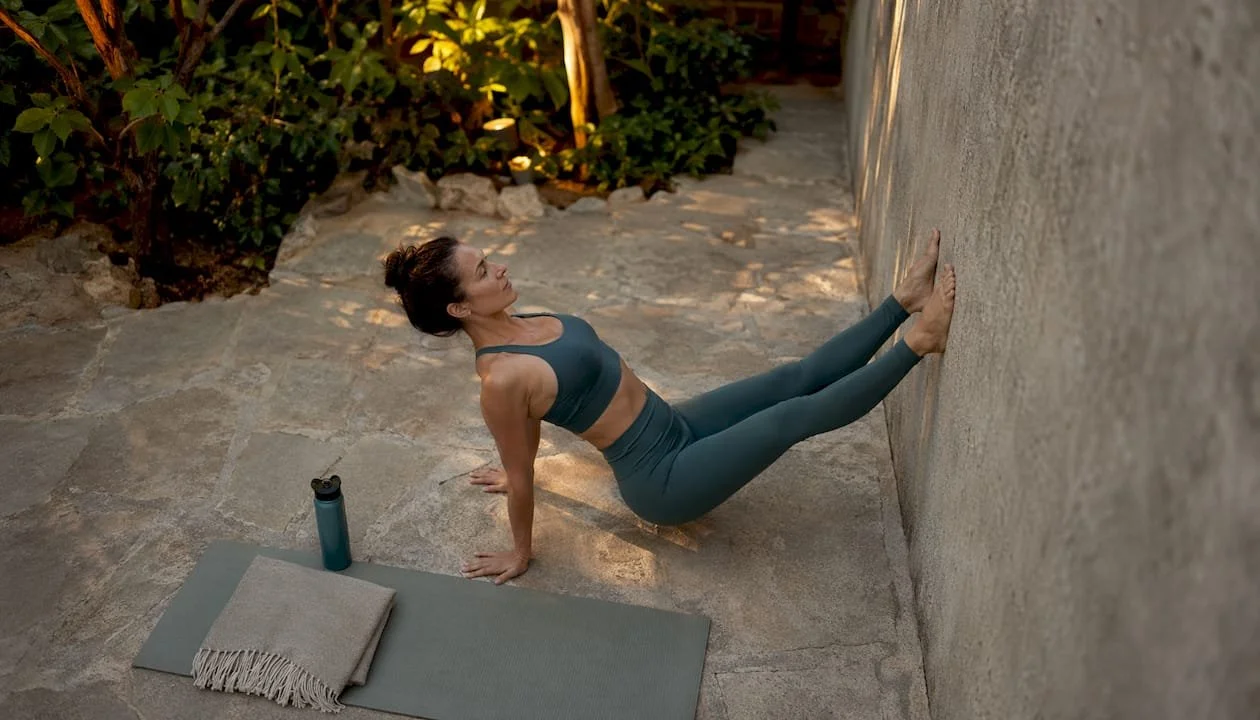
Legs Up the Wall (1–3 minutes). Sit sideways next to the wall, then swing your legs up as you lower your back to the floor. Let your arms rest at your sides, palms up. This restorative pose reduces leg fatigue, calms the nervous system, and is one of the most studied yoga stretches for beginners in both Hatha and restorative traditions.
Pro Tip: Place your heels two inches from the wall rather than flush against it. That small gap forces your legs to stay active instead of collapsing into the wall, which protects your knees and builds real strength.
How often and how long should beginners practice wall yoga?
Consistency beats duration every time. Short daily sessions build better habits and produce more measurable physical results than infrequent longer sessions. That finding holds true across beginner yoga populations, and wall yoga is no exception.
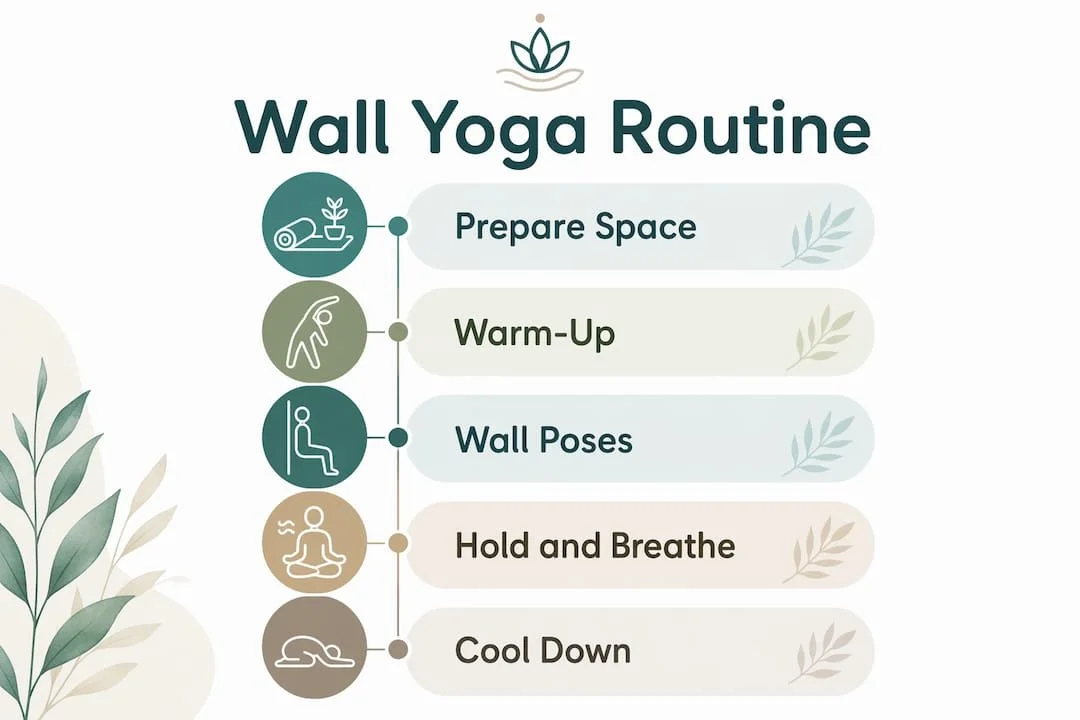
The recommended starting point is 15–25 minutes per session, practiced 4–5 days per week. That range is short enough to fit into a lunch break but long enough to complete all five foundational poses with proper hold times and rest between sets.
Here is what an effective beginner schedule looks like in practice:
Days 1, 3, 5: Full five-pose sequence, 15–20 minutes total
Days 2, 4: Shorter 10-minute session focused on one or two poses you find challenging
Day 6 or 7: Full rest, or gentle Legs Up the Wall for 3–5 minutes
Slow, breath-led sessions of 15 minutes produce more progress for beginners than longer, sporadic high-intensity sessions. The reason is simple: your nervous system needs repetition, not volume, to rewire movement patterns.
Wall yoga follows Hatha yoga principles, which prioritize longer holds and slower transitions. That pacing gives your muscles time to release and your breath time to regulate. Rushing through poses defeats the purpose entirely.
Pro Tip: Set a timer for each pose rather than counting in your head. Counting splits your attention. A timer lets you stay fully present in the stretch.
What common mistakes should beginners avoid in wall yoga?
Most beginners make the same four errors in their first few weeks. Knowing them in advance keeps you safe and speeds up your progress.
Leaning fully into the wall. The wall is a guide, not a crutch. Beginners should position heels slightly away from the wall to maintain active leg engagement. Full reliance on the wall shuts off the stabilizer muscles you are trying to build.
Holding your breath. Breath is not optional in yoga. Holding it triggers a stress response that tightens the very muscles you are trying to open. Inhale to prepare, exhale to deepen every pose.
Pushing into pain. Discomfort from a deep stretch is normal. Sharp or joint-level pain is a signal to back off immediately. The wall makes it easy to overextend because you feel more stable than you actually are.
Locking the knees. Straight legs do not mean rigid legs. Micro-bend your knees in standing poses to keep the joint safe and the surrounding muscles engaged.
Skipping warm-up. Two minutes of gentle walking in place or shoulder rolls before your first pose prepares your connective tissue and reduces injury risk significantly.
The wall gives you confidence, but confidence without awareness creates bad habits. Stay curious about what you feel, not just what you can achieve.
The goal is active participation, not passive leaning. Every pose should feel like a conversation between your body and the wall, not a collapse into it. That distinction separates beginners who progress quickly from those who plateau.
How does wall yoga improve body awareness and alignment?
The wall provides tactile feedback that free-standing poses simply cannot replicate. Pressing into the wall activates stabilizing muscles and refines alignment in ways that are difficult to achieve without a fixed reference point. That physical contact is called proprioceptive feedback, and it is the reason wall yoga works so well for beginners.
Proprioception is your body's ability to sense its own position in space. Most beginners have underdeveloped proprioception, which is why their posture collapses the moment they stop thinking about it. The wall interrupts that pattern by giving your nervous system a clear, constant signal about where your spine, hips, and shoulders actually are.
When you feel the wall against your back, you stop guessing about alignment. You know exactly where you are, and that knowledge transfers to every other movement you make off the mat.
The table below shows how specific wall contact points improve alignment in each foundational pose.
| Pose | Wall contact point | Alignment benefit |
|---|---|---|
| Wall Mountain | Full back, head | Trains neutral spinal curve |
| Wall Chair | Lower back, upper back | Prevents forward lean in squats |
| Wall Downward Dog | Both palms | Distributes shoulder load evenly |
| Wall Forward Stretch | Both palms | Keeps hips stacked over heels |
| Legs Up the Wall | Both legs | Decompresses lumbar spine |
Wall yoga also builds confidence in balance-dependent poses. When you know the wall is there, you take risks you would avoid on an open mat. Those risks, taken safely, are exactly how your balance improves. Amritayogawellness offers yoga for mobility resources that extend this principle into more advanced movement patterns for practitioners ready to progress. The physical and mental benefits of consistent yoga practice also extend beyond the mat, with research noting connections between regular yoga and overall skin and body wellness.
Key Takeaways
Wall yoga for beginners builds real strength and flexibility when you practice consistently, use the wall as a guide rather than full support, and follow Hatha-inspired slow, breath-led sessions of 15–25 minutes, 4–5 days per week.
| Point | Details |
|---|---|
| Optimal session length | Practice 15–25 minutes per session, 4–5 days per week for safe, steady progress. |
| Wall as guide, not crutch | Keep heels slightly away from the wall to maintain active muscle engagement in every pose. |
| Five foundational poses | Wall Mountain, Forward Stretch, Downward Dog, Chair Pose, and Legs Up the Wall cover all key alignment principles. |
| Breath is non-negotiable | Holding your breath tightens muscles and slows progress; exhale to deepen every pose. |
| Consistency over intensity | Short daily sessions produce better results than infrequent longer workouts. |
Why the wall changed how I think about beginner yoga
Most beginner yoga programs throw people into open-mat sequences and expect them to figure out alignment by watching an instructor from across the room. That approach works for some people. For most, it creates frustration and bad habits that take months to undo.
Wall yoga solves that problem at the root. The wall gives beginners immediate, honest feedback about where their body actually is versus where they think it is. That gap is usually surprising. I have watched people who swore their back was straight discover, the moment they pressed against a wall, that they had been rounding their shoulders for years.
What I find most underrated about this practice is the confidence effect. Beginners who feel unstable in open-mat balances often give up before they build any real skill. The wall removes that instability long enough for the body to learn the pattern. Once the pattern is learned, the wall becomes optional. That progression from supported to independent is far more satisfying than grinding through poses you are not ready for.
The slow pace is also not a compromise. It is the point. Breath-led movement at a Hatha-inspired tempo teaches your nervous system to stay calm under physical challenge. That skill carries into every other area of your life. Patience in a Wall Chair Pose is the same skill as patience in a difficult conversation. The gentle yoga poses that seem too easy at first are often the ones that create the deepest change.
— Juiced
Wellness at Amritayogawellness goes beyond the mat
Amritayogawellness, Philadelphia's community-centered wellness studio, offers more than yoga classes. If your wall yoga practice has sparked curiosity about your inner life as much as your physical body, the studio's tarot reading sessions offer a thoughtful complement to your movement practice.
Tarot readings at Amrita Yoga & Wellness are designed for people who take their self-care seriously and want to explore wellness from multiple angles. Pairing a grounded physical practice like wall yoga with reflective tools creates a fuller picture of where you are and where you want to go. Browse the full range of classes, workshops, and wellness services at Amritayogawellness to find what fits your practice right now.
FAQ
What is wall yoga and why is it good for beginners?
Wall yoga is a yoga practice that uses a flat wall as a prop to support balance, alignment, and safe stretching. It suits beginners because it reduces joint strain and provides immediate feedback about body position.
How long should a beginner wall yoga session last?
Beginners should practice for 15–25 minutes per session, 4–5 days per week. That duration is enough to complete foundational poses with proper hold times without overloading the body.
Can wall yoga help with posture?
Wall yoga directly improves posture by training spinal alignment through tactile feedback. Regular practice of Wall Mountain Pose and Wall Chair Pose resets habitual rounding in the shoulders and lower back.
Do I need any equipment for beginner wall yoga poses?
No equipment is required beyond a clear wall space and a yoga mat or non-slip surface. Bare feet work best for grip and proprioceptive feedback during standing poses.
How is wall yoga different from regular yoga?
Wall yoga uses the wall as a fixed reference point that activates stabilizing muscles and corrects alignment in ways free-standing poses cannot. The wall distributes weight and supports balance, making deeper stretches accessible to beginners from the very first session.