How to start online yoga classes: a step-by-step guide

TL;DR:
Starting small with live classes and authentic community-building creates a sustainable online yoga practice.Preparing your setup, testing feedback, and focusing on trust over follower count leads to long-term success.
You've been practicing or teaching yoga for a while now, and the idea of offering classes online feels both exciting and completely overwhelming. The tech questions pile up fast: Which platform? What camera? How do you keep students engaged when you can't physically adjust their posture? If you're a Philadelphia-based yoga enthusiast or emerging teacher, this guide walks you through every stage of launching online yoga classes that feel authentic, community-centered, and built to last.
Table of Contents
Key Takeaways
| Point | Details |
|---|---|
| Start with a pilot group | Begin with 5–15 students for valuable feedback and a lower-risk launch. |
| Focus on community | Cohort-based classes and discussion spaces boost engagement and completion. |
| Invest in clear audio and video | Prioritize camera angles, lighting, and a reliable mic to improve safety and communication. |
| Consider credentials for credibility | If you plan to use Yoga Alliance branding, ensure you meet all certification and compliance requirements. |
| Build sustainable revenue | Recurring memberships, combined with an owned platform, lead to higher long-term earnings. |
Clarifying your vision and requirements
Before you film a single downward dog, you need a clear picture of what you're building. The biggest mistake new online teachers make is jumping straight to "which platform should I use?" before answering more fundamental questions: Who are you teaching? What style of yoga? And what kind of experience do you want your students to have?
Start by writing down your teaching focus. Are you leaning into restorative yoga for busy Philly professionals? Hot yoga fundamentals? A blend of barre, pilates, and vinyasa? When you define your niche early, choosing the right yoga classes for your audience becomes much cleaner. Your niche also shapes your entire tech and format decision.
Next, decide on your class delivery model:
Live classes via Zoom or Google Meet offer real-time feedback and community energy
Recorded classes let students practice on their schedule, but require higher production quality
Hybrid models give you both: a live session that gets repurposed as an on-demand recording
According to a practical framework for online yoga businesses, you should plan your offer including live versus recorded format, pricing, and the fundamental tech and space requirements before anything else. Skipping this step leads to expensive pivots later.
Here's a quick-reference comparison for your home studio setup:
| Class model | Camera needed | Lighting priority | Internet speed | Platform examples |
|---|---|---|---|---|
| Live only | Webcam or smartphone | Natural or ring light | 10+ Mbps upload | Zoom, Google Meet |
| Recorded only | DSLR or mirrorless | Full studio lighting | Standard | Vimeo, Teachable |
| Hybrid | Webcam or DSLR | Natural or ring light | 10+ Mbps upload | Zoom plus Teachable |
| On-demand library | DSLR preferred | Full studio lighting | Standard | Kajabi, Podia |
Your at-home studio doesn't need to be perfect from day one. A clean background, solid natural light, a stable internet connection, and a phone or laptop camera are genuinely enough to start. Also think early about scheduling online yoga classes so students can build consistent habits around your offerings.
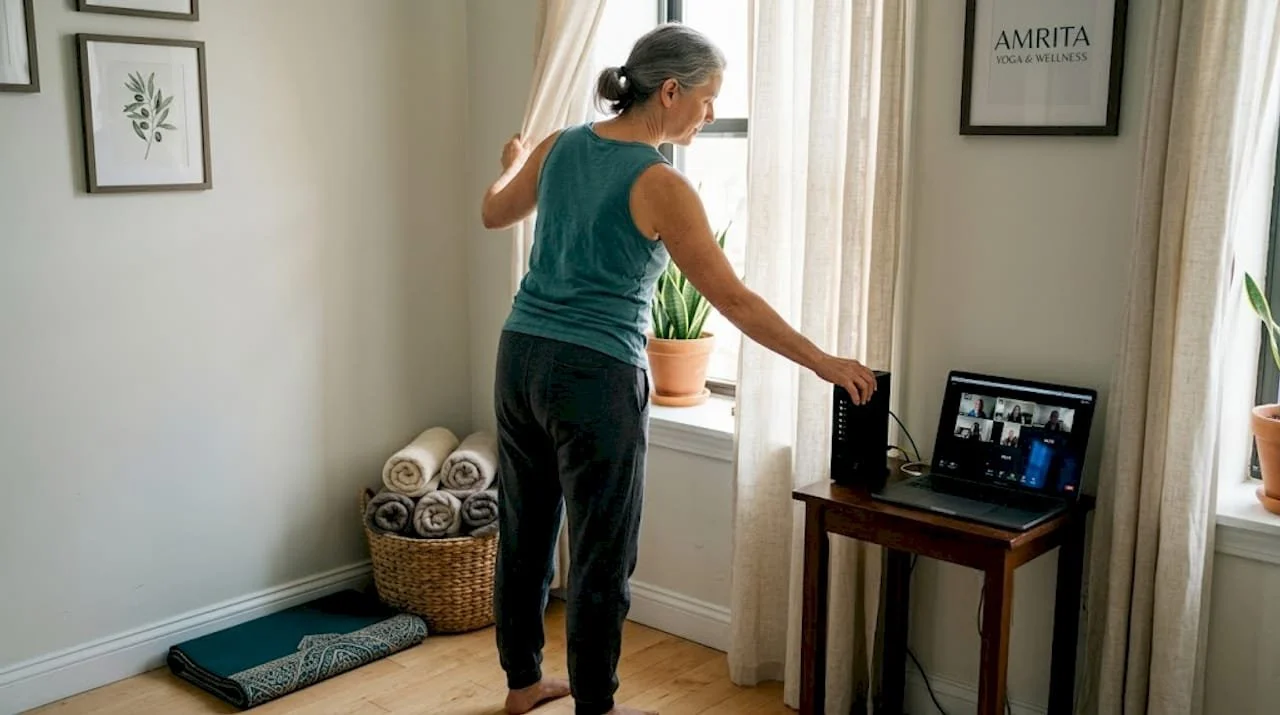
Pro Tip: Start with what you already own and record a short five-minute test video to identify your biggest weak spots. Most of the time it's audio, not video quality, that makes or breaks the student experience.
Crafting your first offerings and gathering feedback
With your vision mapped out, the next move is not to build a polished 12-week course. It's to test your teaching live, with real people, in a low-pressure environment. This protects your time and gives you the honest feedback that no amount of planning can replace.
The goal is a pilot group: a small set of students who agree to take your initial classes at a reduced price in exchange for their detailed feedback. Here's exactly how to run it:
Identify 5 to 15 people from your existing network, social community, or local Philadelphia contacts
Offer a 2 to 4 week introductory series at 50% of your planned price
Run every session live so you can observe engagement in real time
After each class, send a short follow-up form with open-ended questions
After the full pilot, hold a 15-minute group debrief call to collect verbal impressions
Document every piece of feedback and group themes before building your next iteration
The reasoning is simple: starting small reduces risk, and running a pilot group with genuine feedback before scaling any course or larger offering is what separates instructors who grow sustainably from those who burn out after month three.
What kinds of feedback actually matter? Focus on:
Was the pacing too fast, too slow, or just right?
Could students hear you clearly throughout the session?
Did the class structure feel welcoming to different experience levels?
What was the single most valuable moment of the class?
What would they change if they could change one thing?
Pro Tip: Avoid yes/no survey questions. Ask things like "Describe a moment during class when you felt confused" or "What would have made today's session more effective for your practice?" Open-ended questions surface the insights that multiple-choice answers completely hide.
Most successful online yoga teachers use live teaching first to build their authentic library of cues, sequences, and student responses. Once you've refined your live sessions, you can record evergreen content that reflects your actual teaching style, not a polished but hollow performance. For more on scaling this into a thriving practice, explore tips for growing a yoga business.
Designing engaging, community-driven classes
Launching your first classes is only half the challenge. Keeping students coming back, week after week, requires intentional curriculum design and a genuine sense of community. This is where many online yoga programs fall apart: they focus entirely on content quality and forget that students stay for connection, not just sequences.
The structure of your program matters enormously. Here's how the three main models compare:
| Model | Completion rate | Community feel | Flexibility | Best for |
|---|---|---|---|---|
| Scheduled cohort | Highest | Strong | Low | New teachers building trust |
| Open access | Moderate | Moderate | High | Established brands |
| On-demand only | Lowest | Weak | Highest | Supplemental content |
"Online yoga courses that include cohort structure and community tend to have higher completion rates than open access or on-demand-only models, with discussion spaces alone showing completion rates of 65.5% versus 42.6%."
The data makes a strong case: when students feel accountable to a group and a schedule, they finish what they start. For a Philadelphia audience that values neighborhood connection and shared wellness experiences, a cohort model mirrors the studio environment in a way that solo on-demand watching simply cannot.
To build genuine community into your online class design:
Open every live session with a two-minute check-in question (something personal, not yoga-related)
Create a private Facebook group, Discord server, or forum where students post between sessions
Use breakout rooms during longer Zoom classes so students briefly connect in pairs
Celebrate milestones publicly, a student's tenth class, their first crow pose
End classes with a short cool-down circle where students share one word about their experience
One critical curriculum note: not all of your students will be watching their screen during practice. Strong verbal cueing is not optional when teaching online. Describe every transition and alignment cue as if your students have their eyes closed, because many of them do. Read more about building consistent wellness access through membership models that support this kind of sustained engagement.
You can also browse yoga membership ideas to see how other teachers are structuring recurring student relationships around both live and asynchronous content.
Ensuring safety, professionalism, and credibility
Engagement matters, but nothing derails an online yoga career faster than a safety incident, a credential misrepresentation, or unclear instruction that causes a student to get hurt. Professionalism is not just about polished graphics or a clean website. It's about earning trust through clarity, competence, and honest communication.
Start with your technical setup. To give real alignment feedback during live classes, your filming setup must allow the teacher to clearly see students' postures. That means:
Position your camera at mat height, not desk height, so you see the body at the same level
Use a wide-angle lens or back your camera up far enough to capture your full body in frame
Ensure the background behind you is uncluttered so postures read clearly
Test your microphone volume at conversational pace, loud cuing often clips and distorts
Light your face AND body from the front, never from behind (no window at your back)
On credentials: if you plan to market yourself using titles like RYT-200 or RYT-500, Yoga Alliance's RYT registration requires completing training at an officially registered yoga school (called an RYS), and your certificate must include the RYS name, authorized signature, training hours, and proper documentation.
"Non-compliance with Yoga Alliance standards, including misuse of RYT trademarks or failure to meet documentation requirements, risks credential revocation and public suspension from the Yoga Alliance registry."
This matters because students increasingly check credentials before committing to an online program. Even if you choose not to register with Yoga Alliance, being honest about your training background builds far more long-term trust than vague language about experience. Check out resources around online yoga compliance and yoga safety and instructor success to stay current on best practices.
Earning sustainably: Memberships, marketing, and revenue streams
Once your teaching is solid and your community is forming, it's time to think about sustainable income. The goal is to build a business that doesn't collapse the moment your social media reach dips.
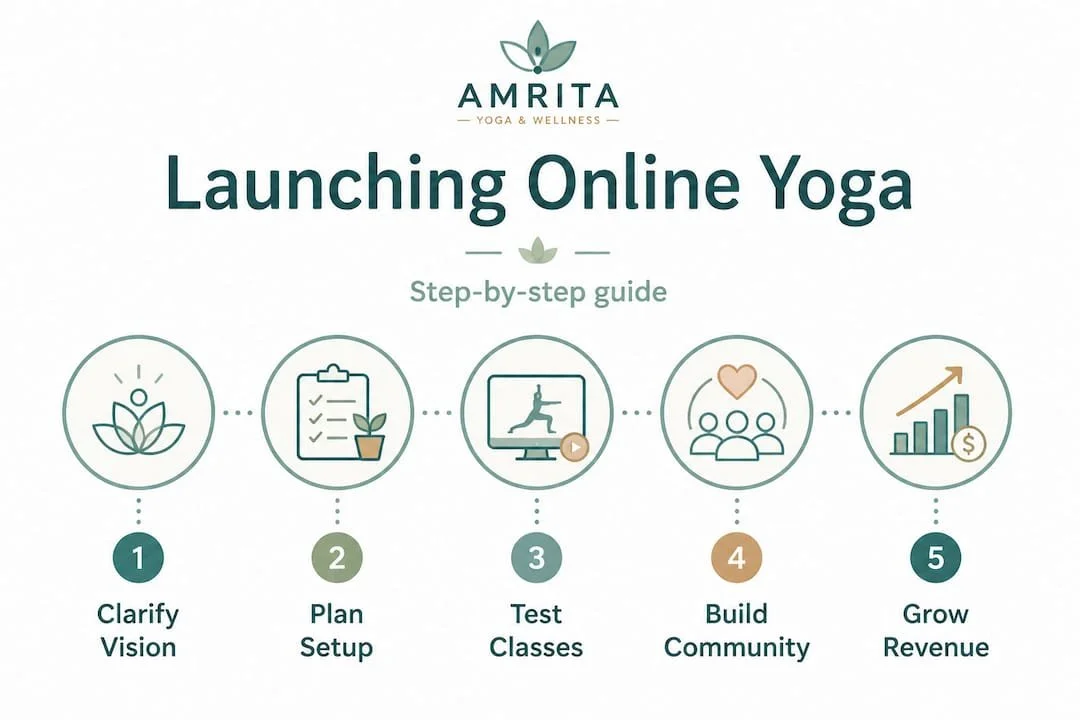
A well-designed membership goes beyond just a video library. A practical membership structure for online yoga includes recurring weekly live practice, an on-demand content library, and a community space. That combination keeps students engaged at multiple levels and justifies consistent monthly pricing.
Here's a realistic income progression for online yoga teachers based on industry data:
| Business maturity | Monthly income range | Key driver |
|---|---|---|
| Year 1 | $300 to $1,500 | Small pilot groups, early memberships |
| Years 2 to 3 | $2,000 to $5,000 | Growing library, referrals, tiered offers |
| Year 4 and beyond | $5,000 to $15,000+ | Brand authority, passive content, larger cohorts |
These income benchmarks vary based on niche, marketing consistency, and how well you retain students month over month. Don't compare your year one to someone else's year four.
For sustainable marketing and revenue growth, build your own platform and audience rather than relying exclusively on Instagram or TikTok algorithms. Own your email list from day one.
Essential local and digital marketing basics for Philadelphia-based teachers:
Partner with local wellness spaces, coffee shops, and community centers for cross-promotion
Collect email addresses at every touchpoint and send a short weekly wellness note
Post consistently on one social platform rather than spreading thin across five
Ask every satisfied student for a testimonial and display it prominently
Offer a free one-class trial to remove the barrier for first-time online students
More on building your recurring revenue model lives in the yoga membership resources section of our blog.
Pro Tip: Your email list is the only audience you truly own. Social platforms change their algorithms constantly. A list of 200 engaged students who open your emails is worth far more than 2,000 passive followers who never click anything.
Why starting small and community-first always wins in online yoga
Here's an uncomfortable truth that most "how to build a yoga business" content glosses over: follower counts mean almost nothing when it comes to building a sustainable, fulfilling online yoga practice.
We've seen this pattern repeatedly among Philadelphia-area instructors. Teachers who launched with a big Instagram push but skipped the pilot group phase often ended up with polished content that nobody finished, expensive platforms they didn't fully use, and a creeping sense that online yoga just doesn't work. The problem was never online yoga. The problem was launching big before building trust.
The teachers who build something lasting almost always start the same way: a small group, live sessions, genuine conversations, and an honest feedback loop. This mirrors what growing a yoga business actually looks like in practice, not theory.
Live classes are the foundation. When you teach live, you feel the rhythm of your students. You notice when silence means confusion versus contemplation. You adapt in real time. That responsiveness is exactly what builds the trust that converts a one-time attendee into a yearly member. Recorded content, no matter how beautiful, cannot replicate that exchange.
Chasing social media numbers before you've nailed your live teaching is like rehearsing a performance before you've written the script. The metrics look like momentum, but they don't translate to revenue or community. Five students who show up every week and tell three friends about your class will build your business faster than 500 passive followers who double-tap a reel.
The Philadelphia yoga community, in particular, responds to authenticity and neighborhood roots. Start with the people already around you. Offer them something real, small, and personal. The growth follows from there, not the other way around.
Ready to start your own online yoga journey?
Taking your yoga practice or teaching online doesn't have to be a solo effort. The knowledge, community, and local expertise you need are already here.
At Amrita Yoga & Wellness, we've built a space where holistic wellness practitioners and students of every level can connect, learn, and grow. Whether you're looking to deepen your own practice before teaching, explore our diverse class offerings, or add a unique experience like tarot readings to your wellness journey, our Philadelphia studio supports you every step of the way. Browse our current schedule, community workshops, and member resources to find your ideal starting point.
Frequently asked questions
What essential equipment do I need to teach online yoga classes?
You'll need a device with a camera, strong and front-facing lighting, a stable internet connection, and a dedicated external microphone for clear audio. A practical setup also includes a quiet, uncluttered space where your full body is visible on camera.
How many students should I start with for my first online yoga class?
A pilot group of 5 to 15 students gives you the most honest feedback with the lowest financial and operational risk. Starting with this size lets you run the full program, gather detailed responses, and refine before opening to a larger audience.
Do I need a Yoga Alliance credential to teach online yoga?
No formal registration is required to teach online, but if you want to market yourself as an RYT or use Yoga Alliance trademarks, you must meet their full credentialing standards and documentation requirements.
How much can I expect to earn teaching online yoga?
First-year teachers typically earn between $300 and $1,500 per month, scaling to $2,000 to $5,000 in years two and three. With a deeper library and community, experienced teachers can reach $5,000 to $15,000 or more per month.
What helps students stick with online yoga classes?
Scheduled live sessions with a community component keep students far more consistent than on-demand formats alone. Courses with discussion spaces show completion rates of 65.5% compared to 42.6% for those without community features.