Yoga Teacher Qualities Checklist: What Great Teachers Share
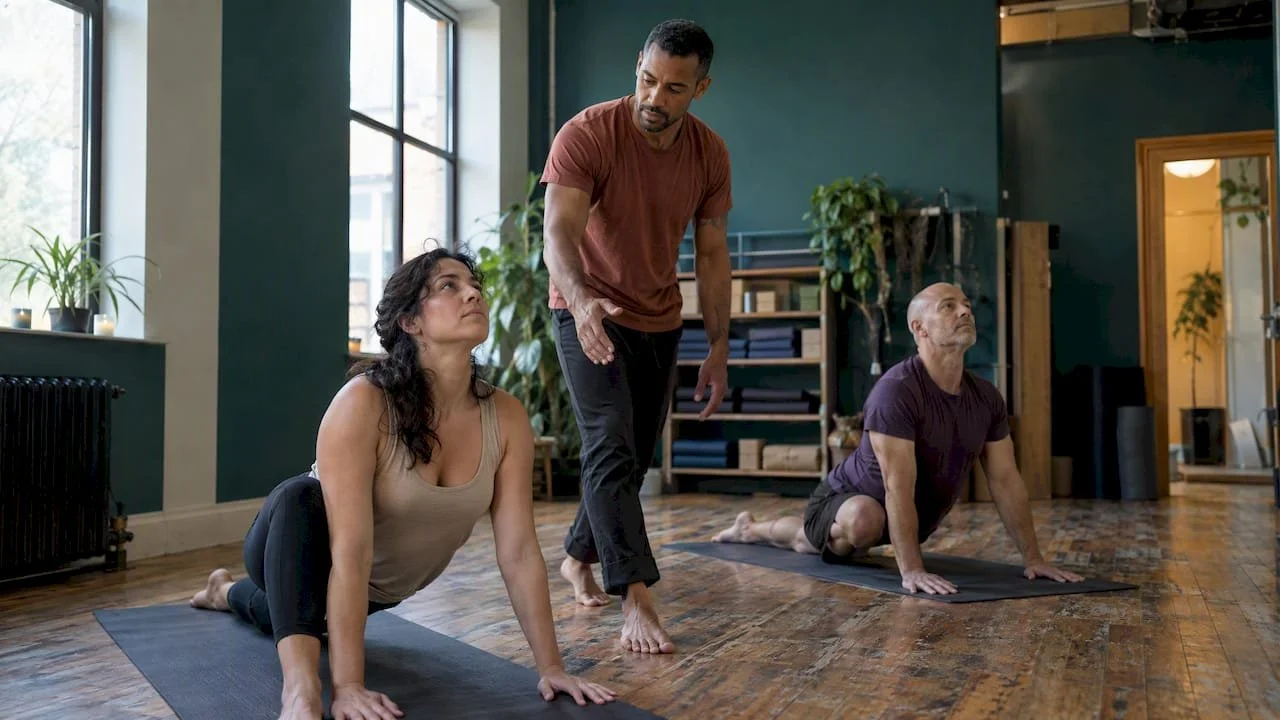
A great yoga teacher combines three things: personal qualities (humility, patience, presence), teaching skills (clear cueing, safe sequencing, real-time observation) and professional habits (consent, boundaries, knowing when to refer a student on). This checklist covers all three. Use it to judge a teacher you are considering, to assess yourself before you enroll in a training, or to audit your own classes if you already teach.
Amritayogawellness
Find Your Yoga Practice
Explore yoga classes and wellness offerings at Amrita Yoga & Wellness in Philadelphia, with options for beginners through advanced practitioners.
TL;DR
The best teachers are made of character plus craft: humility and empathy matter as much as anatomy knowledge and sequencing.
Safety is a skill, not a disclaimer: health screening, modifications, consent-based adjustments and knowing your scope belong on every checklist.
Training should include supervised practice, ethics and assessment, not only hours in a classroom.
Specialization (traditional, exercise-based, therapeutic, Pilates or aerial) shapes your classes and your income options, so choose it deliberately.
Income depends on format, hours, student loyalty and credentials, and most teachers diversify.
Table of Contents
How to use this checklist
The list below is split into five parts. If you are a student, score a teacher on the first four after two or three classes. If you are a future teacher, mark each item as strong, developing or missing, then plan your training around the gaps. If you already teach, ask a trusted student or colleague to rate you too. Your own view of your teaching is usually kinder than theirs.
No one scores a perfect ten. What you are looking for is a teacher who knows where the gaps are and works on them.
Part 1: Personal qualities
These are the traits students feel before they can name them. Yoga Journal's look at what makes a good teacher describes many of them: balancing confidence with humility, respecting boundaries, remembering that everyone is a student, admitting faults, welcoming questions and not taking yourself too seriously.
The checklist
Humility. The teacher says "I don't know, let me find out" without embarrassment, and still practices as a student.
Confidence without ego. They lead the room clearly but do not need to be the center of it.
Empathy. They understand that students arrive stressed, tired, grieving or in pain, and they connect yoga's lessons to ordinary life rather than treating class as a performance.
Patience. They repeat a cue calmly for the fifth time and never make a beginner feel slow.
Memory for people. They learn names, injuries and goals, so a returning student feels recognized.
Openness to questions. Questions during or after class are welcomed, not deflected.
Lightness. A little humor tells students that the room is safe to be imperfect in.
Respect for boundaries. They never pressure a student into a pose, a touch or a belief.
A useful test for any teacher: watch how they respond to the student who cannot do the pose. The answer tells you almost everything.
Part 2: Teaching skills
Character without craft leaves students confused or hurt. The skills below recur across teacher-training frameworks. The UK's BWYQ Level 3 yoga teacher specification is a clear primary example. It expects teachers to plan progressive courses and lessons, consider the effects of yoga on the body, adapt practices for different abilities, give technically correct audible teaching points, and evaluate their own teaching using student feedback.
The checklist
Anatomy and physiology basics. Enough to explain why a cue works and which bodies need a different version.
Clear, audible cueing in plain language. Students should know what to do with their next breath without decoding jargon.
Demonstration used wisely. Showing the shape when words fail, without turning class into a display.
Safe, logical sequencing. A warm-up, preparation for the peak pose, counterposes and a proper wind-down.
Observation. The teacher watches students, not the clock or their own reflection, and adjusts in real time.
Modifications and challenge options. Every pose has an easier and a harder version, offered without judgment.
Prop fluency. Blocks, straps and bolsters are offered as tools, not as signs of failure.
Pacing and voice. Tone and tempo suit the class, from a slow restorative evening to a heated vinyasa.
Reading the room. They notice when the energy drops, when a newcomer is lost, when the group needs rest.
Planning and a Plan B. Lessons have clear aims, and the teacher can pivot when the room is half full or half injured.
The International Yoga Conference's practical guide to teaching lands in the same place: plain-language cueing, careful sequencing, and adapting to students' needs as the class unfolds.
A note on group classes
Traditional yoga was taught one to one, with the teacher adapting practice to the individual. Group classes make that attention harder to deliver. Good teachers compensate: they scan the room, give options aloud, and move among students. That is also why small classes and private sessions suit students with injuries or specific goals.
Part 3: Safety, consent and professional conduct
This is the part many checklists leave out and the part that matters most when something goes wrong. The World Health Organization's Training in Yoga document treats teaching quality as more than technical performance. It ties safe practice to knowledge, supervised practical competence, ethics, empathetic communication, boundaries, assessment and appropriate referral. It also lists confidentiality, informed consent, privacy, incident handling and recognizing medical red flags.
The checklist
Health screening. New students are asked about injuries, pregnancy, medication and conditions before class, and the teacher uses the answers.
Venue and equipment checks. Floors, heat, props and exits are checked before students arrive, and the teacher knows the emergency procedure.
Consent-based adjustments. Verbal cues come first. Hands-on assists are asked for, never assumed, and any student can decline at any time without explanation.
Monitoring discomfort. The teacher distinguishes effort from pain and tells students it is fine to back off.
Scope of practice. A teacher is not a physician or therapist. When a student's needs exceed the teacher's training, a good teacher refers them to a doctor, physical therapist or counselor.
Boundaries and safeguarding. Clear limits on personal contact, social media behavior and the power a teacher holds in the room.
The physical environment is part of consent too. A cramped or exposed space can make students feel unsafe even if the teacher does everything else right. For ideas on how room layout affects comfort, see this piece on trauma-informed room design. The principles carry over to a yoga room: leave space between mats, give students clear sightlines to the door, and never trap anyone in a corner.
If you are a student with a medical condition, tell the teacher before class and ask your doctor about any pose that worries you. If you feel pain, sharp or lasting, stop and seek advice from a qualified health professional rather than pushing through.
Part 4: Training and credentials
Certificates do not make a teacher, but they show a baseline. Three things matter more than the logo on the certificate: how much supervised teaching the trainee did, how they were assessed, and whether the program covered ethics and risk management.
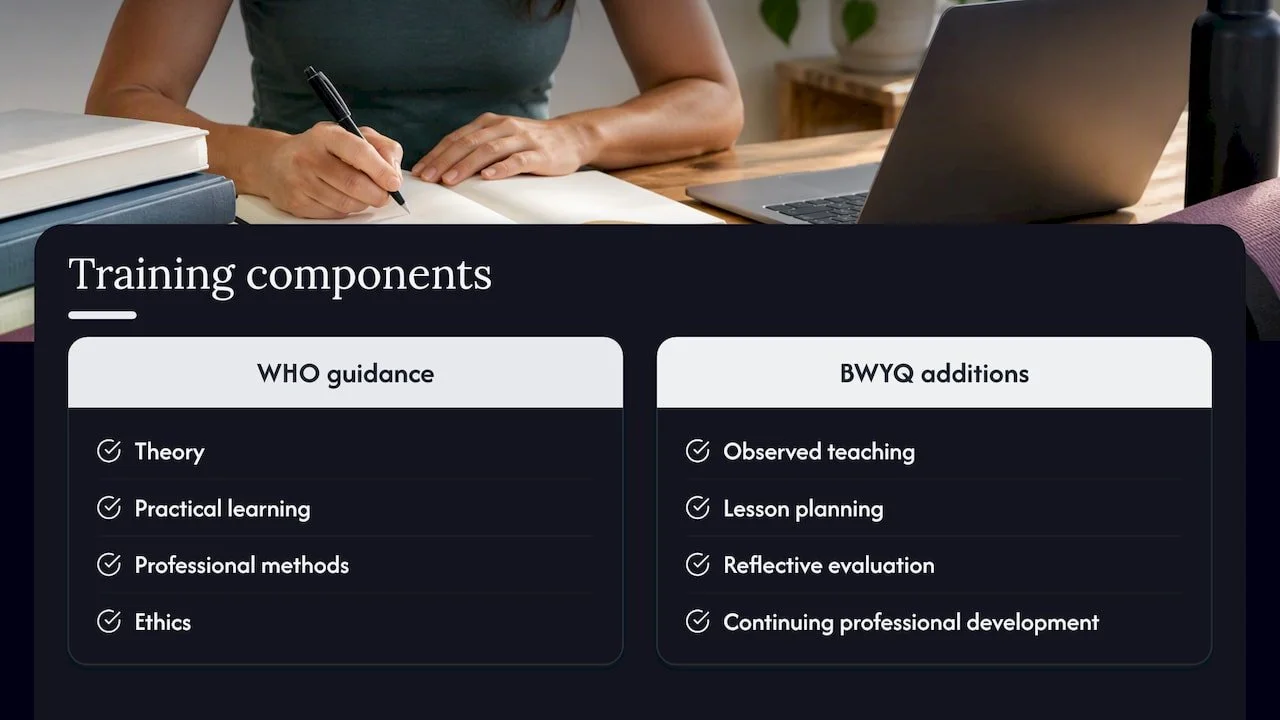
The WHO guidance says professional training should combine theory, practical learning, professional methods, ethics and supervised learning. The BWYQ specification adds observed teaching, lesson planning, reflective evaluation and continuing professional development.
What to compare when choosing a training
| Criterion | What to ask |
|---|---|
| Curriculum | Does it cover anatomy, sequencing, teaching methodology, ethics and philosophy, or mostly one? |
| Trainers | How long have the lead trainers taught, and who assesses you? |
| Lineage or method | Is the approach traditional, athletic or therapeutic, and does that fit the classes you want to teach? |
| Format | In person, online or hybrid, and how much supervised practice teaching is included? |
| Assessment | Are you observed teaching and given written feedback? |
| Standards | Does it meet the standards of a recognized registry? |
| After graduation | Is there mentoring, a path to teach, or continuing education? |
If you are weighing a local route, our guide to a yoga instructor class and certification walks through the steps in more detail.
Prerequisites worth checking
Most trainings expect a consistent personal practice before you enroll, often a year or more as a student. That expectation is sensible: effective pedagogy draws on direct experience and a sustained personal practice of your own. Beyond that, check the age minimum, any required prior classes and attendance rules for the specific program. These vary, so confirm them with the school.
Part 5: Styles and specializations
Your style shapes who you teach and what skills you need to sharpen. An international survey published in 2023 grouped yoga classes into traditional (such as Hatha or Ashtanga), exercise-based (such as Vinyasa or Power) and therapy-focused (such as restorative or gentle). Traditional classes tended to give more time to breathing, meditation and chanting, exercise-based classes gave more time to postures, and therapy-focused classes emphasized meditation and relaxation more than exercise-based ones.
What that means for a checklist:
Traditional styles reward teachers who can explain breath work, philosophy and ritual without preaching.
Exercise-based styles reward precise alignment cues, pacing and the ability to keep a fast class safe. For heated rooms, see our pieces on hot yoga instructor skills and skills, safety and success for hot yoga instructors.
Therapy-focused styles reward listening, a gentle pace and a clear sense of scope, because students often arrive with injuries or stress.
Add-ons such as Pilates, aerial yoga, prenatal or therapeutic yoga typically need extra training and credentials. A Pilates certification is a natural pairing for teachers who already work with rehabilitation or massage clients.
Before specializing, read a good overview of categories of yoga poses so you understand how pose families fit together across styles.
Career benefits and income: what to expect
The benefits of teaching are real: a flexible schedule, a community of regular students, and work that supports other people's health. The money is more modest and more variable than many expect.
Income depends on four things: the teaching format (studio, gym, private, online, workshops, retreats), the number of class hours you can actually fill, how loyal your students are, and your credentials. Most working teachers combine several streams. Group classes in studios are the usual base, and private sessions, workshops and retreats are common additions. Rates differ widely between cities and venues, so ask local studios what they pay before you plan around any national number, and be cautious with online salary figures that assume a full-time class load.
Teaching is also often a second income. In a 2026 UK survey by an insurer, 38% of respondents treated yoga or Pilates teaching as a valued side income alongside other work. That is a UK figure, but it matches what many teachers in the US describe.
A realistic path, step by step
Build a steady personal practice and attend classes in the style you want to teach.
Take a foundational teacher training from a program with supervised practice teaching.
Start with community classes, friends or a few regular students to find your voice.
Ask for feedback after every class and apply it.
Add a specialization once you know which students you enjoy serving.
Pursue continuing education every year, and carry insurance appropriate to your setting.
Our perspective: community first, craft second, ego last
At Amrita Yoga & Wellness, we think the most reliable sign of a good teacher is what happens to the newest person in the room. Our studio is built around inclusivity and beginner approachability, and across our classes, from hot yoga and aerial yoga to Pilates mat and reformer, barre and tai chi, we ask the same of every instructor: guide clearly, offer options, and never make anyone feel behind.
We also believe teaching is a community role. A teacher who knows students' names, notices who has stopped coming, and sends someone to a doctor or therapist when their needs go beyond a class is doing the job well. Technique can be taught in a training. Care shows up in how you treat the person on the mat in the back row.
If you are considering teaching, we would encourage you to practice widely first, in different styles and with different teachers, and to treat your first year of teaching as part of your training.
— Juiced
See good teaching in person
The fastest way to use this checklist is to take a class and score it. At our Philadelphia studio, a group class drop-in is $28 and a community class drop-in is $11, so you can try several teachers and styles without committing to a membership. If you want one-to-one attention on form, modifications or an injury, private sessions start from $85 per hour. You can also read our class descriptions to find a level that fits.
FAQ
What are the essential skills for a yoga teacher?
The essentials are clear audible cueing, safe sequencing, observing students in real time, offering modifications and props, and teaching with consent-based boundaries. Anatomy knowledge and knowing when to refer a student to a health professional sit underneath all of it. Warmth and humility keep those skills from feeling cold.
How do I know if my yoga teacher is qualified?
Ask where they trained, how much supervised teaching the program included, and whether they continue their education. A qualified teacher also asks about injuries before class, offers options, and asks before touching you. If a teacher dismisses your pain or pushes you into a pose, that is a reason to try another class.
Do I need to be able to do advanced poses to teach yoga?
No. Teachers need to understand how poses work, how to build up to them and how to adapt them, which is different from performing the hardest version. A teacher who can explain three ways into a pose often serves students better than one who can only demonstrate the final shape.
Can yoga teaching be a full-time career?
It can, but most teachers combine several income streams, such as studio classes, private sessions, workshops, online classes and retreats. Many also treat teaching as a part-time or second income. Before leaving another job, ask local studios about pay rates and how many classes you could realistically fill.
Sources
BWYQ Level 3 Yoga Teacher Qualification Specification, March 2024
How to Teach Yoga: A Practical Guide, International Yoga Conference
Guidelines for Higher Secondary School Yoga Teacher, Yoga Certification Board of India
Not All Yoga Styles Are the Same: An International Survey, PubMed