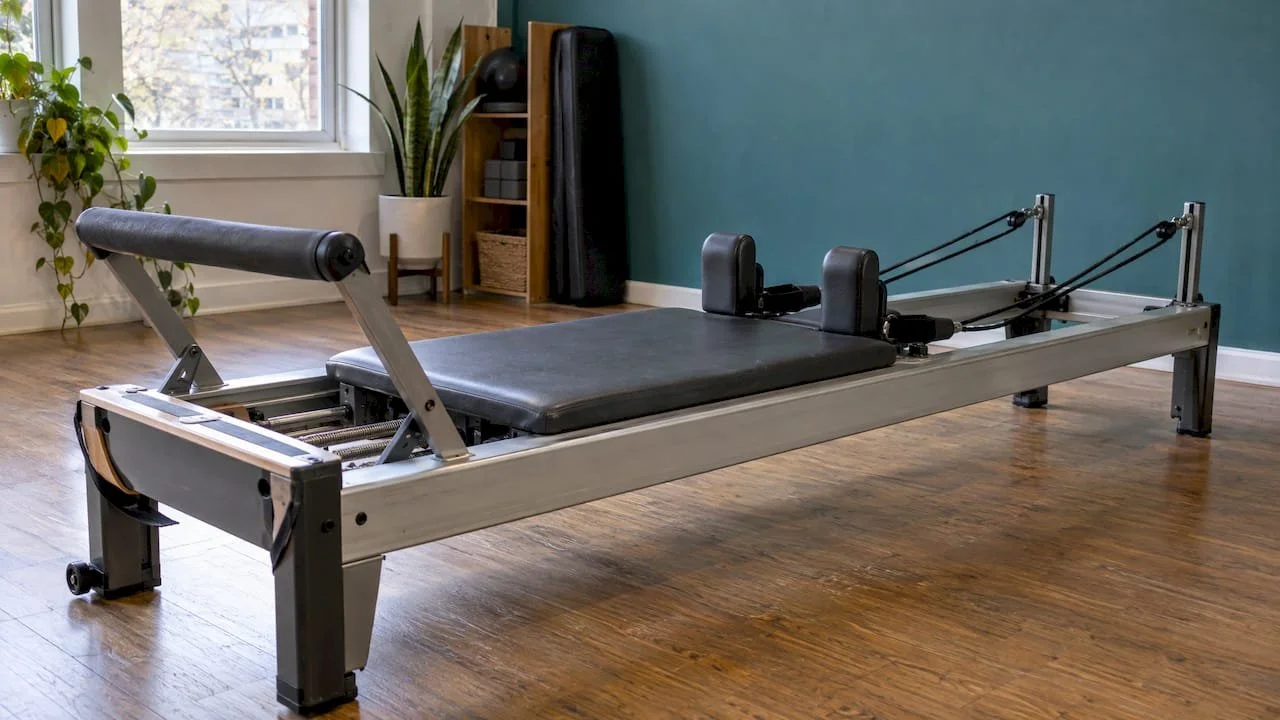
Club Pilates is widely reported to run its classes on Balanced Body reformers, most often the Allegro 2, a studio-grade machine made by one of the best-known names in Pilates equipment. If you are curious about the brand, the short version is that it is a professional spring-based reformer built for group classes, not a gym gadget. The better news for you: the same kind of machine, with the same spring system and adjustable footbar, is what you find in a good boutique studio, and what you feel on it depends far more on the teacher and the class design than on the logo on the frame.
Amritayogawellness
Find Pilates Classes in Philadelphia
Explore Pilates and other wellness offerings at Amrita Yoga & Wellness, a Philadelphia studio with classes for beginners through advanced practitioners.
TL;DR
Club Pilates is widely reported to use Balanced Body reformers, mainly the Allegro 2, with studio-style footbars and springs.
The Allegro 2 is a roughly 94-inch (238 cm) frame with a 39.25-inch carriage, five springs and a locking, adjustable footbar.
Footbar, spring bar and frame height can be configured, so setups can differ between studios.
A reformer class is low-impact and scalable, so beginners can start on the first day with clear instruction.
In Philadelphia, you can try group reformer and mat Pilates with us at Amrita Yoga & Wellness without committing to a membership.
Table of Contents
What Club Pilates is, in one paragraph
Club Pilates is a US franchise of boutique studios built around group reformer classes: one instructor, a room of reformers, and a class that moves through a planned sequence. Our own beginner's guide to Club Pilates describes it as a nationwide, reformer-centered format that adds other apparatus such as a chair and a springboard. If you have taken a class there, you already know the feel: springs, straps, a sliding carriage and a lot of core work.
The reformer behind the classes: Balanced Body
The brand most often named for Club Pilates is Balanced Body, and the model most often named is the Allegro 2. Our summary of the format lists the Allegro 2 as the studio's core apparatus. Some owners and members also describe a wooden Studio Reformer with a Revo footbar. Both are Balanced Body machines, and both belong to the same family of studio reformers, so the answer to "which brand" is consistent even where the model name varies by studio and by when it was equipped.
Balanced Body is not a newcomer. The company says it created the first group reformer program in 2001 and today supplies clubs, studios, universities and resorts with group programs. That history explains why its machines show up so often in franchise rooms: they were designed around the problem of many people sharing equipment, with quick adjustments between users.
Allegro 2 specifications at a glance
If you want to compare machines or just understand what you are lying on, these are the published numbers.
| Feature | Allegro 2 specification |
|---|---|
| Frame length | 94 in (238 cm) with legs, per Balanced Body Australia and Balanced Body Poland |
| Width | 25 in (about 65 cm) frame, 31.25 in with the footbar |
| Carriage | 39.25 x 23.75 in |
| Weight | 151 lb, or 157 lb with legs |
| Maximum user weight | 159 kg, per the Poland product page |
The machine is long and low. Its height is 15 inches on the frame, and the sliding carriage glides on rails so the movement feels smooth and quiet, which matters in a room with a dozen reformers running at once.
The Studio Reformer, its close relative
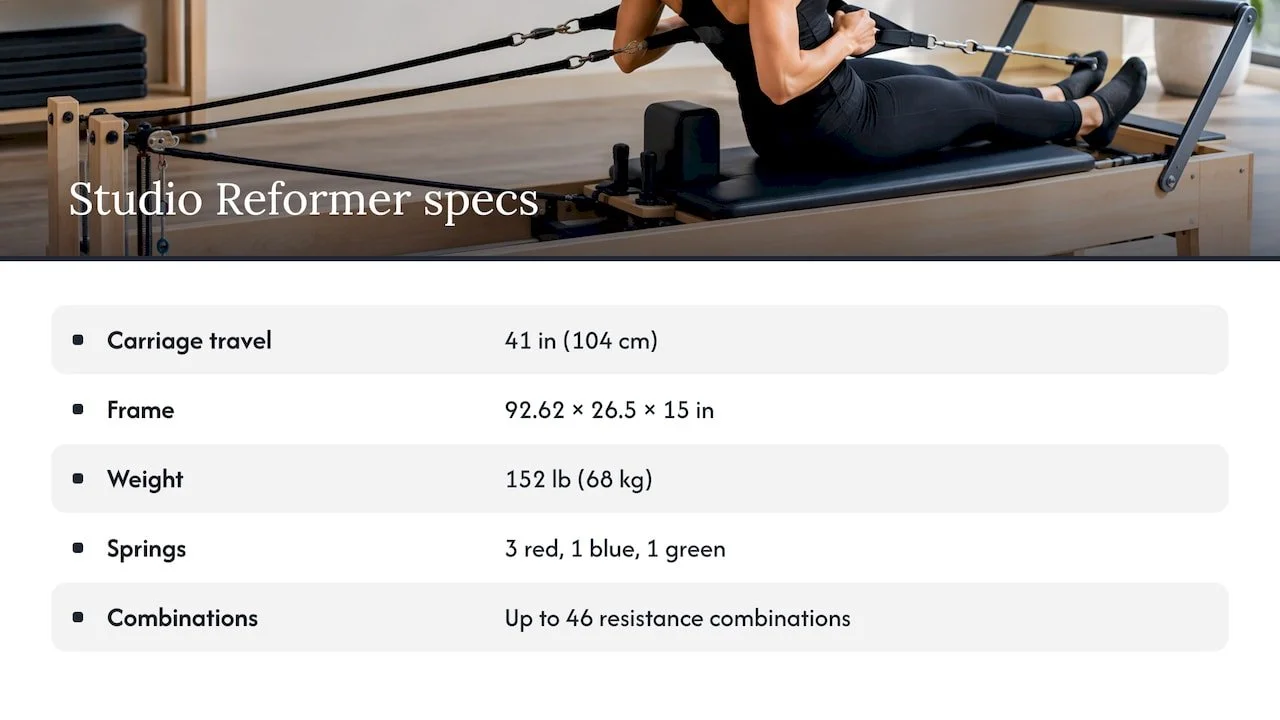
The Studio Reformer is the other Balanced Body machine you will hear about. Its published specifications include 41 inches (104 cm) of carriage travel, a 92.62 x 26.5 x 15 inch frame, a weight of 152 lb (68 kg), and five Signature Springs in three red, one blue and one green, which together give up to 46 resistance combinations. In practice, the difference between the two for a class participant is small: both give you a carriage, springs, a footbar, a headrest and straps.
Where the first Allegro came from
Balanced Body's 2020 catalog describes the first-generation Allegro as the most widely used reformer, with more than 43,000 in service worldwide. It also lists a 36-inch locking footbar with four horizontal and four vertical positions and a 10-year limited warranty. The Allegro 2 builds on that design.
Why setups can differ from studio to studio
Two studios can both say "Balanced Body" and still have slightly different machines. The Studio Reformer, for example, can be ordered with four footbar options (Revo, XSR, Classic and Infinity) and two springbar options (No-Roll and Revo). The same page lists frame heights of 14 inches as standard, 18 inches for easier transfers and 24 inches for clinical ergonomics.
The footbar choice changes how the machine feels:
Infinity: 5 vertical and 32 horizontal positions, the most adjustable.
XSR: 31 inches wide with 6 vertical positions.
Classic: 24 inches wide with 3 heights, the simplest.
This is why a friend who says "my reformer had a different bar" is not wrong. If you are comparing a class you took in one place with a class somewhere else, the machine is usually from the same family, and the differences are in the footbar, the frame height and how the teacher sets the springs.
What to know before buying a reformer for home
Some people search this keyword because they want the exact machine for home. A few practical points help.
Space. A full studio reformer is almost eight feet long. Add room to step around it and to store the footbar and straps.
Weight. At roughly 150 lb, it is not a machine you move between rooms often.
Springs. A studio setup of five springs gives you a range of resistance. Fewer springs means fewer ways to progress.
Footbar. More positions suit more body sizes and exercises.
Build quality. Frame, rails and carriage wheels decide how smooth the glide is for years.
When you compare models, it also helps to read about what premium fitness equipment can offer in durability and design so you judge a machine on materials and function rather than only the price tag.
A home reformer gives you the apparatus. A class gives you the programming, the cues about alignment, and the adjustments for your body. Most people who own a reformer still want a teacher in the room at least some of the time, particularly in the first months.
What a reformer class feels like for a beginner
A reformer has a sliding carriage you push and pull against spring resistance. Your own body weight is the load, and the springs make an exercise easier or harder. Beginners often assume this makes it intimidating. It tends to do the opposite: the springs can support you, and the teacher can change the load in seconds.
Here is what your first class usually involves:
You are shown how to set the footbar and headrest for your height.
You start with footwork, pressing the carriage out and in with controlled breath.
You move through leg work, arm work with straps and core sequences.
The teacher gives a spring and range option for each exercise.
Wear fitted clothing and grip socks. Tell the teacher about any injury, recent surgery or pregnancy before class starts, and talk to your doctor or physical therapist first if you are recovering from an injury or managing a medical condition. Our guides on what a Pilates reformer does for your body and reformer Pilates for core strength and flexibility explain what you can expect to feel over the first weeks. If you want to see the range of machines, we also cover seven types of Pilates reformer.
Why the machine matters less than the class
The reformer is a tool. Two people on identical Allegro 2 machines can have very different experiences, because progress comes from how a class is built: how clearly the teacher cues, how many people share the room, whether modifications are offered, and whether anyone watches your form.
When you choose a studio, these are the things worth asking about:
How many reformers are in a class, and how many people does one teacher cover?
Is there a beginner-specific class or pass?
Can you move between reformer, mat, yoga and barre as your body changes?
Are private sessions available if you need individual attention?
Those questions decide whether you keep going, and consistency is what produces results.
Perspective
We hear the reformer question often, and it is a good one. People want to know what they will be lying on before they walk in. Our view is that the machine is the starting point, and the teaching is where the value is.
At Amrita Yoga & Wellness we are a Philadelphia studio built around inclusivity, beginner approachability and community. We offer pilates mat classes and group reformer classes alongside yoga, barre and tai chi, so you can build a practice that fits your body week to week. Our class structures and detailed guidance are designed for safety, personal growth and connection at every level.
For us, a reformer class should leave a beginner feeling capable, not lost. That is why we also offer private sessions for people who want one-to-one attention, and a beginner pass called Nurtured Beginnings for those taking their first steps.
Juiced
Try reformer and mat Pilates in Philadelphia
If you would rather feel a reformer than read about one, start with a single class. A group class drop-in is $28 per session, and the Nurtured Beginnings pass is $35. If you know you will come regularly, our unlimited group classes are $169 per month, and monthly memberships run from $119 (Earth) to $149 (Air). Private sessions start from $85 per hour on our private yoga and mat Pilates page, a good fit if you are working around an injury or want help with posture and mobility.
You can see current times on our class and monthly experience schedule and read the studio and cancellation policies before you book.
FAQ
What reformer does Club Pilates use?
Club Pilates is widely reported to use Balanced Body reformers, mainly the Allegro 2. Some members describe a wooden Studio Reformer with a Revo footbar. Both are professional studio machines from the same manufacturer.
Can I buy the same reformer for home?
Balanced Body sells its Studio Reformer directly, with a choice of footbars and frame heights. It weighs about 152 lb and is nearly eight feet long, so measure your space first. Many people also keep taking classes for instruction and variety.
Is a reformer class good for beginners?
Yes. The springs let a teacher scale each exercise up or down, and the movement is low-impact. Tell your teacher about injuries, surgery or pregnancy before you begin, and check with your doctor if you have a medical condition.
Do all studios use the same footbar?
No. Balanced Body offers four footbar options and two springbar options, and frame heights vary. A studio's choice changes how adjustable the machine is, but the basic movement is the same.