Pilates Crossover for Fitness Pros: Certify, Program, Launch

TL;DR:
Fitness professionals should pursue a Pilates crossover program to meet growing client demand and enhance retention. Integrating Pilates sequences into strength sessions improves movement transfer, expands client segments, and boosts revenue with minimal equipment investment. Starting with a structured 8-16 week plan, trainers can build their dual-discipline offerings through certification, pilot programs, and targeted marketing efforts.
Yes — pursue a structured Pilates crossover. The fastest path is a bridging (crossover) program if your documented training hours qualify, or a foundational certification if they don't. Start today by pulling your training transcripts and booking an info session with an accredited bridging program. The demand is real: 57% of new members in a recent 2026 U.K. pilot named Reformer Pilates as their primary reason for joining. That's a client-acquisition lever most fitness professionals aren't using yet.
Before you go further, check two things:
Your documented training hours. Most bridging programs require a 450-hour minimum; applicants with fewer than roughly 300 apprenticeship hours often need full re-enrollment rather than a bridge.
Your current scope of practice. Adding Pilates to your offer changes what you screen for, what liability coverage you need, and when you refer out.
Pro Tip: Audit your certificates and training logs this week. A single missing transcript can delay bridging admission by a full enrollment cycle.
Table of Contents
Why should fitness professionals integrate Pilates into their services?
How do you teach Pilates effectively inside a fitness setting?
Which equipment and formats scale Pilates across your business?
The case for Pilates crossover is stronger than most fitness pros realize
Amrita Yoga & Wellness helps you build your Pilates crossover offer
Why should fitness professionals integrate Pilates into their services?
57% of new members in a 2026 U.K. pilot program named Reformer Pilates as the primary reason for joining — making it one of the strongest documented demand signals in group fitness right now.
That number matters for two reasons. First, it shows Pilates isn't a niche add-on; it's a primary acquisition driver. Second, it means clients are already walking in the door expecting it. Fitness professionals who can deliver it capture that demand directly instead of sending clients elsewhere.
The conditioning case is equally strong. Hybrid programs that blend Pilates principles with strength training improve lifting mechanics, mobility, and core control while staying time-efficient. The Pilates x Lift model, for example, structures five 35-minute sessions per hybrid cycle, pairing Pilates sequences with compound lifts to reinforce movement patterns and increase time-under-tension without extending session length.
Business outcomes fitness professionals report from Pilates integration:
Incremental revenue through premium-tier or per-class surcharges on Reformer sessions
Higher session commitment from clients enrolled in progressive cohorts versus drop-in formats
Expanded client segments: post-rehab adults, performance athletes, and busy professionals seeking low-impact strength work
Reduced client attrition, since Pilates for wellness programming tends to build longer-term habits than pure strength cycles
Boutique operators are already moving here. YogaSix launched Y6 Core, a Pilates-inspired class mixing core strengthening, upper-body engagement, and full-body controlled movement, specifically to capture the audience seeking mindful, low-impact strength work.
What certification pathway fits your crossover goals?
The word "crossover" means two different things in this industry, and confusing them costs time and money. The first meaning is a formal teacher-credential bridge: a lineage-specific program that recognizes your prior comprehensive training and aligns you with a new methodological approach. The second is the broader gym trend of adopting standardized Pilates-style group classes to scale delivery. Both are legitimate paths; they just require different commitments.
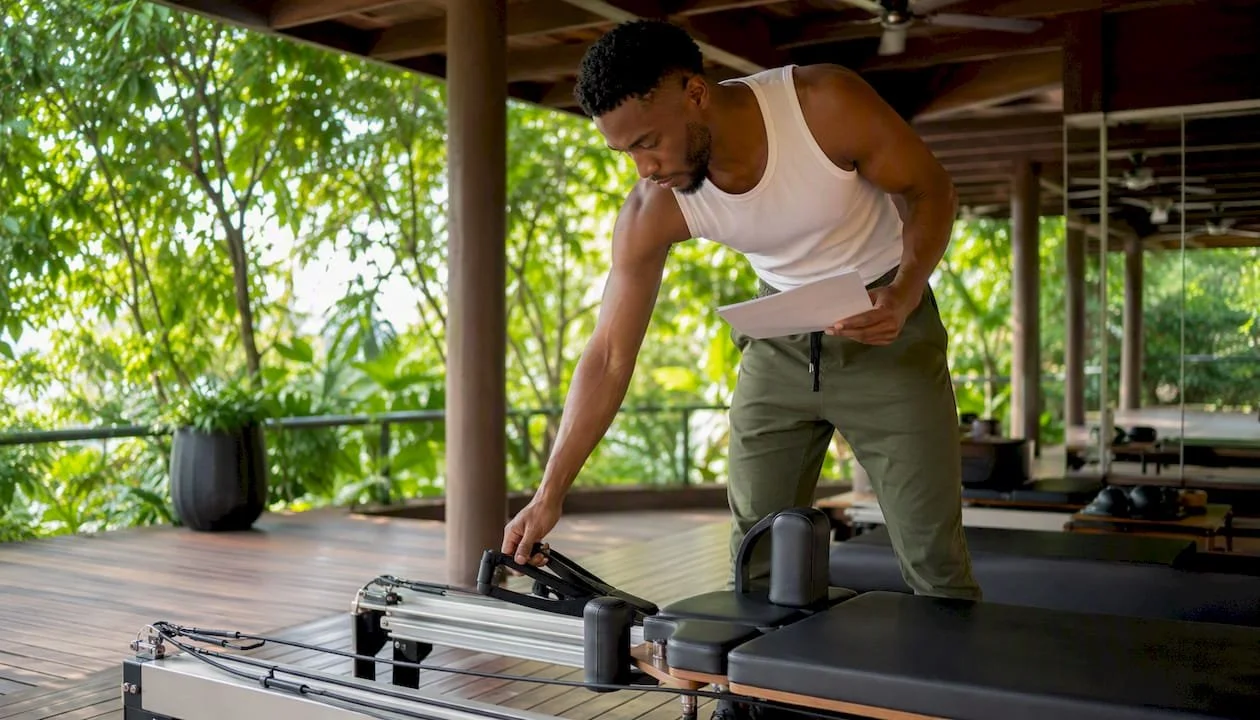
For the formal bridge, Core Pilates NYC's crossover program sets a clear benchmark: a 450-hour minimum for crossover applicants, with the rule that applicants holding fewer than roughly 300 apprenticeship hours may need to re-enroll in a full certification rather than bridge. The program structure typically includes immersive weekend intensives, supervised practice hours, and a practical test-out before the credential is awarded.
Certification checklist before you apply:
Gather all training transcripts and certificates; calculate total documented hours
Confirm whether your hours meet the 450-hour threshold or fall below the ~300-hour re-enrollment line
Contact your target program directly to verify accepted bridging admissions and lineage compatibility
Plan your apprenticeship and supervised practice hours into your calendar before enrolling
Review your liability insurance policy; adding Pilates instruction often requires a rider or separate coverage
Note when to refer out: clients with acute spinal conditions, osteoporosis, or recent surgery need clearance from a healthcare provider before you program Pilates for them. For clients with low bone density, safe exercise guidelines should inform your screening and modification decisions.
One clarification worth making: Crossover Symmetry is a resistance-band shoulder system developed for rehab and performance, not a Pilates method or bridging program. The names overlap in search results and can create real confusion when fitness professionals are researching certification options.
How do you build a practical dual-discipline program?
Integrate Pilates sequences within strength sessions rather than dedicating separate days to each discipline. The dual-discipline model works because it reinforces movement patterns in context: a client who practices pelvic control in a Pilates sequence immediately before a loaded hinge transfers that motor pattern directly into the lift.
Sample one-week microcycle (intermediate level):
Monday — Hybrid session A: 20 min Pilates mat sequence (spine articulation, single-leg work, hip stability) + 25 min compound strength (deadhinge, goblet squat, row)
Tuesday — Active recovery or mobility: 30 min targeted hip and thoracic work
Wednesday — Hybrid session B: 20 min Reformer-style footwork and core series + 25 min upper-body strength (press, pull, carry)
Thursday — Rest or light walk
Friday — Hybrid session A repeat with progressive load or rep increase
Saturday — Group Reformer-style class (45–55 min, see Session Plan A below)
Sunday — Rest
Session Plan A — 45–55 min group Reformer-style hybrid class:
5 min: breath and pelvic floor activation, neutral spine setup
15 min: footwork series (parallel, Pilates V, wide stance) with progressive spring resistance
10 min: core series (hundred variation, single-leg stretch, oblique curl)
15 min: standing compound work (squat to press, lateral lunge with band)
10 min: cool-down, spine stretch, supine hip release
Session Plan B — 45 min private hybrid session (corrective + loadable lifts):
10 min: movement screen (hip hinge pattern, overhead reach, single-leg balance)
15 min: corrective Pilates sequence based on screen findings (e.g., clam series for hip stability, cat-cow for spinal mobility)
15 min: loadable lifts with Pilates cueing integrated (Romanian deadlift with pelvic neutral cue, single-arm row with scapular cue)
5 min: client debrief and movement marker notation.
Progression table:
| Level | Pilates Focus | Strength Load | Key Marker |
|---|---|---|---|
| Beginner | Neutral spine, breath, pelvic control | Bodyweight or light resistance | Consistent neutral pelvis in hinge |
| Intermediate | Single-leg stability, rotation, hip dissociation | Moderate load, 3–4 sets | Scapular upward rotation during press |
| Advanced | Dynamic control under load, full reformer repertoire | Heavy compound lifts, tempo work | Pelvic stability during single-leg loaded hinge |
For exercise progressions across levels, the principle stays the same: add complexity or load only after the movement marker is clean.
How do you teach Pilates effectively inside a fitness setting?
Teach the why first. When clients understand that a cue like "knit your ribs down" prevents lumbar hyperextension during a press, they self-correct faster and stay engaged longer. Master educator Shannon Willits puts it plainly: when students understand the science behind a movement, they stay in their programs for the long haul.
Pre-session screening checklist:
Spinal history: disc issues, fusions, scoliosis
Shoulder history: impingement, rotator cuff repairs
Hip history: labral tears, replacements
Pregnancy or postpartum status
Current pain or active inflammation
High-impact teaching cues:
Breath: "Inhale to prepare, exhale to initiate the movement" — links breath to core activation
Pelvic position: "Find neutral, not flat" — prevents posterior pelvic tuck during hip work
Ribcage management: "Soften the front ribs toward the floor" — reduces thoracic flare in supine work
Scapular stability: "Draw the shoulder blades down and wide" — sets the base for all pressing and pulling
Three common modifications:
Lower-back sensitivity: Replace roll-up with supported spine stretch; use a wedge under the pelvis for supine work
Shoulder impingement: Substitute overhead reach with a horizontal pull; avoid loaded external rotation until cleared
Pregnancy/postpartum: Avoid supine work past the first trimester; use side-lying and seated variations; screen for diastasis recti before loading the core. For clients managing bone health concerns alongside these modifications, high-impact exercise guidance can help you calibrate load safely.
Pro Tip: Use one objective movement marker per session — pelvic control during a hinge, for example — and note it in the client's file. That single data point becomes your progress story and your pricing justification.
Which equipment and formats scale Pilates across your business?
Pick the lowest-friction format that fits your business model first, then upgrade equipment as revenue supports it.
Equipment options:
Mat + small props (resistance bands, foam roller, magic circle): lowest cost, highest scalability, works in any space
Reformer: premium positioning, higher per-session revenue, requires dedicated space and significant capital investment
Tower/Cadillac: advanced corrective work, best for private or semi-private settings
Resistance bands (general): versatile for group formats, easy to standardize
Format guidance:
Single private sessions: highest revenue per hour, best for corrective or post-rehab clients; price at a premium tier
Small-group Reformer cohorts (4–6 clients): strong retention, progressive curriculum, justifies equipment investment
Class-based Reformer-style formats: scalable with pre-choreographed delivery (similar to the Les Mills model); lower instructor prep time, consistent client experience
Mat-based group classes: easiest to launch, lowest overhead, ideal for piloting demand before investing in equipment
For a breakdown of different Pilates styles and which formats suit different client goals, that's a useful reference when building your initial class menu.
Pre-choreographed formats prioritize scalability and staff consistency. Classical lineage-based training prioritizes depth and client specificity. Neither is wrong; the choice depends on whether you're building a volume model or a premium private practice.
How do you launch a Pilates crossover in 8–16 weeks?
A realistic rollout fits an 8–16 week window. The first four weeks are preparation; weeks five through ten are pilot; weeks eleven through sixteen are scale.
Weeks 1–2: Audit training hours, pull transcripts, select bridging program or foundational course, confirm insurance coverage
Weeks 3–6: Complete bridging intensive or first certification module; acquire minimum equipment (mat + props to start)
Weeks 7–10: Run a paid pilot cohort (4–8 clients); collect attendance, movement marker data, and client feedback
Weeks 11–16: Refine programming based on pilot data; set permanent pricing; market to broader client base
Budget ranges:
Mat-based launch: $500–$1,500 for props, continuing education, and liability rider
Reformer-equipped launch: $3,000–$15,000+ depending on whether you lease, buy used, or purchase new
Marketing moves that work:
Lead with the pilot result: "X out of Y clients improved their hinge pattern in four weeks"
Position Pilates crossover for specific segments: post-rehab adults, performance athletes, time-pressed professionals
Use Pilates core strength content to educate prospective clients before they book
Early club pilots show that adding a small per-class surcharge on Reformer sessions drives both attendance increases and stronger client commitment compared to flat-rate memberships.
Always screen clients before their first session and carry appropriate liability coverage for the modalities you teach. This article is general professional guidance; confirm scope-of-practice and insurance requirements with your certifying body and a qualified legal or insurance professional for your specific situation.
Key Takeaways
Fitness professionals who pursue a structured Pilates crossover, combining a bridging credential with integrated dual-discipline programming, gain a measurable client-acquisition and retention advantage backed by documented pilot demand.
| Point | Details |
|---|---|
| Demand is documented | 57% of new members in a 2026 U.K. pilot cited Reformer Pilates as their primary joining reason. |
| Know your hour threshold | Bridging programs typically require 450 hours; fewer than ~300 apprenticeship hours usually means full re-enrollment. |
| Integrate, don’t segregate | Blend Pilates sequences within strength sessions using the dual-discipline model for better motor transfer and time efficiency. |
| Track one movement marker | Objective markers (pelvic control, scapular rotation) measure progress, justify premium pricing, and guide programming adjustments. |
| Amritayogawellness supports your launch | Amrita Yoga & Wellness offers workshops, programming templates, and private mentoring to help fitness professionals build and pilot a Pilates crossover offering. |
Pro Tip: Your immediate next step: pull your training transcripts today, calculate your documented hours, and register for a bridging info session or a foundational Pilates course this week.
The case for Pilates crossover is stronger than most fitness pros realize
The conventional wisdom treats Pilates as a separate discipline, something you add to your menu after you've built everything else. That framing is backwards. The fitness professionals seeing the strongest client retention and the most referrals right now are the ones who've stopped separating Pilates from strength work and started treating them as one integrated system.
What gets underestimated is the teaching shift required. Adding Pilates to your offer isn't just learning new exercises. It's learning to see movement differently: to notice a client's ribcage flaring during a press, to catch the moment pelvic control breaks down under load, and to cue the correction before the compensation becomes a habit. That skill transfers back into every other modality you teach.
The 57% pilot stat is striking, but the more durable argument is what happens after the client joins. Clients who understand why they're doing a movement, not just how, stay longer, progress faster, and refer more. That's the real return on a Pilates crossover investment, and it shows up in your retention numbers within a single programming cycle.
Amrita Yoga & Wellness helps you build your Pilates crossover offer
Fitness professionals who want to move from "I should add Pilates" to a running pilot cohort in under 16 weeks have a concrete starting point at Amrita Yoga & Wellness. The studio offers workshops, one-week microcycle templates, and private mentoring sessions designed specifically for trainers building their first integrated Pilates and strength program.
Reach out to get a programming audit, a starter kit with session plan templates, and direct guidance on selecting the right certification pathway for your current training hours. Whether you're launching a mat-based group class or building toward a small-group Reformer cohort, the support is structured around your timeline and budget, not a generic curriculum.
Visit Amrita Yoga & Wellness to book a mentoring session or explore upcoming workshops and get your Pilates crossover off the ground.
Useful sources and further reading
2026 Reformer Pilates pilot statistic and Les Mills program launch: Athletech News — Les Mills Reformer Pilates
Core Pilates NYC crossover program (450-hour threshold, bridging structure): Core Pilates NYC — The Core Crossover
Pilates x Lift hybrid programming model: Women's Health — Pilates x Lift Plan
Shannon Willits on biomechanics-based teaching and the 'why' behind movement: shannonwillits.com
Crossover Symmetry clarification (resistance-band shoulder system, not a Pilates bridge): Crossover Symmetry — What Is It?
YogaSix Y6 Core Pilates-inspired class launch: Athletech News — YogaSix Y6 Core