
Heated Vinyasa Yoga Benefits: What the Research Shows

TL;DR:
Heated vinyasa yoga offers benefits like improved flexibility, balance, and mental health, but it carries risks for certain individuals. Most healthy adults can practice safely with gradual acclimation, proper hydration, and attentive monitoring. Evidence supports flexibility and balance gains, while cellular stress responses differentiate hot from normal yoga effects.
Heated vinyasa yoga delivers real, measurable physical and mental benefits — faster flexibility gains, improved balance, a meaningful cardiovascular stimulus, and reduced perceived stress — but it carries genuine risks for people with heart disease, pregnancy, heat intolerance, or dehydration. Most healthy adults can practice it safely with a gradual acclimation plan and attentive body-signal monitoring.
Primary benefits at a glance:
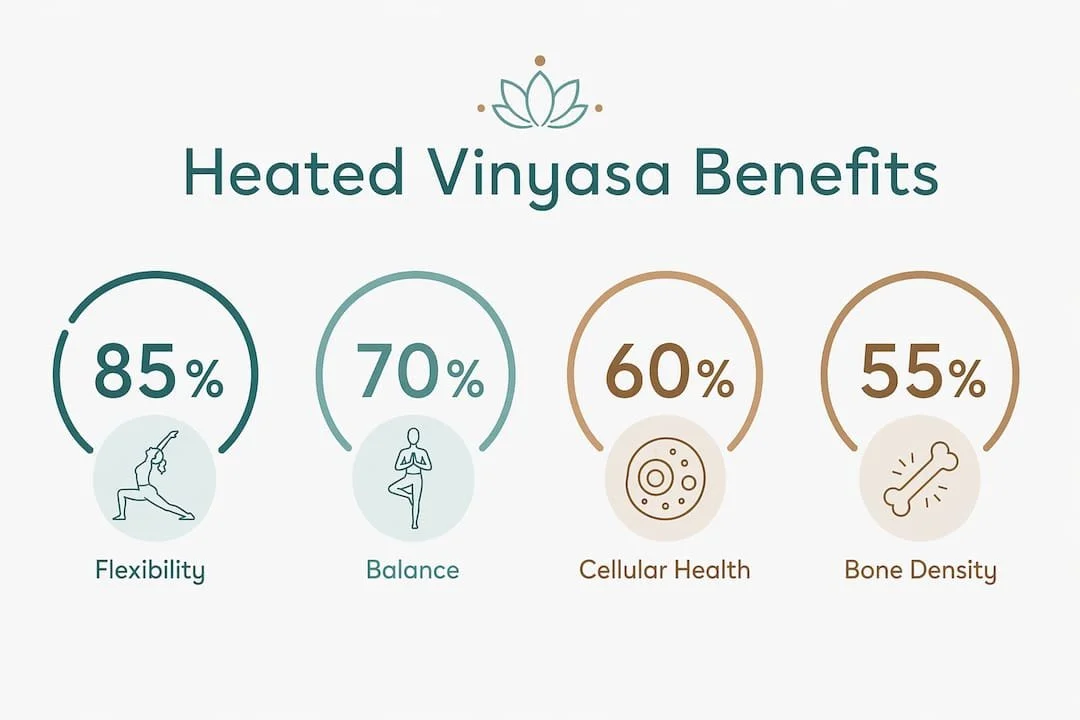
Flexibility and range of motion: Heat softens connective tissue, and studies consistently show flexibility gains with chronic practice.
Balance and functional strength: Randomized trials report significant single-leg balance improvements and modest isometric strength gains over 8-week programs.
Cardiovascular and cellular stimulus: Heated sessions raise heart rate and core temperature and, in some protocols, increase HSP70 expression in immune cells — a cellular stress-adaptation marker.
Mood and stress reduction: Research links regular hot yoga practice to lower perceived stress and improved quality of life, particularly in inactive or stressed adults.
Bone mineral density: The 2025 systematic review found chronic practice associated with bone-density improvements across 43 studies and 942 participants.
Safety headline: Avoid heated classes if you are pregnant, have heart disease, take medications that impair heat regulation, or have a history of heat illness. If any of those apply, consult a clinician before stepping into a hot room. For everyone else: start slow, hydrate early, and treat breathlessness or dizziness as a hard stop signal.
Table of Contents
Physical benefits explained: what the research actually supports
Mental and emotional benefits: stress, mood, and what heat actually adds
Who should avoid heated vinyasa and how to recognize heat illness
How to get started: practical steps for your first heated vinyasa class
What heated vinyasa yoga is and how it differs from Bikram
Heated vinyasa (sometimes called hot vinyasa) is a flow-based yoga practice performed in a warm or hot room. Unlike Bikram yoga, which follows a fixed 26-posture sequence in a room held at exactly 105°F and 40% humidity for 90 minutes, heated vinyasa classes vary the sequence, the teacher, and often the temperature. That flexibility is part of the appeal — and part of why the research picture is messier.
According to the 2025 systematic review, typical hot-yoga sessions across 43 studies lasted a variable duration at temperatures within a wide range that reflects real studio variation, with humidity varying as well. Those are wide bands and reflect real studio variation. A "warm" vinyasa class might run at 86°F; a hot vinyasa class at a more intense studio might push toward 100°F or above.
| Feature | Heated vinyasa | Bikram yoga |
|---|---|---|
| Sequence | Variable, teacher-led flow | Fixed 26-posture sequence |
| Class length | Typically 20–90 minutes | 90 minutes |
| Temperature range | ~86–105°F (varies by studio) | ~105°F / 40% humidity |
| Humidity control | Often not strictly controlled | Precisely maintained |
| Research representation | ~2% of hot-yoga studies | Majority of the literature |
One important caveat: vinyasa comprised approximately 2% of the hot-yoga methods studied in the systematic review. Most of what researchers know comes from Bikram trials. That does not mean heated vinyasa lacks benefits — it means the evidence is extrapolated more than it is direct.
Physical benefits explained: what the research actually supports
Heat changes the body's mechanical and physiological environment in ways that matter for yoga practice. The Cleveland Clinic notes that warmth helps lubricate tendons and ligaments, making stretches more accessible — but also raising the risk of overexertion if practitioners push too hard.
Flexibility and range of motion show the most consistent evidence. Heat reduces tissue stiffness acutely, and chronic practice compounds that with genuine neuromuscular adaptation. Across the studies reviewed, flexibility improvements were among the most reliably reported outcomes.
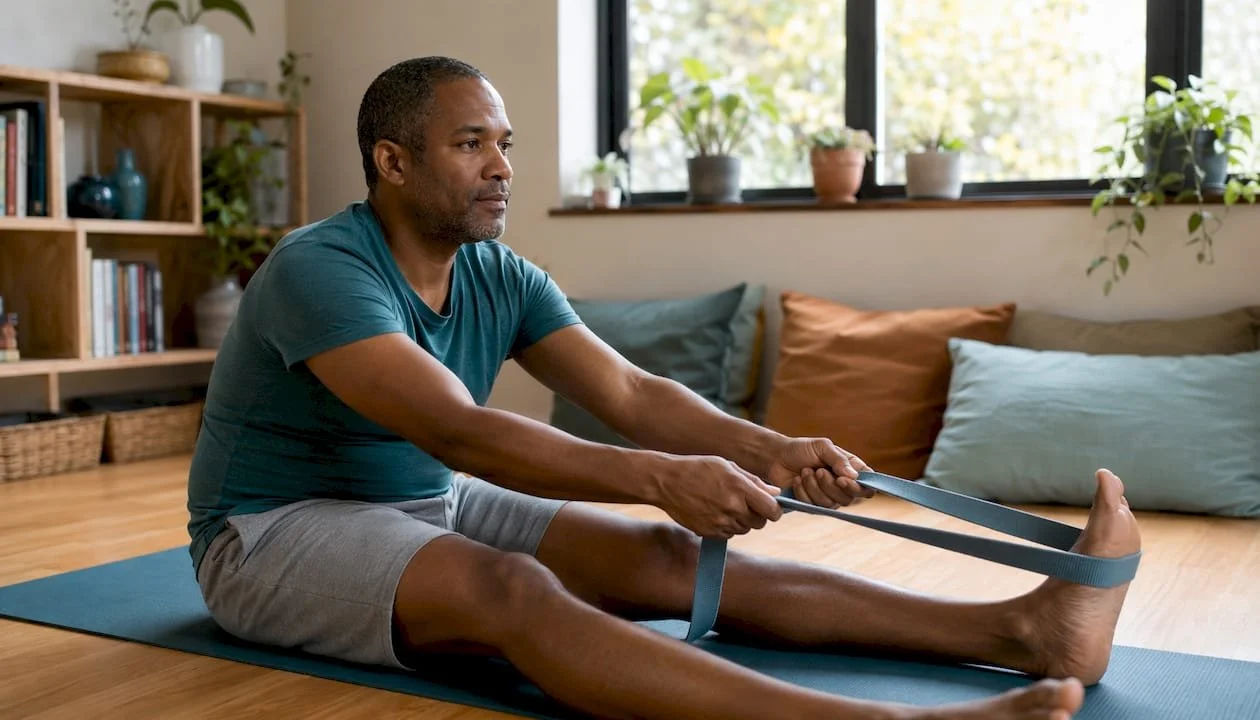
Balance and functional strength also have solid backing. One protocol that produced measurable gains ran 8 weeks at three sessions per week; reported improvements included a 13% increase in isometric strength and large improvements in single-leg balance in some randomized controlled trials. Those are meaningful numbers for everyday functional health, not just yoga performance.
Cardiovascular and cellular adaptations are more nuanced. Heated sessions raise core temperature and heart rate acutely, but the Sports Medicine systematic review found that hot yoga does not necessarily increase overall energetic demands compared with non-heated yoga. The heat adds a thermoregulatory stress, not simply more calories burned. In one randomized study, 12 sessions of hot yoga increased expression of HSP70 (a cellular heat-shock protein tied to stress adaptation) in peripheral blood cells, while BDNF — a neural growth factor — rose across yoga groups regardless of temperature.
Bone mineral density improvements appeared in chronic interventions (6–36 sessions), which is a meaningful finding for adults concerned about long-term skeletal health.
| Benefit | Evidence strength | Notes |
|---|---|---|
| Flexibility / range of motion | Consistent positive evidence | Acute and chronic effects both documented |
| Balance | Consistent positive evidence | Large improvements in some RCTs |
| Functional strength | Moderate evidence | Isometric gains in 8-week protocols |
| Bone mineral density | Moderate evidence | Chronic practice (6+ sessions) required |
| Aerobic fitness (VO2max) | Limited / mixed | Some trials show modest gains; others show none |
| Body composition | Limited / mixed | Inconsistent across studies |
Pro Tip: In a heated class, your body will feel more open than it actually is. Stop a stretch when you feel mild tension, not when you hit your apparent maximum. If you feel a sharp sensation at the joint, back off immediately — heat masks the warning signal that would normally stop you.
Mental and emotional benefits: stress, mood, and what heat actually adds
The mental-health case for heated vinyasa is real, though it requires some unpacking. Not every benefit comes from the heat itself.

How to get started: practical steps for your first heated vinyasa class
Before you arrive:
Drink 16–20 oz of water in the two hours before class; avoid large meals within 90 minutes of the start time.
Wear light, moisture-wicking clothing — less fabric is better in a hot room.
Bring a full water bottle (at least 20 oz), a yoga mat, and a towel.
Tell the teacher it is your first heated class. That single sentence will get you better cues and more check-ins.
During class:
Beginners should treat the first few sessions as orientation, not performance. Child's pose is always available and always appropriate. Use it whenever your breath becomes labored or your heart rate feels too high to sustain. A useful internal benchmark: if you cannot breathe through your nose, you are working too hard for where you are in your acclimation.
A 4-week acclimation approach:
Week 1: One class, shorter format if available (45 minutes). Focus entirely on staying in the room and breathing. Do not worry about pose depth. Rest at least two days before your next session.
Week 2: Two classes. Begin engaging with the flow, but continue using child's pose freely. Notice how your body responds in the 24 hours after class — fatigue, thirst, and sleep quality are all useful signals.
Week 3: Two to three classes. Start working on pose alignment rather than just survival. Hydration should now be a habit, not an afterthought.
Week 4: Three classes if recovery feels good. You can begin exploring fuller ranges of motion, but keep the end-range caution from the physical benefits section in mind.
For detailed hot yoga preparation guidance including what to eat and how to recover post-class, Amritayogawellness's blog covers the specifics well.
Pro Tip: Wear a heart-rate monitor or use your watch's HR feature for the first few classes. If your heart rate climbs above what feels sustainable for conversation, sit down. In a hot room, cardiovascular load can spike faster than perceived exertion suggests.
Myths vs. facts: what heated vinyasa does not do
A few persistent misconceptions follow hot yoga everywhere. They are worth addressing directly.
Myth: Sweating detoxifies your body. Sweat cools you down. The liver and kidneys handle detoxification. Sweat contains trace amounts of metabolic waste, but the quantities are physiologically insignificant compared with what your organs process daily. No credible clinical source supports sweat-based detox as a meaningful health mechanism.
Myth: You will lose fat from a hot yoga class. The weight you lose immediately after class is almost entirely fluid. Drink water and it comes back. Fat loss requires sustained caloric expenditure over time. Hot yoga can contribute to that if practiced consistently, but a single session's sweat is not a fat-loss event.
Myth: Heat makes a pose intrinsically better or safer. Heat makes a pose more accessible by reducing tissue stiffness. It does not make it safer. The same heat that lets you sink deeper into a forward fold also masks the strain signals that would normally tell you to stop. Practitioners who push to their apparent maximum in a hot room are at higher injury risk, not lower.
Myth: If you feel fine, you are fine. Heat illness can develop quickly and without obvious warning. Feeling okay at minute 45 does not mean you will feel okay at minute 60. Monitoring breath quality and heart rate throughout class matters more than how you feel in any single moment.
What the studies actually say: a research summary
The strongest single source on this topic is the 2025 systematic review published in Sports Medicine — Open, which analyzed 43 studies and 942 participants — 76% of whom were female. Common protocols ran sessions of 20–90 minutes at 86–125°F, with chronic interventions spanning 6–36 sessions over 1–16 weeks. The outcomes that improved most reliably were flexibility, balance, and some functional-strength markers. Bone mineral density improvements also appeared in longer interventions.
Aerobic fitness and body composition results were mixed. Some trials showed modest VO2-related improvements; others did not. The heat adds a thermoregulatory challenge, but it does not automatically translate into a harder cardiovascular workout in terms of total energy expenditure.
| Study / Source | Sample | Protocol | Primary outcomes |
|---|---|---|---|
| 2025 Systematic Review (Sports Med Open) | 942 participants, 43 studies | 20–90 min, 86–125°F, 6–36 sessions | Flexibility, balance, BMD, functional strength |
| RCT — hot vs. normal-temperature yoga | Not specified in pool | 12 sessions | HSP70 increase (hot only); BDNF increase (both groups) |
| 16-week clinical program | Inactive/stressed adults | 16 weeks | Reduced perceived stress, improved QoL |
Key limitations researchers flag:
- Most studies use Bikram; vinyasa-specific evidence is thin (roughly 2% of the literature).
- Sample sizes are generally small.
- Intensity controls vary widely across studies, making comparisons difficult.
- Long-term follow-up data (beyond 16 weeks) is largely absent.
A studio practitioner's perspective on pacing and cues
The most common mistake beginners make in a heated vinyasa class is treating the heat as a challenge to conquer rather than a variable to manage. They walk in determined to keep up with the room, ignore their breath, and end up on their mat in child's pose not by choice but by necessity — sometimes feeling dizzy or nauseated. That is not a failure of fitness. It is a failure of pacing.
A well-run heated vinyasa class will give you explicit permission to modify. Good instructors say things like "if your breath is gone, your pose is gone" and "child's pose is always the right choice." When you hear those cues, they are not filler. They are the actual instruction. Beginners should listen for them and act on them without self-consciousness.
The breath-first principle is the single most useful thing a new student can take into a hot room. Before you worry about whether your heels touch the floor in downward dog, ask whether you can breathe slowly and evenly in the shape. If you cannot, the shape is too much for today. That is not a limitation — it is the practice working exactly as intended.
Amritayogawellness builds this kind of instructor-led safety culture into its heated classes, with teachers trained to spot and address cardiovascular strain before it becomes a problem. New students are encouraged to introduce themselves before class so the instructor can offer appropriate modifications throughout.
Try heated vinyasa at Amrita Yoga & Wellness
If the research has you ready to experience these benefits in person, Amrita Yoga & Wellness in Philadelphia offers heated vinyasa classes designed with exactly this kind of beginner in mind. First-time participants can expect a warm welcome at check-in, clear hydration guidance before the room opens, and a teacher who will walk you through modification options before the first pose.
Classes run in formats suited to different experience levels, so you are not thrown into an advanced flow on day one. The studio's approach centers on safe acclimation: instructors actively cue breath-first pacing, offer pose modifications, and monitor the room for signs of heat-related strain. You will leave knowing what to do differently next time, not just how tired you are.
Ready to book your first class or check the current schedule? Visit Amritayogawellness to find a heated vinyasa session that fits your week.
Useful sources for further reading
| Source | What it covers | Why it matters |
|---|---|---|
| 2025 Systematic Review — Sports Medicine Open | 43 studies, 942 participants; protocols, outcomes, limitations | The most comprehensive current synthesis of hot-yoga evidence |
| PMC — Hot vs. Normal-Temperature Yoga RCT | HSP70, BDNF, VO2 adaptations across 12 sessions | Key mechanistic data on what heat adds vs. movement alone |
| PMC — Systematic Review (full text) | Full review including vinyasa representation data | Source for the ~2% vinyasa figure and protocol ranges |
| Mayo Clinic — What is hot yoga? | Contraindications, heat-illness risk, clinical cautions | Authoritative clinical guidance for screening and safety |
| Cleveland Clinic — Is hot yoga right for me? | Studio temperature ranges, stretching benefits, exertion risks | Practical health-system overview for general readers |
| Harvard Health — Yoga for mental health | Mood, anxiety, depression markers across yoga styles | Broader mental-health context for yoga's psychological effects |
| NIH Bone Health — Exercise and bone health | Exercise types and bone mineral density evidence | Background on why weight-bearing yoga practice supports bone health |
| Colorado State — Hot yoga fitness benefits | Researcher commentary on fitness outcomes from hot yoga | University-sourced perspective on cardiovascular and functional gains |