Advanced yoga benefits: why deeper practice transforms you

TL;DR:
Long-term advanced yoga provides unique physical and psychological benefits through increased neural efficiency, strength, and emotional resilience.It involves complex movements, breath mastery, and sustained mental focus that deepen awareness and promote healthy aging.Practitioners should approach advanced yoga safely with proper guidance, gradual progression, and mindfulness to prevent injury and maximize growth.
Most experienced yogis assume the biggest gains happen early, when a beginner discovers they can finally touch their toes or hold Warrior II without shaking. But research tells a different story. Long-term practitioners who push into advanced territory continue to gain measurable physical and psychological benefits that simply are not available at earlier stages. If you have been practicing for years and wonder whether going deeper is worth the effort, the answer is a clear yes. This guide breaks down what advanced yoga actually does to your brain, your body, and your emotional life, with evidence to back it up.
Table of Contents
Key Takeaways
| Point | Details |
|---|---|
| Mind-body integration | Advanced yoga unites mental focus, emotional regulation, and physical strength for holistic well-being. |
| Measurable benefits | Long-term practice reduces stress, boosts flexibility, and enhances immune function, as confirmed by research. |
| Prioritize safety | Prevent injury and sustain progress by practicing with patience, preparation, and expert guidance. |
| Sustainable growth | Success in advanced yoga comes from incremental improvements and mindful consistency rather than achieving peak poses alone. |
How advanced yoga goes beyond the basics
Advanced yoga is not just harder yoga. It is a qualitatively different experience that engages your nervous system, your breath, and your attention in ways that beginner and intermediate practice cannot replicate. Where a new student focuses on alignment and balance, an advanced practitioner works with subtle energy, breath retention (pranayama), and sustained mental focus under physical stress. The gap between intermediate and advanced is less about the pose itself and more about the depth of awareness you bring to it.
What makes a practice "advanced" generally includes:
Complexity: Multi-joint, multi-plane movements that require coordination across the whole body
Strength and stamina: Sustained holds, inversions, and arm balances that demand real muscular endurance
Breath mastery: Precise control of inhale, exhale, and retention under load
Mental challenge: Staying present and composed when the body is at its limit
Integration: Combining asana, pranayama, and meditation into a unified experience
Long-term advanced yoga leads to neural and physiological gains, including measurable changes in brain efficiency and body regulation that accumulate over years of dedicated practice. This is not about performing for an audience. It is about building a richer, more resilient version of yourself.
Here is a quick comparison of what shifts as you move through the levels:
| Dimension | Beginner/Intermediate | Advanced |
|---|---|---|
| Posture focus | Alignment basics | Breath-integrated precision |
| Strength demand | Moderate | High, sustained |
| Mental engagement | Concentration | Sustained mindfulness under stress |
| Breath work | Basic cues | Pranayama with retention |
| Recovery awareness | Minimal | Active, intentional |
The key insight here is that mastery is not a destination. It is an ongoing process of adaptation. Each new challenge your body and mind face creates new neural pathways and physiological responses. Exploring group practice options alongside other advanced practitioners accelerates this process, since the collective energy of a room pushes you further than solo practice often can. Structured formats like Iyengar classes are especially valuable here because they build precision and body awareness in a systematic, evidence-informed way.
Mental benefits: focus, discipline, and emotional strength
The psychological rewards of advanced yoga are where many practitioners are most surprised. You already know yoga reduces stress. But at the advanced level, the mental gains become more specific and more powerful.
Advanced sequences demand that you hold your attention on a single point while your body is working hard. That is a form of cognitive training. Over time, it sharpens your ability to focus in everyday life, whether you are in a difficult meeting, navigating a stressful conversation, or simply trying to sleep. Mental benefits of advanced yoga include reduced stress, improved mood, and stronger emotional regulation, all documented in practitioners with long-term experience.
"Staying with discomfort on the mat is one of the most direct ways to build the emotional muscle you need off the mat."
Here is how the mental transformation tends to unfold for advanced practitioners:
Increased tolerance for discomfort: Holding a challenging pose teaches you that discomfort is temporary and survivable.
Sharper present-moment awareness: Advanced breath work anchors you in the now, reducing rumination.
Greater emotional regulation: The discipline of practice carries over into how you respond to frustration, anxiety, and grief.
Stronger self-trust: Achieving a difficult pose builds a quiet confidence that transfers to other areas of life.
Reduced reactivity: Long-term practitioners often report that situations that used to trigger them simply no longer do.
Think about a time when life threw something genuinely hard at you. Advanced practitioners consistently report that their yoga training gave them a resource, a way to breathe through it, to stay present instead of spiraling. That is not a small thing. That is a life skill.

Pro Tip: Before you begin a complex asana sequence, take 60 seconds to set a specific mental intention. Not "I want to nail this pose" but something like "I want to stay curious when it gets hard." This reframes the session as mental training, not just physical performance.
If you want to track your own psychological progress, checking in with the monthly experience schedule helps you build consistency, which is the single biggest driver of mental gains.
Physical rewards: flexibility, strength, and longevity
While the psychological shifts are remarkable, the physical gains from advanced yoga can't be overlooked. And the data here is genuinely striking.
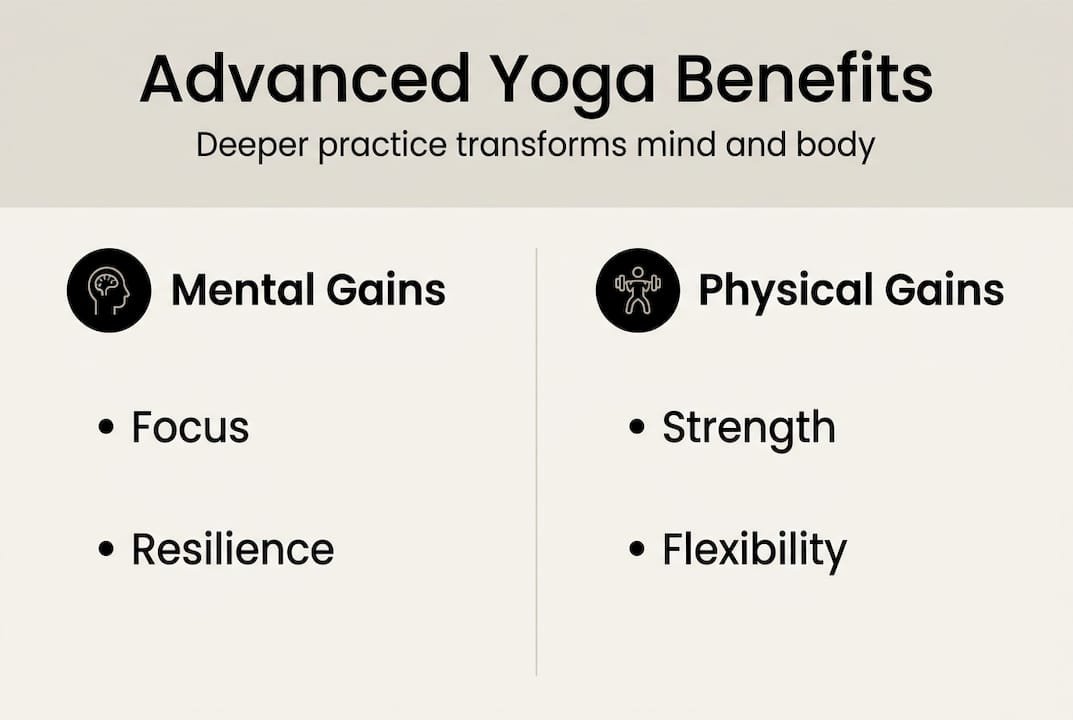
Physical and physiological improvements after long-term yoga practiceinclude reduced muscle stiffness, improved elasticity, better circulation, and stronger parasympathetic tone, meaning your nervous system gets better at rest and recovery. These are not soft outcomes. They are measurable, functional improvements that affect how you age.
Key physical benefits documented in long-term advanced practitioners:
Improved joint mobility: Regular deep stretching and load-bearing maintains cartilage health and range of motion
Greater muscle elasticity: Reduced stiffness means less injury risk and faster recovery
Parasympathetic activation: Your body spends more time in rest-and-digest mode, supporting immune function
Better circulation: Dynamic sequences and inversions improve blood flow throughout the body
Healthy aging markers: Long-term practitioners show slower decline in balance, coordination, and bone density
Here is a look at how benefits accumulate over time:
| Timeframe | Key physical changes |
|---|---|
| 0 to 3 months | Improved flexibility, initial strength gains |
| 3 to 6 months | Reduced muscle stiffness, better posture |
| 6 to 12 months | Measurable parasympathetic improvements, immune support |
| 1 year and beyond | Healthy aging markers, sustained joint mobility |
Pro Tip: Pair your advanced sessions with intentional active recovery. Gentle yin yoga, restorative poses, or even mat Pilates integration on off days keeps connective tissue healthy and prevents the overuse patterns that sideline even experienced practitioners.
Staying safe: common pitfalls and injury prevention
As you aim for new thresholds, it is wise to balance ambition with awareness and safety best practices. Advanced yoga carries real risks if approached carelessly. The complexity that makes it rewarding also makes it easier to push past your body's actual limits.
Mitigating injury risks in advanced yoga practice requires patience, proper preparation, and conscious progression. That is not a warning to slow down. It is a framework for going further without breaking down.
Five principles every advanced practitioner should follow:
Warm up with intention: Cold muscles and connective tissue do not respond well to deep loading. Spend at least 15 minutes preparing the specific areas you will challenge.
Progress gradually: Adding one new element at a time, whether depth, duration, or complexity, gives your body time to adapt.
Listen to sharp signals: Dull fatigue is normal. Sharp, localized pain is a stop sign, not a challenge to push through.
Seek qualified instruction: Even experienced practitioners benefit from expert eyes. A skilled teacher catches compensations you cannot see yourself.
Rest as part of the practice: Recovery is not optional. It is where adaptation actually happens.
Philadelphia has a strong community of qualified yoga instructors who understand the specific demands of advanced practice. Working with professionals in a structured environment is one of the most effective ways to keep progressing safely. For a deeper look at managing risk in specific formats, the guide on aerial yoga safety offers practical principles that apply broadly to any advanced discipline.
Pro Tip: Keep a yoga journal. Log what you practiced, how your body felt, and any areas of tension or discomfort. Patterns emerge over weeks that are invisible in the moment, and catching a recurring strain early is far better than treating an injury later.
What most practitioners overlook about advanced yoga
Here is something we have observed consistently: the practitioners who get the most out of advanced yoga are rarely the ones chasing the most impressive poses. They are the ones paying attention to what is happening underneath.
The real transformation in advanced practice is not about finally landing a handstand. It is the shift in how you perceive yourself, how you respond to challenge, and how your relationship with your own body evolves over years. That is subtle. It does not photograph well. But it is the change that actually lasts.
Many practitioners get stuck in a performance mindset, measuring progress by what they can do rather than who they are becoming. The cumulative wisdom of a long practice, the ability to stay grounded, to recover quickly, to feel genuinely at home in your body, is worth far more than any single peak pose.
Philadelphia's yoga community offers something rare: a culture of genuine inquiry and shared growth. Showing up consistently for community practice creates accountability and connection that makes the subtle work easier to sustain. That is where the real advanced practice lives.
Deepen your yoga journey with Amrita Yoga & Wellness
Ready to bring these insights from knowledge into practical, fulfilling transformation?
At Amrita Yoga & Wellness, we offer advanced group classes, private sessions, and specialized workshops designed for practitioners who are ready to go deeper. Whether you want structured progression, personalized guidance, or a supportive community to practice alongside, we have a path for you. Beyond yoga, our offerings include holistic wellness experiences like Tarot readings that complement the reflective, inward work of advanced practice. Philadelphia's most dedicated yogis call this studio home, and we would love to support the next chapter of your journey.
Frequently asked questions
What are some scientific benefits of advanced yoga?
Long-term advanced yoga leads to neural and physiological gains, including improved brain efficiency, better emotional regulation, and greater physiological flexibility. These benefits are documented in practitioners with years of consistent advanced practice.
How long does it take to see benefits from advanced yoga?
Noticeable changes in flexibility, mental focus, and stress often appear within 3 to 6 months of regular advanced practice. Six-month studies report reduced muscle stiffness and measurably improved muscle elasticity in consistent practitioners.
Can advanced yoga help with stress management?
Yes. Advanced yoga supports stress reduction and emotional stability by training the nervous system to regulate more effectively under pressure. The effects compound the longer you practice.
Are there risks to practicing advanced yoga without guidance?
Practicing advanced yoga without professional guidance significantly increases the risk of strain and injury. Proper preparation and guidance reduce injury risk and help you progress sustainably rather than setting yourself back.