Start Pole Dancing in Philadelphia Safely With a 6–8 Week Beginner Series
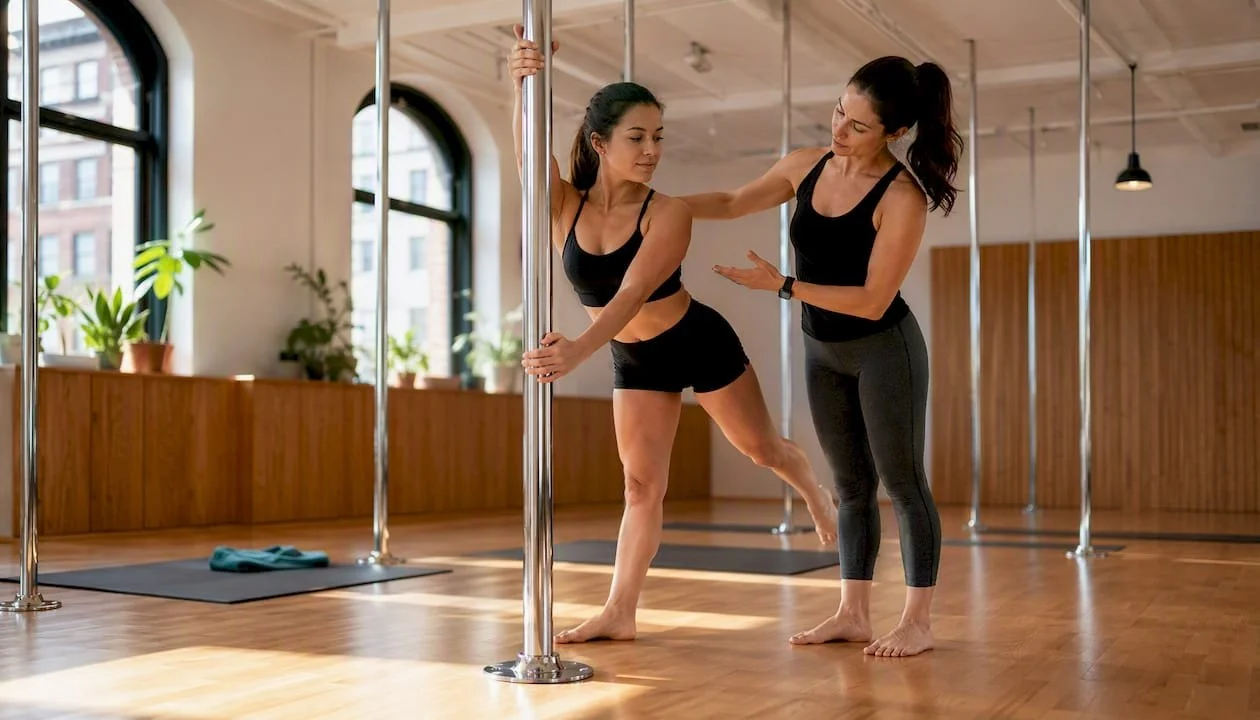
Yes, Philadelphia has beginner-friendly pole fitness classes, and the fastest way in is a structured beginner series or a new-student trial pass rather than dropping into an open-level class cold. Prioritize studios that name a specific beginner track, spell out their instructor safety and spotting policy, and keep class sizes small enough for hands-on correction. Book the earliest available start date once you find one that checks those boxes.
TL;DR:
Structured beginner series or private lessons are the safest and most effective entry points for new pole students, emphasizing safety and personalized progression.
Studios should have clear, published beginner tracks, small class sizes, and transparent safety and cancellation policies, with instructor qualifications easily accessible.
Expect to pay around $16 to $40 per class depending on the format, with bundle packages often offering better value than drop-ins, and plan for a 60 to 90-minute class duration.
Consistent attendance and cross-training in flexibility, core, and strength exercises significantly improve progress and help overcome common plateaus within the first few weeks.
Building community through beginner cohorts and local events reinforces motivation, while realistic expectations position beginners to treat the first month as skill-building rather than talent or flexibility-based.
Table of Contents
Pole Dancing Classes in Philadelphia: Types and Where to Start
Not every pole class serves the same goal, and picking the wrong entry point is the main reason beginners quit after one awkward session. Philadelphia's pole fitness studios generally offer a handful of formats, each built for a different outcome.
Beginner series: A structured 6 to 8-week course (sometimes shorter, around 4 to 6 weeks) that walks new students through grip, spins, and basic climbs in order, week by week.
Open-level drop-in classes: Mixed-experience sessions where you practice alongside intermediate students. Fun once you have fundamentals, disorienting if you don't.
Heels classes: Choreography-focused, built around fluid movement and performance rather than tricks on the pole itself.
Conditioning and strength classes: Bodyweight and resistance work targeting the shoulders, core, and grip strength pole work demands.
Flexibility classes: Splits, backbends, and mobility drills that make advanced pole positions accessible sooner.
Private lessons: One-on-one instruction with a coach, useful for faster, personalized progress or for anyone who gets nervous in a group setting.
Each format produces a different kind of fitness. Beginner series and conditioning classes build raw strength and coordination. Heels classes develop performance quality and confidence in front of others. Flexibility work supports both.
For someone who has never touched a pole, the clearest entry point is a progressive beginner series rather than an open drop-in. Structured beginner series and private lessons provide personalized progressions that build confidence and safety habits before you're thrown into a mixed-level room. Private coaching works well too, especially if scheduling flexibility matters more to you than the social element of a group class.
How to Choose a Pole Fitness Studio in Philly
A good studio makes its beginner path obvious. A weak one buries it, or doesn't have one at all. Before you hand over a card number, run through this checklist.
Does the studio publish a beginner series? Look for a named, multi-week track, not just "all levels welcome" language.
Are instructor certifications or training backgrounds listed? You don't need a framed diploma, but you should be able to find who teaches and what their background is.
What's the student-to-instructor ratio? Smaller classes mean more hands-on spotting and correction, which matters most in your first few sessions.
What's the spotting and safety policy? Ask directly. A studio that can't answer in one sentence probably hasn't thought it through.
Does the schedule fit your actual week? A perfect studio you can attend once a month won't get you anywhere.
Is pricing transparent, with a clear cancellation or makeup-class policy? Vague pricing pages or "call us for rates" language is often a sign of inconsistent scheduling.
Watch for red flags: no visible beginner track, safety information that's vague or missing entirely, and reviews mentioning frequent last-minute cancellations. Studios with clear public information, dedicated class descriptions, and visible schedules tend to run tighter, more reliable programs, a pattern that shows up consistently in how studio pages present their offerings to new students.
Pro Tip:Email or call before booking and ask, "What happens if I've never touched a pole?" A studio with a real beginner program will have a rehearsed, specific answer. One that doesn't may be improvising your safety plan in real time.
What Pole Classes Cost and How Schedules Typically Work
Beginner series in most cities run for multiple weeks, with individual classes typically lasting around an hour to an hour and a half. That timeframe is intentional. Pole work builds slowly through repeated exposure to the same grips and positions, and rushing it is how people get frustrated or hurt.
Pricing generally follows a few predictable shapes:
Drop-in classes: Roughly $20 to $40 per session, best for testing a studio before committing.
Beginner series bundles: A discounted rate for the full multi-week course, usually cheaper per class than paying drop-in each week.
Multi-class passes or monthly memberships: Better value if you plan to attend consistently.
Private lessons: The highest per-hour rate, but the fastest personalized progress.
New-student specials and trial passes are common in the fitness industry generally, and class catalog and scheduling platforms show that studios routinely sell these passes specifically to attract new students. Do the cost-per-class math before you commit to a package: a $99 six-class beginner series works out to $16.50 per class, often cheaper than three drop-ins. If you're not sure you'll stick with it, a single drop-in or a short trial pass is the lower-risk way to test the waters before buying a bigger bundle.
Getting Ready for Your First Pole Class
Most reputable studios follow the same safety fundamentals: instructors teach progressively rather than pushing tricks before you're ready, spotting is standard for climbs and inversions, and nobody should force you into a range of motion that feels wrong. A one-hour introductory class typically spends its time on pole contact points and foundational grips rather than jumping straight into spins or climbs, which is exactly the pacing a first-timer needs.
What to wear matters more in pole than almost any other fitness class, because grip depends on skin contact.
Bring shorts and a fitted tank top; bare skin on your legs and arms is what lets you actually hold the pole.
Skip lotion or oil the day of class; it makes the pole dangerously slick.
Bring water and a small towel; you'll sweat more than you expect.
Pro Tip:Spend five minutes before class on wrist circles, shoulder rolls, and a few bodyweight squats. It won't make you strong overnight, but it wakes up the joints pole work leans on hardest. For steady progress, aim for two to three sessions per week with rest days between, rather than cramming once a week and stalling out.
How Amrita Yoga & Wellness Fits Into Your Pole Journey
Pole strength doesn't come from pole class alone. The shoulders, core, and grip endurance pole work demands respond well to cross-training, and that's where a broader wellness studio earns its keep even if it doesn't teach pole itself.
At Amrita Yoga & Wellness, the class catalog includes formats that can support fitness elements beneficial to pole progress, such as Pilates mat and reformer classes for core stability, barre classes for postural alignment and stabilizer strength, and flexibility-focused sessions to improve mobility in hips and shoulders.
Pilates reformer work in particular targets the same core musculature pole instructors constantly cue, and Pilates for core strength is a natural complement if you're serious about advancing past beginner tricks. If you're not ready to book a pole class yet, starting with a beginner-friendly mobility session or a private coaching consult at a wellness studio can be a supportive way to build a foundation.
The Social Side of Pole Classes in Philadelphia
Pole studios tend to build community faster than most fitness spaces, largely because progress is visible and shared. When you land your first spin or hold an invert for the first time, the people next to you usually notice and celebrate it with you. That kind of immediate, physical feedback loop creates camaraderie that a treadmill row never will.
Beginner series amplify this because the same small group progresses together for the full six or eight weeks. You're not a stranger dropping into a room of regulars. You're part of a cohort learning the same moves at the same pace, which softens the awkwardness of being new. Many students describe their beginner series classmates as the reason they kept showing up on weeks they wanted to skip.
Philadelphia's pole community also extends beyond the studio floor. Local showcases, themed classes, and informal meetups give more experienced students a reason to stay connected, and many studios encourage beginners to watch or attend these events even before performing themselves. That visibility, seeing what's possible two or three levels ahead, tends to keep motivation high during the slower early weeks when progress feels incremental.
The inclusivity angle matters too. Pole fitness spaces in Philadelphia generally emphasize body diversity and skill diversity over a single aesthetic, which is part of why the format has grown into a mainstream fitness option rather than a niche one.
How You Advance From Beginner to Intermediate Pole
Progression in pole is sequential by necessity. You can't safely attempt an invert before you've built the grip strength and body awareness a beginner series teaches, and most instructors won't let you skip ahead regardless of how motivated you feel in week two.
A typical path looks like this: beginner series first, covering basic spins, sits, and climbs. From there, most students move into a low intermediate or "level 2" class that introduces inverts, more demanding transitions, and combos that string multiple moves together. Instructors generally use informal skill checks, can you climb cleanly, can you invert with a spot, to decide when a student is ready to move up, rather than a fixed calendar date.
Repetition matters more than most beginners expect. Progressive modules paired with supplementary strength and flexibility training accelerate safe skill gain far more reliably than trying to muscle through an advanced move before your body is ready for it. Structured, sequential series also tend to keep students enrolled longer than irregular drop-in attendance, since a defined progression gives you something concrete to work toward each week rather than a vague sense of "getting better eventually."
Plateaus are normal. Most students hit one around week four or five of their first series, right when the easy early gains taper off and the harder combinations start requiring real strength. Sticking with consistent attendance through that stretch is usually what separates students who advance from those who stall out.
What a Typical Pole Class Looks Like
A standard pole class runs 60 to 90 minutes and follows a fairly consistent rhythm regardless of studio. Expect roughly 10 to 15 minutes of warmup, cardio, dynamic stretching, and grip activation, followed by the technical portion of class where the instructor introduces or reviews specific moves.
The middle chunk of class, usually the longest segment, is spent drilling those moves with instructor feedback and spotting. In a beginner series, this section builds directly on the previous week rather than starting fresh each time, which is part of why consistent attendance matters so much early on. Instructors typically break the pole work into small segments: a spin, then a sit, then a combination linking the two, rather than teaching everything at once.
Class usually closes with 10 to 15 minutes of cooldown stretching, targeting the shoulders, hip flexors, and hamstrings that took the brunt of the session's load. Some studios end with a few minutes of free practice time, letting students run through what they just learned without instruction.
Total time commitment per class, including the drive and a quick shower after, realistically runs closer to two hours once you factor in the mats-off, sweaty nature of the workout. Planning your week around that full window, not just the class time itself, keeps expectations realistic from the start.
COVID-19 Safety Practices at Philadelphia Pole Studios
Pandemic-era safety protocols have loosened considerably at fitness studios generally, and pole studios in Philadelphia are no exception. Most no longer require masks or vaccination proof as a blanket policy, though individual studios set their own rules based on current local health guidance and owner discretion.
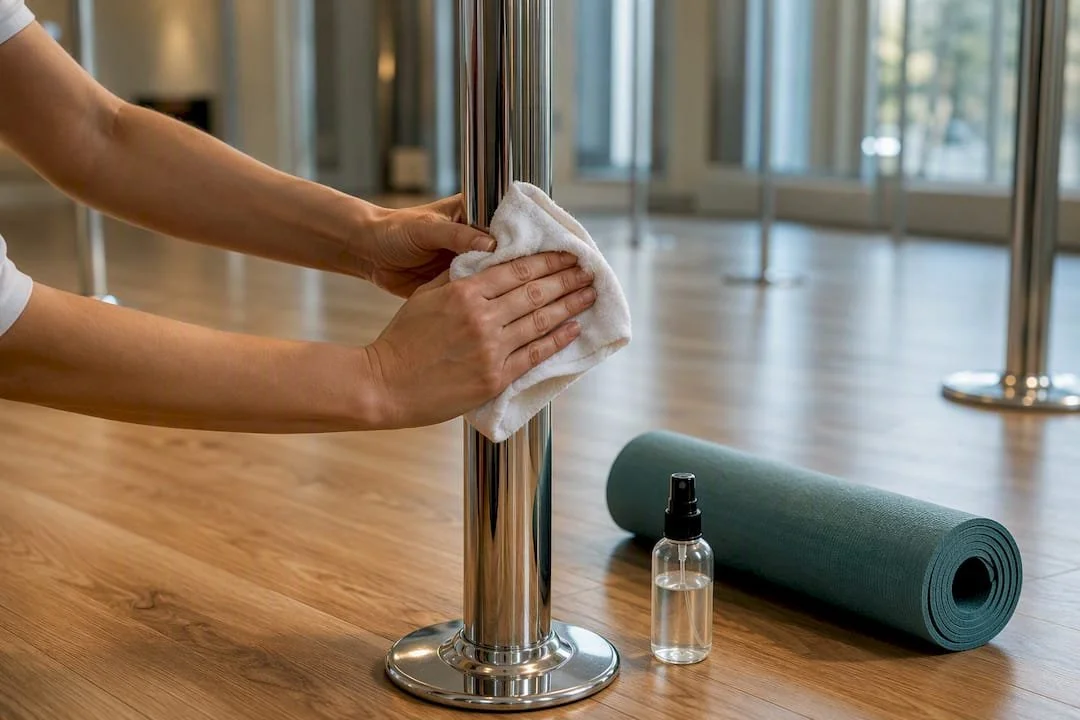
What has stuck around, largely because it was good practice, is stronger emphasis on shared-equipment hygiene. Pole studios routinely wipe down poles, mats, and grip aids between classes, partly for illness prevention and partly because sweat and grip residue affect pole traction for the next student. Many studios also kept smaller class caps that started as distancing measures and stayed in place because instructors realized closer ratios simply improved teaching quality and safety spotting.
If you have specific health concerns, whether related to respiratory illness, immune sensitivity, or anything else, the right move is to call the studio directly and ask what their current policy looks like. Policies vary by studio and change with local health guidance, so don't assume a class page written months ago still reflects today's rules. A studio that answers this question clearly and without hesitation is generally the same kind of studio that takes its physical safety and spotting policies seriously too.
What Beginners Get Wrong About Starting Pole
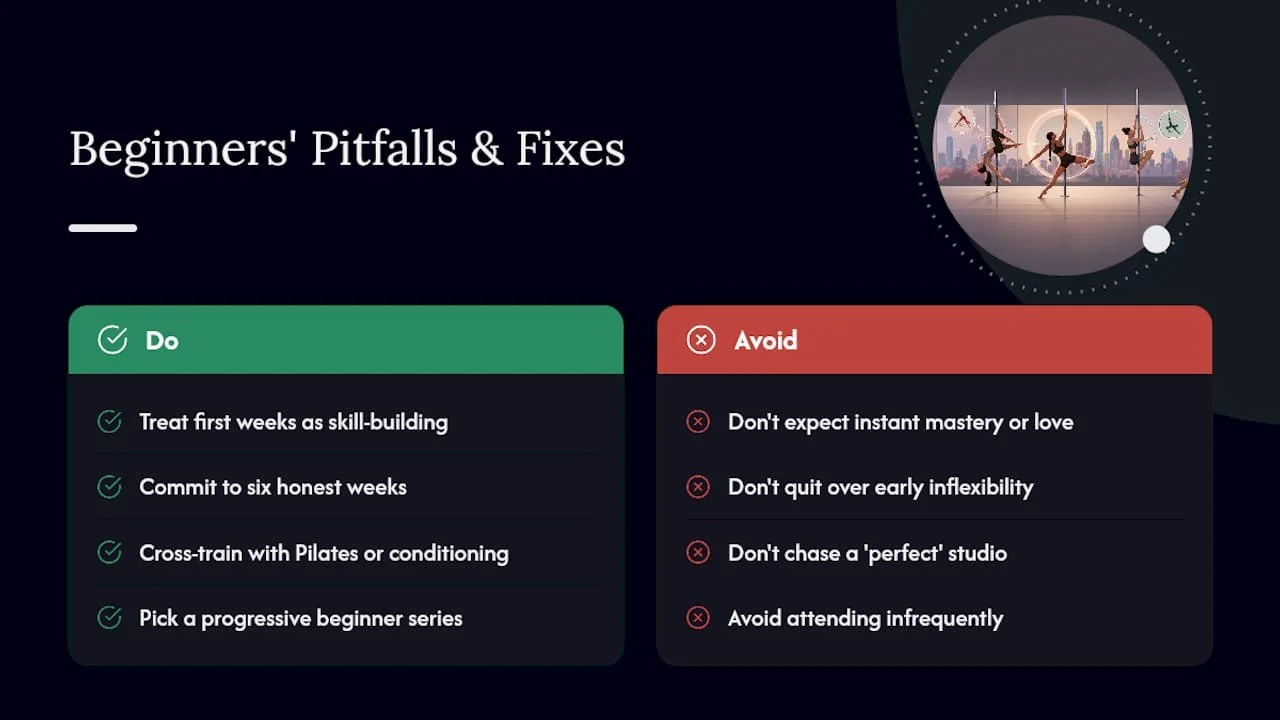
The biggest misconception about pole fitness in Philadelphia isn't about the studios. It's about what beginners expect from themselves in the first month. Most people walk into their first class assuming they'll either love it immediately or discover they're "not flexible enough" to continue. Neither reaction reflects reality. Pole is a skill built through repetition, not a talent you either have or lack, and the students who stick with it are usually the ones who treated the first few weeks as pure skill acquisition rather than a referendum on their fitness level.
Conventional advice tends to overemphasize finding the "best" studio, as though one perfect option exists in a city with this many gyms and wellness spaces. The bigger lever is consistency and cross-training. A solid beginner series at an average studio, paired with two Pilates or conditioning sessions a week, will outperform a superstar studio attended once a month. Prioritize a program with real progression and spotting, build supporting strength elsewhere, and give it six honest weeks before judging whether it's for you.
— Juiced
If pole isn't quite the right starting point yet, or if you want to build strength and flexibility before your first class, Amrita Yoga & Wellness offers Pilates, barre, and flexibility-focused sessions that can help prepare your body for demanding physical activities involving the shoulders and core. You can also explore the studio's broader wellness offerings, including its tarot readings, as part of a well-rounded approach to physical and mental well-being. For general guidance on choosing the right beginner-friendly class format across any discipline, this overview of fitness class types is a useful starting point.